Measures to turn Vietnam into digital powerhouse: WB economist

World Bank (WB) Lead Economist and Programme Leader for Vietnam Jaques Morriset has pointed out solutions to turn the Southeast Asian nation into a digital powerhouse.

Digital revolution has never been just about discovering breakthrough technologies, he stated. For most countries in the world, including Vietnam, the future will not be determined by their drive for innovation but rather by their capacity to make the most of digital technologies developed elsewhere.

To become a digital powerhouse, Vietnam will need to offer the conditions that will enable its local operators to adopt and adapt new global digital technologies. So far, the country has done a good job, Morriset said. 

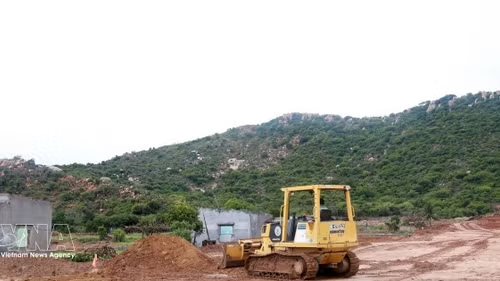
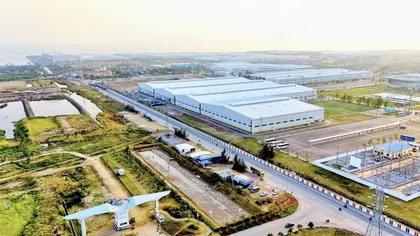
Perspective of the Da Nang Software Park No 2

Perspective of the Da Nang Software Park No 2

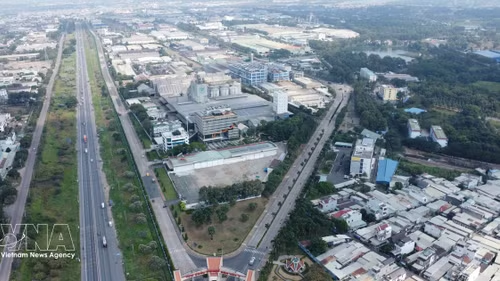
“Today, it compares well to peer and aspirational comparators in penetration of mobile phones and its citizens and enterprises are well connected to the Internet. Its digital infrastructure is quite modern, covering all provinces, and funded by forward looking national telecommunication companies”, he wrote on a post on World Bank blogs on August 24.

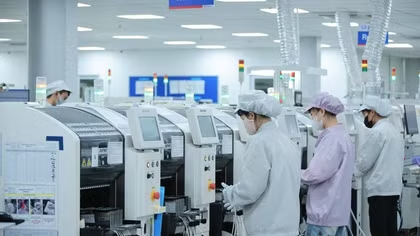
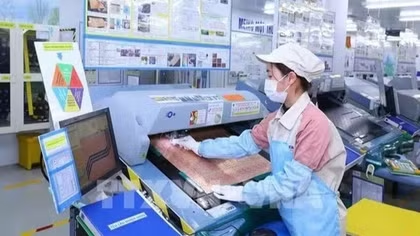
The country also hosts several world leading IT firms such as Apple, Samsung, and Intel, among others. This demonstrates Vietnam’s competitiveness and offers a unique platform for local firms and developers - the model adopted by Japan and the Republic of Korea in the 1970s and 1980s, and more recently by China.

Vietnam needs to ensure the development of a digitally skilled labour force, the emergence of a dynamic and agile local private sector, and good but secure access to information.

The WB expert said that ensuring the availability of a labour force with digital skills is central because up to one third of existing jobs in Vietnam are at risk to be lost in a five-year span due to digitalisation. While digital transformation will create new jobs, those will require a new set of skills. 

One can expect the labour market to adjust gradually as the excess demand for skilled labour will lead to higher relative wages. This will in turn incentivise workers and firms to further invest in education and training.

However, international experience has demonstrated that workers may not have the information or the financial resources to invest in longer education paths. 

He went on to say that at the current pace, it might take 25 years for Vietnam to catch up with the number of students registered at the university in Thailand today. 

In successful countries, the government has acted to address the market failure by removing legal obstacles to labour mobility; providing information to workers on labor market trends and demands to inform their decision making; improving the quality of technical/vocational education programmes; and supporting financial firms and workers in their efforts to acquire sets of new skills.

To keep the private sector agile and motivated to adopt new technologies, the Vietnamese Government should act to preserve competition when some markets are almost naturally dominated by digital champions because of their know-how, network externalities, and economies of scale. 

"Such concentration is already observed in the fixed broadband market and rises sharply in social media and other digital subsectors, including e-commerce, fintech, digital financing, and data management," the economist said. 

The reduction of barriers to entry and the strengthening regulations is often a necessary policy to avoid abuses.

Concurrently, at the other hand of the spectrum, the authorities should support local startups and small and talented investors who face financing constraints by offering them alternative funding options as done successfully in several countries, including Singapore.

Morriset advised that Vietnam needs to facilitate access to data and information. This is a public good by definition as the benefits of sharing information largely exceed the cost of collecting it.

The Vietnamese Government can improve access to information by developing inter-operability across its databases and through open data initiatives – which consist of sharing online public data in a user-friendly manner. 

The Government can also encourage the private sector to collect and share data. All these efforts should also consider data and data-users privacy and security.

Vietnam would need to urgently apply measures to set the country on the path to achieve its ambitious digital economy goals.

As a principle, the Government’s interventions must be designed and implemented in close collaboration with the private sector and with maximum transparency to avoid their capture by either vested public or private interests, the WB expert concluded.

VNA

Other News

Private economic sector poised for breakthrough growth

Private economic sector poised for breakthrough growth

More than a year after the Politburo's Resolution No. 68-NQ/TW on private sector development came into effect, expectations now extend beyond increasing the number of enterprises. The goal is to build a stronger business community with greater resilience, larger ambitions and the capacity to compete in global supply chains.

Vietnam remains ASEAN growth leader in 2026 despite global headwinds: WB

Vietnam remains ASEAN growth leader in 2026 despite global headwinds: WB

Vietnam is expected to remain one of ASEAN’s fastest-growing economies in 2026, supported by resilient exports, strong investment inflows and an ambitious reform agenda, despite mounting global uncertainties, according to the World Bank’s latest Vietnam Economic Update released on May 15.

Ministry establishes monitoring framework for carbon market

Ministry establishes monitoring framework for carbon market

Under a new circular, the exchange of greenhouse gas emission quotas and carbon credits is conducted on the domestic carbon credit exchange through the carbon trading system, which is interconnected with the national registration system.

Biofuel ready for nationwide rollout

Biofuel ready for nationwide rollout

For biofuels, particularly E10, to develop successfully, stronger and more coordinated policies are needed, especially pricing mechanisms capable of creating a sufficiently attractive gap between E10 and mineral-based petrol, an expert has said.

Vietnamese farm produce promoted at African investment, trade forum

Vietnamese farm produce promoted at African investment, trade forum

The 12th Africa Forum for Investment & Commerce (AFIC 12) opened in Algiers, the capital of Algeria, on May 9, drawing around 2,000 participants, including officials, economists, businesses, financial and development organizagtions from 43 African countries and international partners, including Vietnam.

Int'l medical, pharmaceutical expo opens in Hanoi

Int'l medical, pharmaceutical expo opens in Hanoi

The exhibition, which runs until May 9 at the Hanoi International Centre for Exhibition, showcases advanced products and technologies across a range of fields, including pharmaceuticals, drug manufacturing machinery and equipment, medical devices, hospital and clinic services and dental equipment.

Mega projects to transform Ho Chi Minh City urban landscape

Mega projects to transform Ho Chi Minh City urban landscape

Leading the charge in this massive building spree is the new central city square in the core of the Thu Thiem new urban area. Spanning more than 20 ha, it’s the crown jewel of the Central Square and new administrative center complex.

Vietnam establishes itself as one of region’s most dynamic manufacturing and supply bases

Vietnam establishes itself as one of region’s most dynamic manufacturing and supply bases

The country’s stable political and economic environment provides a critical foundation for long-term sourcing strategies. At the same time, Vietnam has demonstrated a strong ability to scale up manufacturing, supported by a continuously expanding industrial base capable of meeting both high-volume demand and increasingly complex technical and quality requirements.

Vietnamese pomelos gain broader access to Australian market

Vietnamese pomelos gain broader access to Australian market

The update by Australia’s Department of Agriculture, Fisheries and Forestry to its Biosecurity Import Conditions system (BICON) on April 10, officially setting out import conditions for Vietnamese pomelos, is regarded as a major milestone in market access efforts.

Vietnam's industry spearheads transition to circular economy

Vietnam's industry spearheads transition to circular economy

The circular economy is no longer just a policy choice. It has become an inevitable trend for delivering sustainable and green growth, sharpening competitiveness at home and abroad, and meeting Vietnam’s net-zero emissions target by 2050. It is now a prerequisite to sustain long-term economic expansion, particularly in industrial production and supporting industries.

Nearly 100 tonnes of Vietnamese fruits, vegetables airlifted to UAE

Nearly 100 tonnes of Vietnamese fruits, vegetables airlifted to UAE

Vietnamese fresh produce and processed foods are increasingly recognised for their quality, with items such as cashew nuts, coffee and spices gaining popularity among Middle East consumers. In 2025, Vietnam’s farm produce exports to the UAE exceeded 445 million USD, up nearly 24% year-on-year.