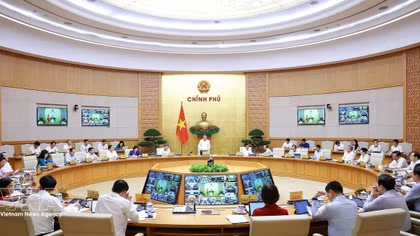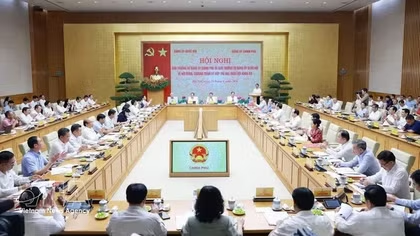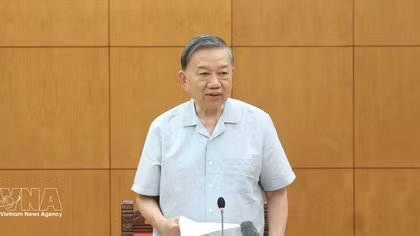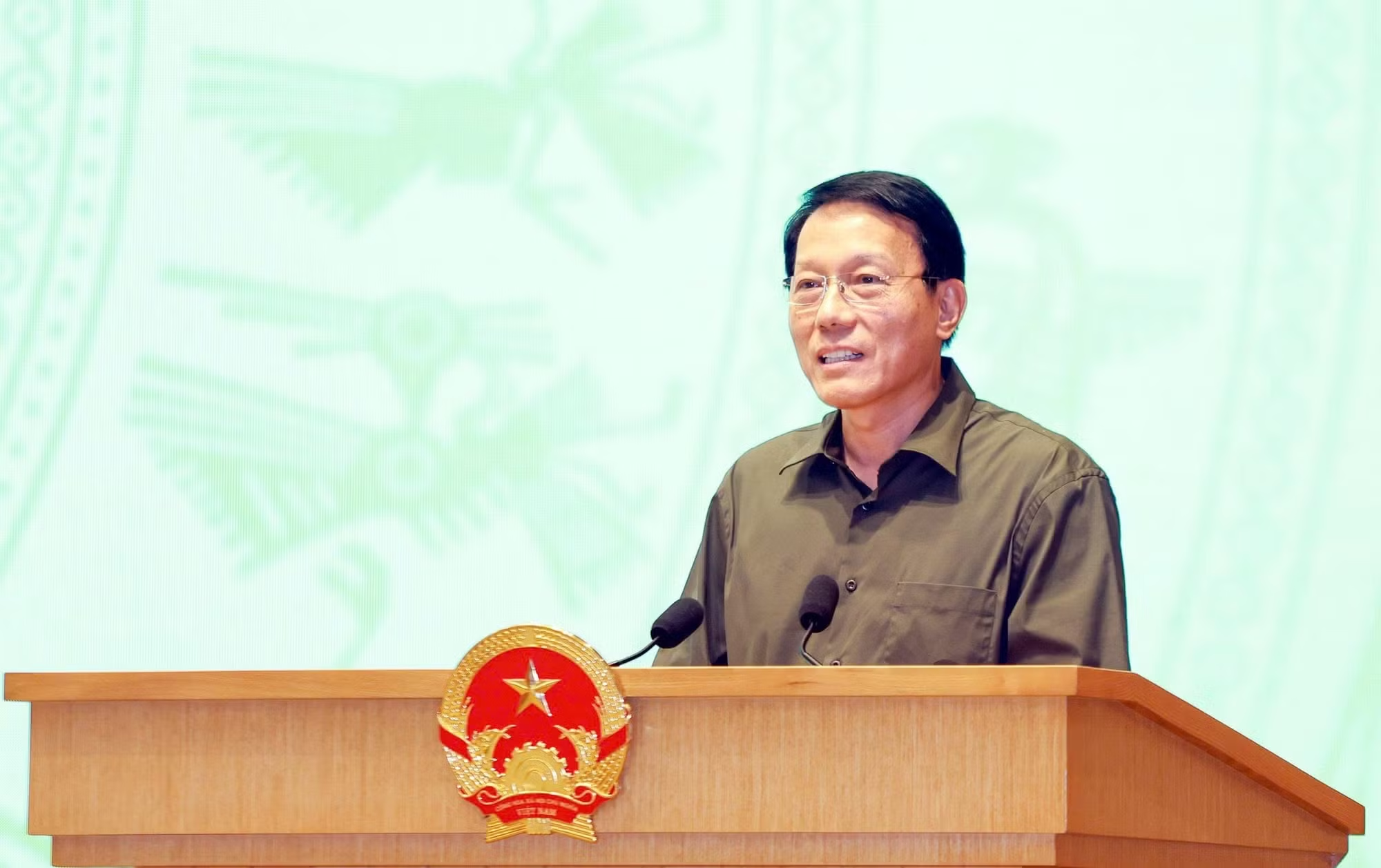
Speaking at the event, Minister Luong Tam Quang stated that the Party Central Committee and the Government have recently placed great emphasis on directing and issuing guidelines and policies, as well as amending the legal framework to create a favorable environment for the development of science, technology, and innovation.
However, in terms of specific products that yield a clear impact on socio-economic development, substantial results remain elusive. The core issue is the failure to effectively leverage the roles of the three central pillars of the science, technology and innovation ecosystem: ministries/sectors, local authorities, and enterprises.
Elaborating on this point, Minister Luong Tam Quang pointed out that at the ministerial level, the current focus heavily leans toward strategic technologies and large-scale national issues, without adequately identifying specific products tied to state management responsibilities in each sector. A lack of consistency in developing technology programs has led to fragmented resources. More importantly, ministries have not truly fulfilled their roles as "sector commanders" to guide localities. They have failed to allocate roles along regional value chains, failing to specify which locality handles raw materials, which handles processing, and which enterprises lead the charge. They have yet to organize closed production chains—from seeds, raw materials, processing, standards, logistics and branding to domestic consumption and export.
Local authorities currently lack specific orientation and remain confused in implementation, often selecting products that do not align with their unique strengths and potential. Because they register for unsuitable scientific and technological research projects, their execution becomes scattered and formulaic, failing to yield breakthrough or highly competitive products.
Meanwhile, enterprises have not been empowered to take a proactive, leading role in the science and technology sector. They have limited opportunities to access state budget capital due to the absence of a state-commissioned investment mechanism for novel products that do not yet have an established commercial market.
Minister Luong Tam Quang also shared international experiences, arguing that flexible public-private partnerships play a crucial role in scientific and technological advancement.
Accordingly, the Minister's first recommendation is the clear stratification and assignment of roles:
- The National Level: Focus on strategic technology products and major solutions involving AI, semiconductors, robotics, new materials, quantum technology, renewable energy, and offshore energy.
- The Regional and Specialized Level: Encompassing high-tech agriculture and the processing and preservation of agricultural, forestry, and fishery products, this level requires ministries and sectors to provide strategic direction. This will help create complete inter-regional value chains—from raw materials, processing, and logistics to production and consumption—while localities take charge of research and implementation.
- The Local Level: Tied to specific products directly related to local advantages that can generate immediate economic benefits, such as OCOP (One Commune One Product) items and local specialties. Localities are responsible for proactive research and implementation, provided they align with the general orientation and planning of ministries and sectors.
The second recommendation emphasizes defining specific responsibilities. Ministries and sectors must truly act as "sector commanders."
Minister Luong Tam Quang proposed that the Government grant maximum autonomy, coupled with clearly defined responsibilities for the heads of ministries and sectors. Without their leadership and role allocation, execution will be exceedingly difficult.
For localities, there must be a strong shift from merely registering portfolios to actual product manufacturing. He suggested that localities review their registered products and clearly categorize them.
Regarding enterprises, the Minister proposed that the Government select a group of truly capable high-tech enterprises in 2026 to pilot a special mechanism. They should be assigned specific tasks tied to output products, commercialization deadlines, and clear commitment responsibilities. For security industrial products, priority should be given to commissioning products that meet prescribed standards and regulations.