Party Statutes must be practical, future-ready: Top leader

Party General Secretary and State President To Lam said the current Party Statutes remain fundamentally valid but must also respond to emerging issues such as administrative apparatus restructuring, the two-tier local administration model, decentralisation, control over the exercise of power and digital transformation.
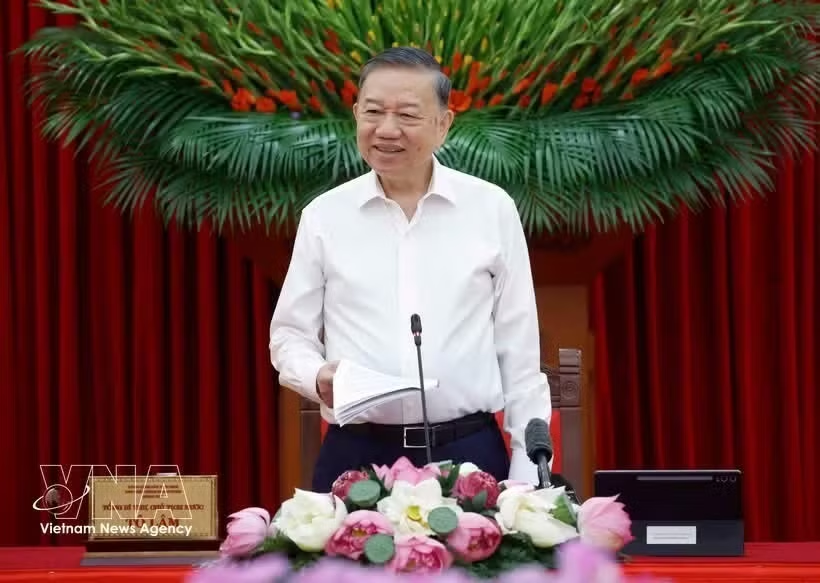
The leader, who heads the committee, described the work as a particularly important political task in the 14th term, directly serving the amendment and supplementation of the Party's Platform and the preparation for the 15th National Party Congress. It is also a process in which the Party makes self-reflection, reviews realities, develops theory on a ruling Party, and perfect the organisational foundation for leading national development in the new phase.

He said the current Party Statutes remain fundamentally valid but must also respond to emerging issues such as administrative apparatus restructuring, the two-tier local administration model, decentralisation, control over the exercise of power and digital transformation.

lam-1.jpg
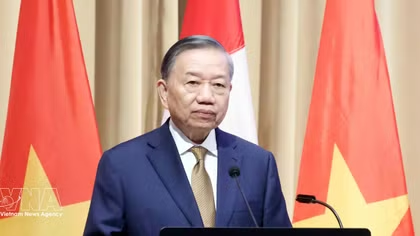
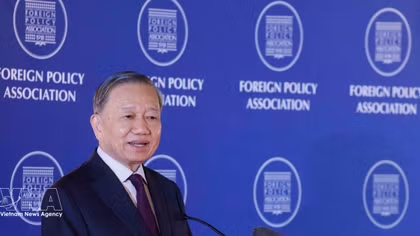
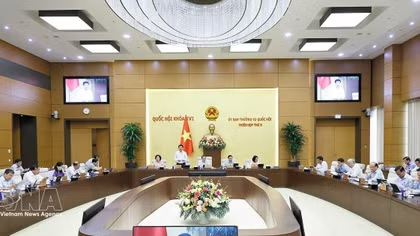
Party General Secretary and State President To Lam addresses the first meeting of the Central Steering Committee for reviewing practice and considering the amendment and supplementation of the Party Statutes on August 5. (Photo: VNA)

The objective, he said, is to create statutes that strengthen the Party, ensure smooth operations, clarifies responsibilities, enhance power control, improve the quality of Party members and grassroots organisations, and reinforce ties between the Party and the people.

The Party and State leader stressed that revisions must uphold Marxism-Leninism, Ho Chi Minh Thought and the Party's Doi moi (renewal) policy while staying steadfast in the goal of national independence and socialism, and firmly maintaining the Party's leadership role and the principle of democratic centralism. The review should align with the 14th National Party Congress Resolution, the proposed amendments to the 2011 Platform and the ongoing research on revisions to the 2013 Constitution.

He said provisions that remain effective should be retained while those creating widespread difficulties or institutional gaps should be amended. Issues not yet sufficiently mature should continue to be considered, piloted or addressed through implementing regulations and guidance.
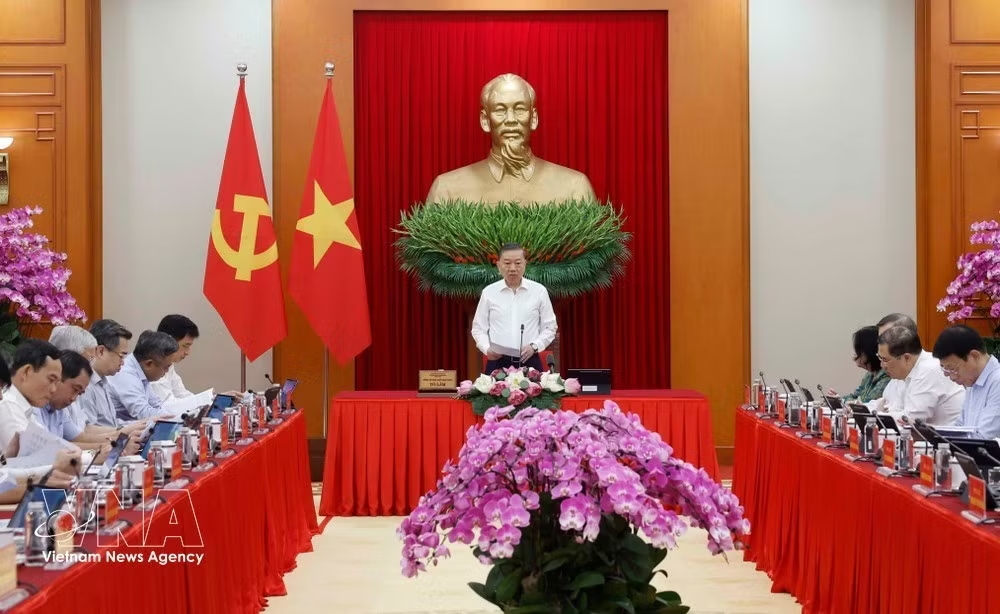
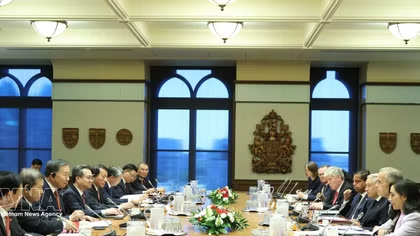
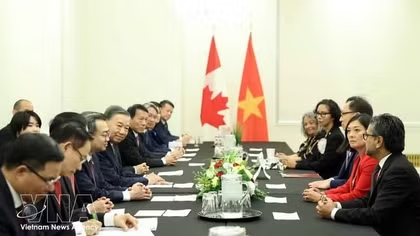
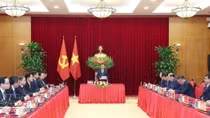
Party General Secretary and State President To Lam chairs the first meeting of the Central Steering Committee for reviewing practice and considering the amendment and supplementation of the Party Statutes on August 5. (Photo: VNA)

General Secretary and President Lam emphasised a clear distinction among the Party Statutes, implementation regulations and guidance documents. The Statutes should cover only fundamental and long-term issues and principles. Meanwhile, detailed and frequently changing matters should be addressed through subordinate regulations.

He called for every proposed amendment to clearly explain the practical issue involved, why it requires amendment at the Statute level, available options, expected impacts and implementation conditions. Success, he said, should be measured by whether Party organisations become stronger, the apparatus runs more efficiently, responsibilities become clearer, the exercise of power is better supervised, and Party members become closer to and better serve the people.

The review should focus on four key areas – fundamental issues concerning the Party, Party members, grassroots Party organisations and relations with the people; the Party's organisational structure and leadership methodology under the new model; Party inspection, supervision, discipline and power control; and digital transformation, specialised areas and technical issues of the Statutes.

The General Secretary and President also asked for a reformed research and implementation approach, building on the review of the 2011–2025 implementation of the Party Statutes rather than starting from scratch.

He urged comprehensive evidence-based assessments, broad consultation, representative field studies and selective reference to international experience while ensuring all proposals remain grounded in Vietnam's realities.

The leader instructed the standing body to promptly finalise the steering committee's working regulations, action plan, task allocation, editorial team and roadmap for the review and amendment process. Committee members were told to take direct responsibility for assigned tasks, with progress monitored by concrete outputs and deadlines.

Concluding the meeting, General Secretary and President Lam urged members to begin work immediately, stressing a spirit of "less talk, more action" and measuring success by tangible results, expressing confidence that the steering committee will produce a high-quality draft to support the building of a strong and pure Party capable of leading the nation in a new era./.
en.vietnamplus.vn

Other News

Vietnam to remain active player in shaping ASEAN's future: minister

Vietnam to remain active player in shaping ASEAN's future: minister

Entering a new era of national development with the aspiration of building a strong and prosperous country, the mindset of "growing alongside ASEAN" will guide Vietnam’s more proactive, positive, and substantive contributions to the ASEAN Community and the co-creation of the region’s shared future, noted Minister of Foreign Affairs Le Hoai Trung.

Thailand's parliamentary leader concludes official visit to Vietnam

Thailand's parliamentary leader concludes official visit to Vietnam

Thailand attaches great importance to its Comprehensive Strategic Partnership with Vietnam, and the two countries share a solid foundation of friendship, many common strategic interests and significant potential for cooperation, said President of the National Assembly and Speaker of the House of Representatives of Thailand Sophon Zaram.

33rd Diplomatic Conference wraps up in Hanoi

33rd Diplomatic Conference wraps up in Hanoi

Foreign relations are no longer viewed simply as relations with the outside world but as an integral component of national comprehensive strength and a responsibility shared by the entire Party, people, armed forces and political system.

Vietnam, Laos step up cooperation in social sciences

Vietnam, Laos step up cooperation in social sciences

Against the backdrop of complex and rapidly evolving regional and international developments, cooperation in social sciences and political theory between the Vietnam Academy of Social Sciences and the Lao National Academy of Politics and Public Administration is expected to provide solid scientific evidence and databases to support the formulation of orientations, policies and strategies for socio-economic development.

Politburo member and Permanent member of the Party Central Committee’s Secretariat Tran Cam Tu (centre) and leaders of the Ministry of Foreign Affairs at the plenary session on Party and people-to-people diplomacy on August 5, part of the 33rd Diplomatic Conference. (Photo: VNA)

Party, people-to-people diplomacy urged to contribute more effectively to national development

Party diplomacy has made breakthroughs in expanding and deepening relations with political parties around the world, helping consolidate political foundations and orient State-level relations. Meanwhile, people-to-people diplomacy has seen positive changes in its thinking, content and methods, with an expanding network of partners and more active and substantive participation in regional and international people-to-people mechanisms.

NA Chairman urges 'revolution' in legal information access

NA Chairman urges 'revolution' in legal information access

NA Chairman Tran Thanh Man said the requirement that “every citizen live and work in accordance with the Constitution and the law” remains hollow unless people can fully access, understand, and actually use the rules that govern their lives.

National Assembly approves Nguyen Tien Hai as Minister of Home Affairs

National Assembly approves Nguyen Tien Hai as Minister of Home Affairs

The NA held a secret ballot on the appointment and later adopted a resolution approving Nguyen Tien Hai as Minister of Home Affairs. The resolution was passed with 483 votes in favour out of 484 deputies participating in the electronic vote, accounting for 96.60% of those present.

Institutional reform key to unlocking new development model: experts

Institutional reform key to unlocking new development model: experts

Resolution No. 19-NQ/TW, adopted at the third plenum of the 14th Party Central Committee, identifies breakthroughs in institutions and reforms as the starting point for renewing Vietnam’s development model, alongside reforms in national governance, organisation and operations to build new development capacity.

Lawmakers discuss customs reform linked to digital transformation, risk management

Lawmakers discuss customs reform linked to digital transformation, risk management

Continuing the agenda of its ongoing first extraordinary session, the 16th National Assembly (NA) on August 3 heard proposals and verification reports on two bills, including the Law amending and supplementing several articles of the Law on Customs, and the Law revising Article 6 and Appendix IV on the list of conditional business lines under the Law on Investment.

First extraordinary session of 16th National Assembly opens

First extraordinary session of 16th National Assembly opens

The first extraordinary session of the 16th National Assembly (NA) kicked off in Hanoi on August 3, with lawmakers set to consider and decide on a series of items, including 15 draft laws, four draft normative resolutions and a range of major issues concerning national development.

Over 43,000 legal normative documents reviewed

Over 43,000 legal normative documents reviewed

As of July 30, ministries, agencies and localities had conducted a preliminary review of more than 43,000 legal normative documents nationwide, identifying provisions that need to be amended, supplemented, replaced or annulled.