NA Standing Committee discusses draft law on PPP

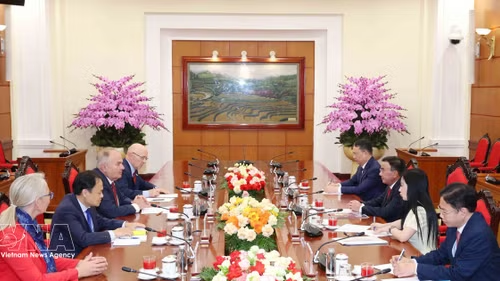
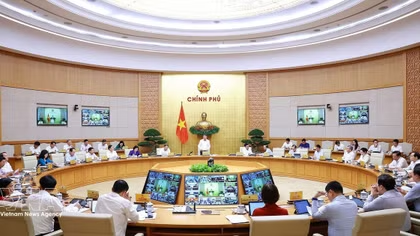
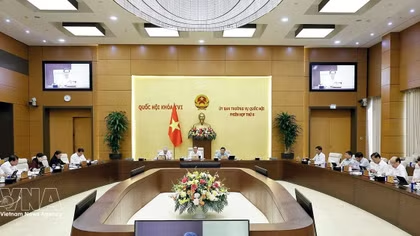
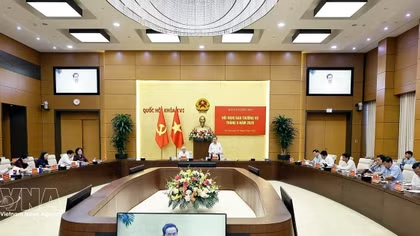
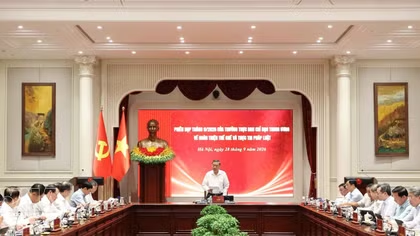
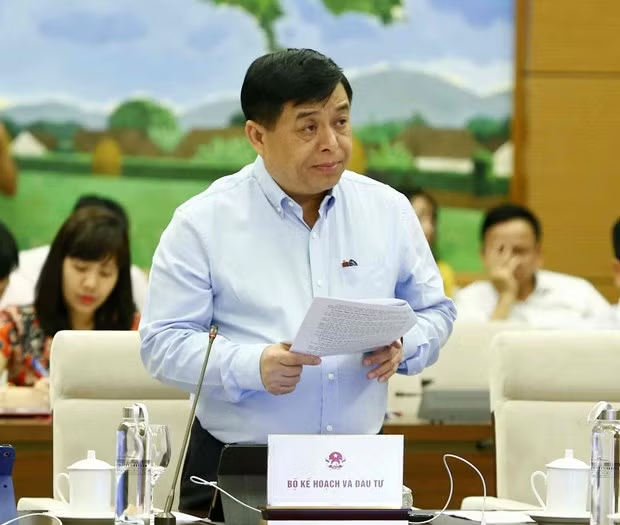
The National Assembly Standing Committee discussed a draft law on public-private-partnership (PPP) projects, composed by the Ministry of Planning and Investment (MPI), during its 37th session in Hanoi on September 16.
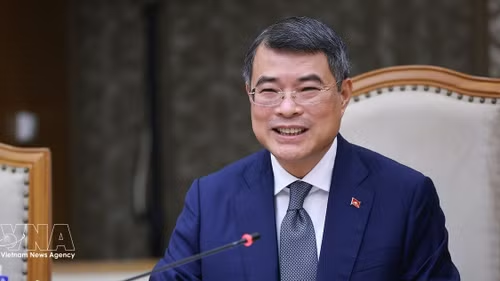
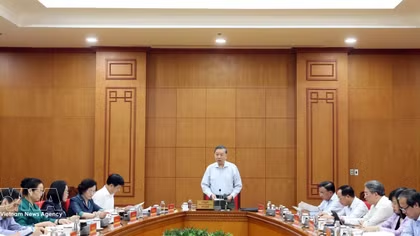
Minister of Planning and Investment Nguyen Chi Dung presents the report on the draft law on public-private partnership (PPP) at the National Assembly's Standing Committee meeting on September 16 (Photo: VNA)

The National Assembly Standing Committee discussed a draft law on public-private partnership (PPP) projects, composed by the Ministry of Planning and Investment (MPI), during its 37th session in Hanoi on September 16.

The draft proposes PPP projects be unavailable in sectors that have so far seen no PPP projects, those with ineffective PPP projects, or those lacking appeal to investors, and others where other kinds of investment would be more fitting.

Under the draft, tourism; culture and sports; telecommunications infrastructure; infrastructure for science and technology development; infrastructure at industrial parks, economic zones, industrial clusters, and high-tech parks; and infrastructure for rural areas and agriculture would be banned from running PPP projects.

There are also changes in the draft law regarding Government guarantees and risk-sharing. Specifically, the draft proposes Government guarantees of foreign exchange balance for PPP projects be determined by the NA and the Prime Minister, with a maximum of 30 percent of project revenue paid to private investors in VND.

The risk-sharing mechanism for revenue is also proposed in the draft law to be extended to key projects decided by the NA and the PM.

Minister of Planning and Investment Nguyen Chi Dung said implementation of PPP projects in the past showed the investment in this model of PPP in Vietnam still had many risks.

Among them, there are market risks, but there are also many risks stemming from the Government's decisions, such as decisions to abandon fee collection tools or to waive road fee adjustment of planning and pricing mechanisms, or changes in foreign currency policy. Such risks would affect project revenue.

The Minister of Planning and Investment said a risk-sharing mechanism is necessary.

According to Dung, the draft law's revenue risk-sharing mechanism lets investors share a part of the risk when a project has a revenue deficit. On the other hand, the Government will receive back the shares when the project has revenue higher than the initial targets.

Specifically, the Government would have to commit to sharing with investors not more than half of the deficit between actual revenue and committed revenue in the contract, while investors have to share with the Government not less than half of the increase in revenue between actual revenue and committed revenue in the contract.

Head of the NA Judiciary Committee Le Thi Nga said the proposal was not rational.

When the Government signs a contract with investors, it should ensure the contract is feasible, she said.

For instance, when building a build-operate-transfer toll booth, the Government and the investor should make sure the location is rational. It would not be right if the toll booth is set up at a location where people would object to pay, and then the Government has to share risk costs, she said.

Phan Thanh Binh, head of the National Assembly's Committee for Culture, Education, Youth, Adolescents and Children, proposed re-considering the risk-sharing mechanism in the draft law.

“We are an agricultural country, but for farmers, do we have a policy to share risk? Why do we raise the problem of risk-sharing when it comes to PPP projects? Every year, when farmers face consumption problems, we say they have to deal with it because it’s a market problem!” he said.

Vietnam has so far attracted 336 PPP projects in transport, technical infrastructure, energy, water supply and drainage, environment, culture, sports, and education and training, among other fields.

The draft Law on PPP is expected be completed this month before being submitted to the National Assembly for discussion in October 2019 and approval in May 2020.
VNA

Other News

Vietnam and Panama can become gateways linking two regions

Vietnam and Panama can become gateways linking two regions

"Panama can serve as a strategic platform for Vietnamese companies seeking greater access to Latin America and the Caribbean, while Vietnam represents an important gateway for strengthening Panama’s engagement with Southeast Asia", Ambassador Nubiela Ayala Modes confirmed.

Localities committed to achieving 2026 growth targets

Localities committed to achieving 2026 growth targets

Localities nationwide hailed effective and flexible directions delivered by the Government so far this year, resulting in positive nine-month socio-economic growth, and reaffirmed their commitment to achieving targets set for the whole 2026 at an online Government-locality conference on October 3.

Creating new drivers for Vietnam-Canada cooperation

Creating new drivers for Vietnam-Canada cooperation

The elevation of bilateral ties to a Strategic Partnership shows that Vietnam and Canada increasingly view each other not simply as trading partners, but as long-term partners in addressing economic, technological and regional challenges.

Top leader asks for sports development to build national strength

Top leader asks for sports development to build national strength

The top leader applauded the efforts of ministries, sectors, localities, social organisations, coaches, athletes, experts in developing physical education and sports in recent times, stressing that Resolution No. 08 has provided an important political foundation for sports development over the past 15 years, while Conclusion No. 70 set important orientations for the new period.

Vietnam mobilises resources to affirm its leadership role in APEC 2027

Vietnam mobilises resources to affirm its leadership role in APEC 2027

PSNews - Vietnam is recognised by its partners as an influential member of the Asia-Pacific Economic Cooperation (APEC) forum, with expectations that it will continue to demonstrate leadership when it hosts APEC for the third time in 2027, according to Standing Deputy Minister of Foreign Affairs Nguyen Minh Vu.

Top Vietnamese leader receives Chairman of Japan Bank for International Cooperation

Top Vietnamese leader receives Chairman of Japan Bank for International Cooperation

General Secretary and President Lam urged JBIC to continue promoting the substantive implementation of projects under the Asia Zero Emission Community (AZEC), and step up discussions on potential cooperation within the framework of the POWERR Asia (Partnership on Wide Energy and Resources Resilience Asia) initiative, including the development of strategic energy reserves.

NA, Government's Party committees meet on legislature's second session agenda

NA, Government's Party committees meet on legislature's second session agenda

National Assembly President Tran Thanh Man coordination must go beyond finishing the agenda to improve the quality of NA decisions and Government enforcement; deal with policies rather than just paperwork, especially in the fight against corruption and other negative phenomena; and pin down final responsibility for each product, not just progress.

Prime Minister receives Cambodian Minister of Inspection

Prime Minister receives Cambodian Minister of Inspection

Prime Minister Le Minh Hung asked the two countries' inspection agencies to build on their achievements by regularly exchanging information and experience, maintaining delegation exchanges, and coordinating inspections in areas related to bilateral economic, trade and investment cooperation.

Urgent action needed to address law enforcement as weak link: Top leader

Urgent action needed to address law enforcement as weak link: Top leader

General Secretary of the Communist Party of Vietnam Central Committee and President To Lam on September 28 called for urgent and fundamental improvements in law enforcement, stressing that legislation and its enforcement must form a unified whole and ultimately serve development, protect legitimate rights and interests, and strengthen public trust.

Vietnamese, Cambodian inspectors reinforce collaboration

Vietnamese, Cambodian inspectors reinforce collaboration

The Government Inspectorate of Vietnam broadly accepted the Cambodian ministry's proposals to maintain, renew and make more effective regular meetings between professional units and training establishments, and increase exchanges of senior, expert and specialised working-group delegations.