New generation FTAs fuel US$750 billion trade hope in 2022

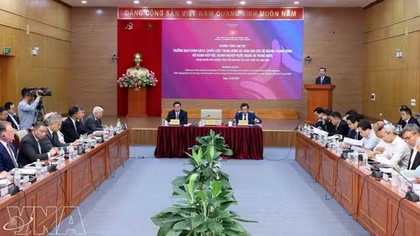
Vietnam has signed 15 free trade agreements (FTAs), including several new generation FTAs, a move which is anticipated to create a breakthrough in trade and produce a large trade surplus in the year ahead.

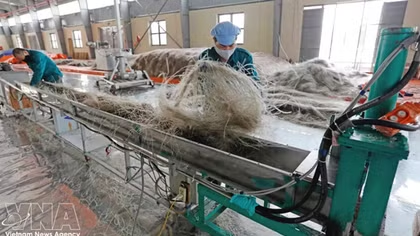
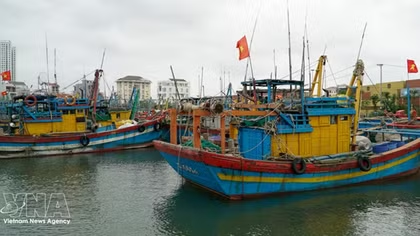
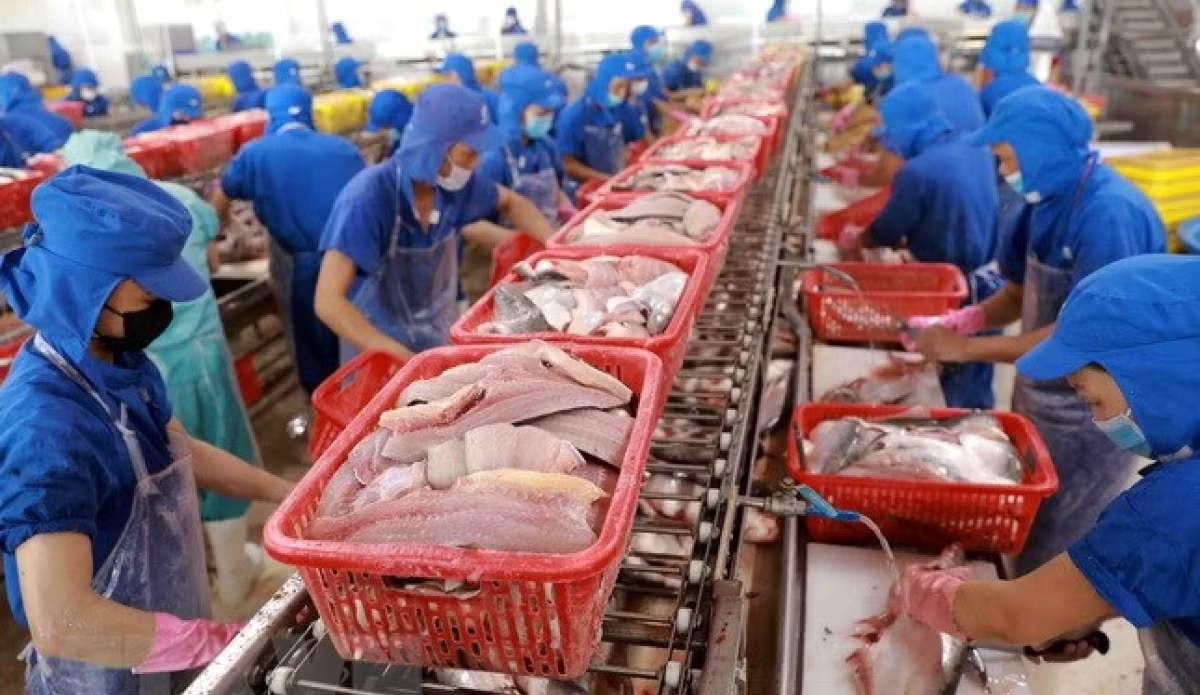
Seafood remains one of Vietnam's key exports to the EU.

Seafood remains one of Vietnam's key exports to the EU.

Despite facing difficulties and challenges during the opening four months of the year, Vietnamese exports recovered strongly to reach US$122.4 billion, a rise of 16.4% over the same period from last year. This impressive export growth brought the country’s four-month trade value to US$242.19 billion, a year-on-year increase of 15.8%.   

This outstanding performance can largely be attributed to the efforts of local firms, their resilience and creativity, as well as the strength of FTAs signed, especially new generation FTAs. Among these deals are the Comprehensive and Progressive Agreement for Trans-Pacific Partnership (CPTPP), the EU-Vietnam Free Trade Agreement (EVFTA), the UK-Vietnam Free Trade Agreement (UKVFTA), and most recently the Regional Comprehensive Economic Partnership (RCEP) Agreement.

According to Nguyen Chanh Phuong, vice president of Ho Chi Minh City Handicraft and Wood Industry Association (HAWA), new generation FTAs such as the EVFTA and the CPTPP have assisted the Vietnamese wood processing industry to boost exports to many markets, and increase the competitiveness of their products against those of other countries, especially countries without such agreements. Evidence for this can be seen in wooden furniture exports increasing sharply, led by living room and dining room furniture, followed by bedroom furniture. 

Meanwhile, Nguyen Ha, a tuna market expert of the Vietnam Association of Seafood Exporters and Producers (VASEP), reveals the first quarter of the year saw Vietnamese tuna exports rise 72% annually to over US$259 million, representing an increase of 1.6 times from the pre-pandemic period in 2019. This figure is the highest tuna export value compared to the same period over the past five years.

Thanks to the EVFTA, Vietnamese tuna exports to the EU inched up by 33% in the first quarter alone to US$38 million.

Assoc. Prof. Dr. Nguyen Thuong Lang of the National Economics University, notes FTAs can be considered the catalyst for promoting bilateral and multilateral trade between Vietnam and developed countries.

Along with the efforts of businesses, as well as the opportunities that FTAs bring, import-export this year is expected to boom and reach a new record of US$750 billion, says Dr. Lang.

Untapped opportunities from FTAs

Economic experts agree the opportunities that FTAs bring to local enterprises are huge, although businesses have yet to take full advantage of these opportunities due to some limitations, in which logistics autonomy is considered the biggest bottleneck.

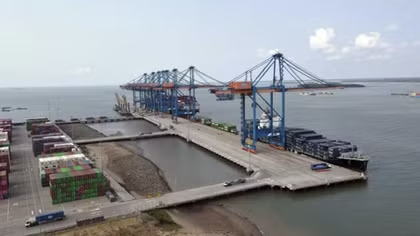
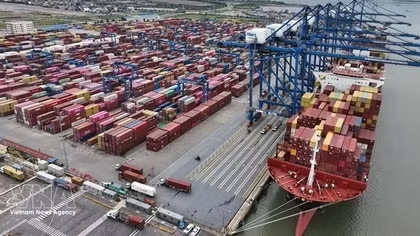
Vietnam needs to improve policies and laws on logistics services, with a focus on building a fleet of super-long and super-heavy ships along with modern logistics infrastructure that is capable of meeting import-export needs. This means the country will no longer rely on the fleet of foreign ships as it does now, suggests Vu Tuan Anh, president of the Junior Chamber International (JCI) Vietnam.

According to Tran Thanh Hai, deputy director of the Import-Export Department under the Ministry of Industry and Trade, businesses must clearly understand what advantages FTAs can bring to their fields. It is essential to gain this level of understanding so that they can alter the production process, change the supply of raw materials, meet the requirements relating to the origin of goods, and enjoy the preferential tax rates that FTAs offer.

The fact is that while the majority of FTAs mainly focus on cutting tax lines, many partners still pursue trade protectionism by erecting new technical barriers and imposing other strict requirements, such as those relating to labour issues, environmental protection, goods origin, or input materials.

Consequently, although tariff barriers have been reduced, non-tariff barriers are increased, thereby causing Vietnamese businesses to face difficulties. In other words, businesses are ineligible to enter new markets if they do not improve their business models, upgrade services and products, and re-arrange the input supply chain.

VNA/VOV

Other News

Private economic sector poised for breakthrough growth

Private economic sector poised for breakthrough growth

More than a year after the Politburo's Resolution No. 68-NQ/TW on private sector development came into effect, expectations now extend beyond increasing the number of enterprises. The goal is to build a stronger business community with greater resilience, larger ambitions and the capacity to compete in global supply chains.

Vietnam remains ASEAN growth leader in 2026 despite global headwinds: WB

Vietnam remains ASEAN growth leader in 2026 despite global headwinds: WB

Vietnam is expected to remain one of ASEAN’s fastest-growing economies in 2026, supported by resilient exports, strong investment inflows and an ambitious reform agenda, despite mounting global uncertainties, according to the World Bank’s latest Vietnam Economic Update released on May 15.

Ministry establishes monitoring framework for carbon market

Ministry establishes monitoring framework for carbon market

Under a new circular, the exchange of greenhouse gas emission quotas and carbon credits is conducted on the domestic carbon credit exchange through the carbon trading system, which is interconnected with the national registration system.

Biofuel ready for nationwide rollout

Biofuel ready for nationwide rollout

For biofuels, particularly E10, to develop successfully, stronger and more coordinated policies are needed, especially pricing mechanisms capable of creating a sufficiently attractive gap between E10 and mineral-based petrol, an expert has said.

Vietnamese farm produce promoted at African investment, trade forum

Vietnamese farm produce promoted at African investment, trade forum

The 12th Africa Forum for Investment & Commerce (AFIC 12) opened in Algiers, the capital of Algeria, on May 9, drawing around 2,000 participants, including officials, economists, businesses, financial and development organizagtions from 43 African countries and international partners, including Vietnam.

Int'l medical, pharmaceutical expo opens in Hanoi

Int'l medical, pharmaceutical expo opens in Hanoi

The exhibition, which runs until May 9 at the Hanoi International Centre for Exhibition, showcases advanced products and technologies across a range of fields, including pharmaceuticals, drug manufacturing machinery and equipment, medical devices, hospital and clinic services and dental equipment.

Mega projects to transform Ho Chi Minh City urban landscape

Mega projects to transform Ho Chi Minh City urban landscape

Leading the charge in this massive building spree is the new central city square in the core of the Thu Thiem new urban area. Spanning more than 20 ha, it’s the crown jewel of the Central Square and new administrative center complex.

Vietnam establishes itself as one of region’s most dynamic manufacturing and supply bases

Vietnam establishes itself as one of region’s most dynamic manufacturing and supply bases

The country’s stable political and economic environment provides a critical foundation for long-term sourcing strategies. At the same time, Vietnam has demonstrated a strong ability to scale up manufacturing, supported by a continuously expanding industrial base capable of meeting both high-volume demand and increasingly complex technical and quality requirements.

Vietnamese pomelos gain broader access to Australian market

Vietnamese pomelos gain broader access to Australian market

The update by Australia’s Department of Agriculture, Fisheries and Forestry to its Biosecurity Import Conditions system (BICON) on April 10, officially setting out import conditions for Vietnamese pomelos, is regarded as a major milestone in market access efforts.

Vietnam's industry spearheads transition to circular economy

Vietnam's industry spearheads transition to circular economy

The circular economy is no longer just a policy choice. It has become an inevitable trend for delivering sustainable and green growth, sharpening competitiveness at home and abroad, and meeting Vietnam’s net-zero emissions target by 2050. It is now a prerequisite to sustain long-term economic expansion, particularly in industrial production and supporting industries.

Nearly 100 tonnes of Vietnamese fruits, vegetables airlifted to UAE

Nearly 100 tonnes of Vietnamese fruits, vegetables airlifted to UAE

Vietnamese fresh produce and processed foods are increasingly recognised for their quality, with items such as cashew nuts, coffee and spices gaining popularity among Middle East consumers. In 2025, Vietnam’s farm produce exports to the UAE exceeded 445 million USD, up nearly 24% year-on-year.