Party steps up anti-corruption drive in new phase

Anti-corruption efforts have achieved significant and breakthrough results, contributing to the Party and political system building, political stability, socio-economic development and stronger public trust in the Party, the State and the regime.

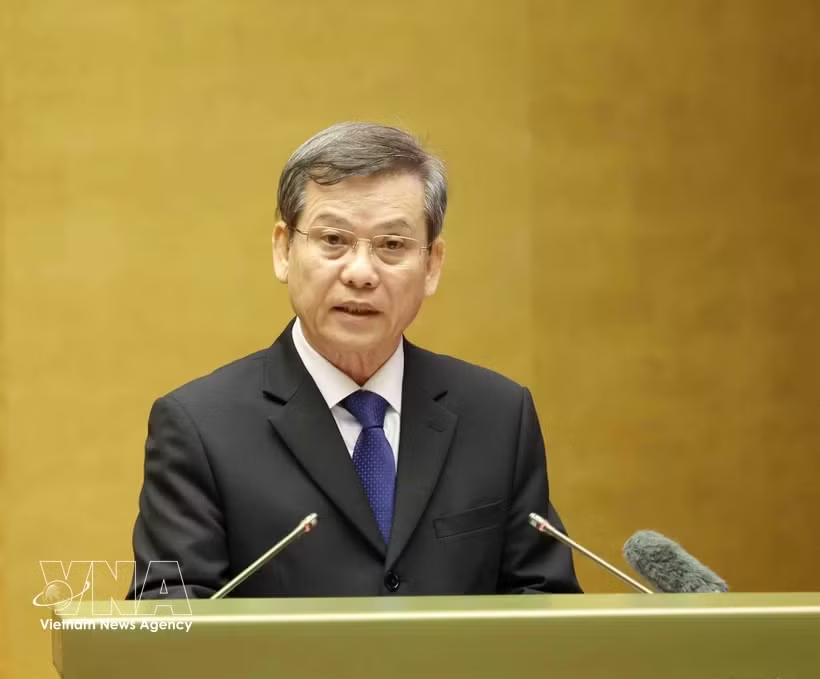
Politburo member, Secretary of the Party Central Committee and Chairman of its Commission for Internal Affairs Le Minh Tri has highlighted a shift from reactive enforcement to proactive prevention as one of the key contents of the resolution on the continued enhancement of the Party’s leadership in the fight against corruption, wastefulness and negative phenomena in the new period.

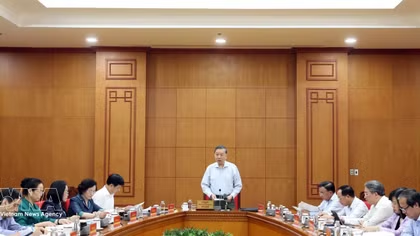
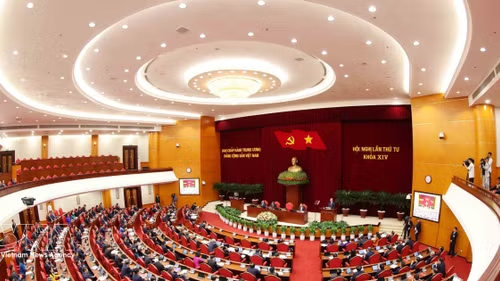
At the national conference held on April 13 to study, disseminate and implement the resolutions of the second plenum of the 14th Party Central Committee, Tri reviewed the 20-year implementation of the Resolution of the 10th-tenure Party Central Committee’s third plenum, noting that anti-corruption efforts have been carried out in a persistent, resolute, comprehensive and coordinated manner, with no “off-limits zones” or exceptions.
Party steps up anti-corruption drive in new phase -0

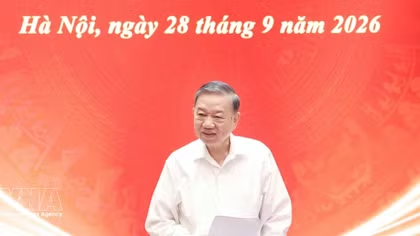
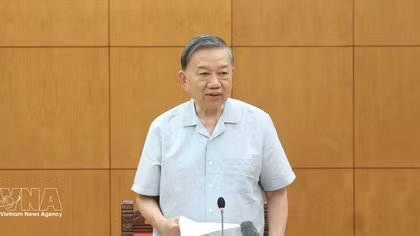
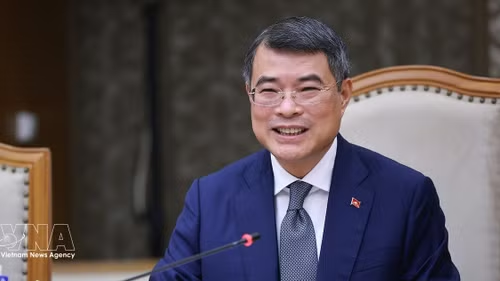
Politburo member, Secretary of the Party Central Committee and Chairman of its Commission for Internal Affairs Le Minh Tri speaks at the conference. (Photo: VNA)


The work has achieved significant and breakthrough results, contributing to the Party and political system building, political stability, socio-economic development and stronger public trust in the Party, the State and the regime, he said.

The campaign has gained broad public support and evolved into a powerful movement. Discipline and power control have been strengthened, with synchronised enforcement of Party discipline, administrative sanctions and criminal measures. Notably, the Party has issued five regulations on the control over the exercise of power and anti-corruption across key areas, namely the personnel work; Party inspection, supervision, discipline enforcement and auditing; investigation, prosecution, adjudication and enforcement of judgements; law-making; and public asset management and use.

Recent major resolutions, including those on science – technology development, legal reform and private sector development, along with the conclusions addressing bottlenecks in land-related and delayed projects, are being institutionalised to quickly translate Party policies into practice.

The resolution sets the overarching goal of firmly and persistently preventing, detecting and deterring corruption, wastefulness and misconduct; building the Party and political system clean and comprehensively strong to enhance the people's trust in the Party, the State and the regime; while promoting socio-economic development and supporting sustained high economic growth, contributing to Vietnam’s long-term development vision toward 2045.

A notable new approach emphasises strict yet humane and context-sensitive handling of violations, ensuring fairness while prioritising maximum asset recovery and encouraging voluntary remediation. This approach aims to protect those who innovate and act for the common good, according to Tri.

The resolution also underscores that science – technology, innovation and digital transformation are central drivers of a new growth model, while the private sector is a key engine of the national economy. Therefore, the resolution targets refining legal frameworks, including the Penal Code and the Criminal Procedure Code, to both encourage innovation and appropriately manage risks, including considering reduced liability for those committing violations without personal gain and with remedial actions.

In line with a shift from fighting to prevention, the resolution outlines measures to ensure officials “do not want, cannot, do not dare, and do not need” to engage in corruption, through integrity-building, stricter mechanisms, effective power control and stringent settlement, along with improved remuneration.

Tri said key priorities include improving institutions, enhancing transparency and accountability, strengthening the control of the exercise of power, building a contingent of capable and ethical cadres, accelerating administrative reform and digital transformation, and ensuring effective management of public resources. Greater emphasis will also be placed on combating wastefulness in both material resources and development opportunities.

The resolution clearly assigns responsibilities to Party committees and leaders at all levels, requiring them to take direct accountability while also encouraging proactive efforts to detect and handle wrongdoings, he noted, adding that the Politburo has ordered the building of an implementation plan which will include eight major tasks and 114 specific actions with defined timelines and outputs.

Described as a “declaration” of the Party’s determination to push ahead with the fight against the "internal enemy", the resolution is expected to create strong momentum in building a clean, strong, efficient and effective Party and political system, in line with the directions set by Party General Secretary and State President To Lam.
VNA

Other News

National Assembly Chairman urges renovation in leadership, working style

National Assembly Chairman urges renovation in leadership, working style

The NA's Committee for Cultural and Social Affairs has moved fast to reshuffle its organisation after the 14th National Party Congress and the election of deputies to the 16th NA, updating its work agenda to match new directives set out in the resolutions of the 14th National Party Congress and the first Congress of the NA Party Organisation for the 2025–2030 term.

Vietnam treasures ties with Croatia: PM

Vietnam treasures ties with Croatia: PM

Vietnam and Croatia should strive to double bilateral trade turnover from the current level of 161 million USD; study the establishment of a Joint Committee on Economic Cooperation to create a long-term, stable, and effective framework for collaboration, said Prime Minister Le Minh Hung.

President Ho Chi Minh's enduring legacy highlighted at Venezuela commemoration

President Ho Chi Minh's enduring legacy highlighted at Venezuela commemoration

Vice President of the United Socialist Party of Venezuela (PSUV) Jesús Faria expressed deep admiration for President Ho Chi Minh and Vietnam’s indomitable struggle for national independence. He described President Ho Chi Minh as an immortal symbol of 20th-century national liberation movements, whose legacy continues to inspire leftist parties, progressive movements, and peoples across Latin America, including Venezuela.

Vietnam proposes key cooperation orientations at BRICS Foreign Ministers' Meeting

Vietnam proposes key cooperation orientations at BRICS Foreign Ministers' Meeting

Deputy Foreign Minister Nguyen Minh Hang shared Vietnam’s approach to building an independent and self-reliant economy linked to deep international integration, while proposing several key areas for enhanced cooperation between BRICS and partner countries at the Expanded BRICS Foreign Ministers' Meeting that opened on May 14 in India.

Vietnam asks parties to respect its sovereignty over Truong Sa

Vietnam asks parties to respect its sovereignty over Truong Sa

PSNews - The spokesperson stated that the dispatch of personnel by relevant parties to features belonging to Truong Sa without Vietnam’s permission constitutes a violation of Vietnam’s sovereignty under international law. She stressed that such actions run counter to the Declaration on the Conduct of Parties in the East Sea (DOC) as well as ongoing efforts by countries to negotiate a Code of Conduct in the East Sea (COC).

Hanoi to host ASEAN Future Forum 2026 in mid-June

Hanoi to host ASEAN Future Forum 2026 in mid-June

PSNews - Vietnam’s proposals placed the highest priority on ensuring a peaceful and stable environment conducive for continued sustainable development and improving the well-being and happiness of the ASEAN people. They were praised by member states and incorporated into the core contents of the ASEAN Leaders’ Statement on the response to the Middle East crisis.

Vietnam promotes cooperation with United Nations on crime prevention

Vietnam promotes cooperation with United Nations on crime prevention

Vietnam highly values the support of the United Nations Office on Drugs and Crime (UNODC) in strengthening national capacity in crime prevention and criminal justice, drug control, and addressing emerging challenges, particularly cybercrime, said Ambassador Vu Le Thai Hoang.

Party, State leader calls for consolidation of central steering committees on legal, judicial reform

Party, State leader calls for consolidation of central steering committees on legal, judicial reform

Consolidating the central steering committees for institutional and legal reform and for judicial reform is necessary in order to streamline organisational structures without reducing responsibilities, while ensuring clear accountability, measurable outputs and concrete results. Following the restructuring, the body will be renamed the central steering committee for institutional improvement and law enforcement, with the Party General Secretary and State President serving as its head.

Vietnam strives for substantive outcome at NPT review conference

Vietnam strives for substantive outcome at NPT review conference

At the meeting this week, Ambassador Viet briefed the UNGA President on developments during the first two weeks of the conference. He stressed that the current international geopolitical landscape poses numerous complex challenges, while reaffirming Vietnam’s determination, together with other member states, to promote substantive and balanced outcomes at the conference.

Top leader of Vietnam receives Vientiane official in Hanoi

Top leader of Vietnam receives Vientiane official in Hanoi

The host leader stressed that cooperation between localities, particularly between the capitals of Hanoi and Vientiane, plays an especially important role as a pioneering force in effectively implementing the foreign polices of the two Parties and States, while also serving as a bridge between politics and development, as well as between strategy and concrete action.