PM urges close integration of security, defence with socio-economic development in Mekong Delta

The PM stressed the close integration of socio-economic development with defence and security from the grassroots level under the unified leadership of local Party committee and administration leaders and coordinated inter-agency action.

PM urges close integration of security, defence with socio-economic development in Mekong Delta -0
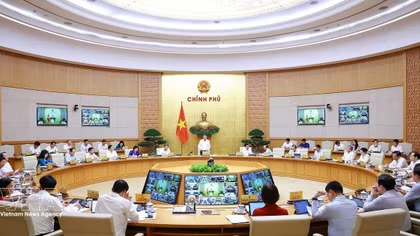
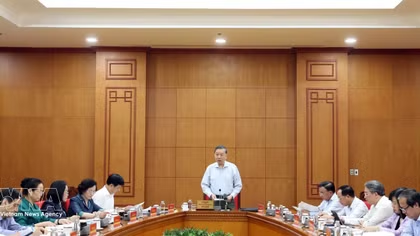
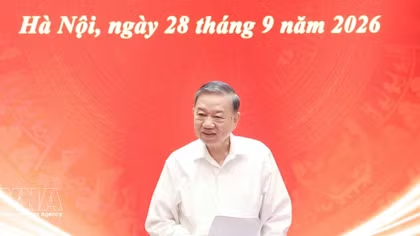
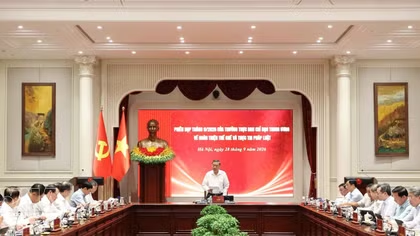
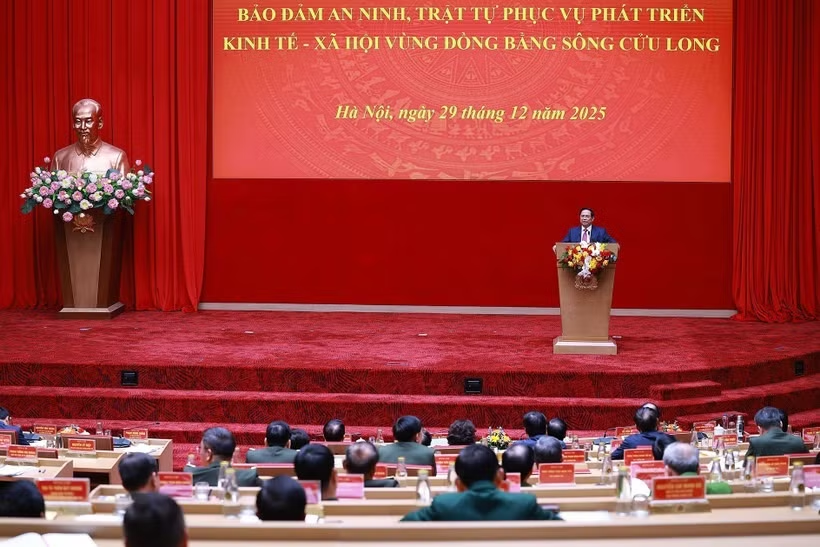
Prime Minister Pham Minh Chinh chairs the conference in Hanoi on December 29. (Photo: VNA)

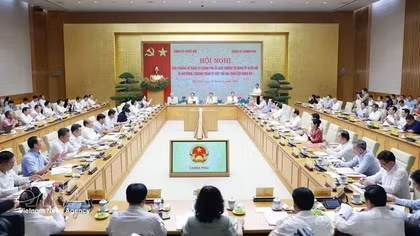
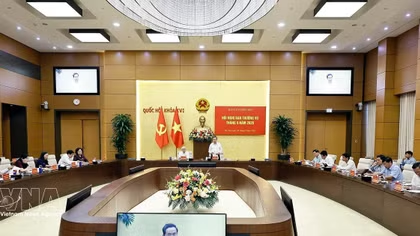
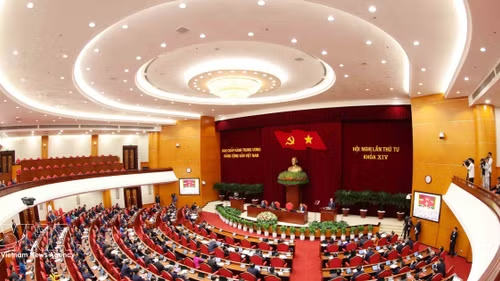
Prime Minister Pham Minh Chinh chaired a conference in Hanoi on December 29, with a focus on ensuring security and public order to support socio-economic development in the Mekong Delta region.

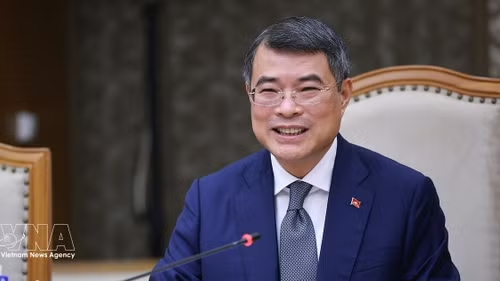
The conference was co-chaired by Minister of Public Security General Luong Tam Quang, with the participation of official from ministries and central agencies as well as provinces and cities in the Mekong Delta and neighbouring areas.

Addressing the meeting, General Quang said that in recent years, the Party’s guidelines and the State’s policies and laws on safeguarding security and combating hostile activities and crimes in the Mekong Delta have been effectively implemented. These efforts have helped maintain a secure and safe environment conducive to socio-economic development and people’s life improvement in the region.

However, with vigilance and proactiveness, the Government convened the conference to promote awareness and identify goals, tasks, and measures to further implement the Party’s viewpoints and the State's policies and laws on ensuring security and public order in support of fast and sustainable development in the Mekong Delta and neighbouring areas.

Participants focused on breakthrough tasks and measures to remove bottlenecks, mobilise all resources for development, and prevent unexpected or complicated security situations, including the emergence of security “hotspots”.

They reviewed the overall security situation in the region, achievements, along with limitations and challenges. Potential risks were pointed out while orientations and measures proposed for ensuring security and order in the coming period. They agreed that the Party and State have consistently paid close attention to the Mekong Delta, issuing numerous resolutions, conclusions, and programmes that have been fruitfully carried out to drive socio-economic progress while maintaining stability.
PM urges close integration of security, defence with socio-economic development in Mekong Delta -0
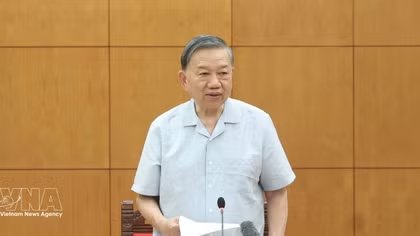
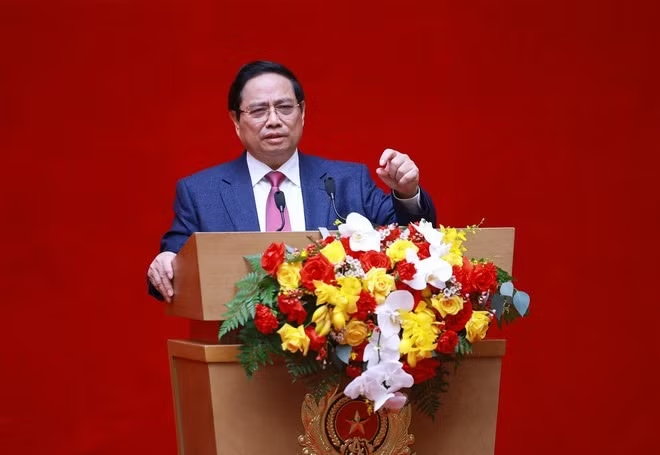
Prime Minister Pham Minh Chinh addresses the conference. (Photo: VNA)

Concluding the conference, PM Chinh stressed that the Mekong Delta holds particularly important strategic significance in terms of politics, socio-economic development, defence, security, ecology and external relations, serving as the country’s southern gateway and closely linked to national development and sovereignty safeguarding.

He highlighted key policy frameworks, including the Politburo's Resolution No. 13-NQ/TW, dated April 2, 2022, on socio-economic development and defence – security safeguarding in the Mekong Delta to 2030 with a vision to 2045, and the Government’s action plan for implementing this resolution.

While acknowledging major achievements, the PM pointed out shortcomings in the enforcement of ethnic and religious policies, socio-economic development, grassroots political system efficiency, and the coordination in ensuring security and order.

To address these challenges, he demanded concrete measures to fully tap into the region’s potential, preserve cultural identity, and improve people’s material and spiritual life, thereby firmly defending Vietnam’s southwestern region and safeguarding local security.

The Government leader requested ministries, sectors, and localities to regard the protection of security and public order as a key, urgent, and long-term political task under the Party’s direct, absolute, and comprehensive leadership and the State’s unified governance. The combined strength of the entire political system from the central to grassroots levels and of all people must be mobilised for the work, with heads of local Party committees and authorities bearing primary responsibility.

He urged the implementation of several core task groups, stressing the close integration of socio-economic development with defence and security from the grassroots level, under the unified leadership of local Party committee and administration leaders and coordinated inter-agency action.

Priority should be given to effectively implementing ethnic and religious policies; promoting economic, cultural and social development, creating jobs, resolving grassroots grievances; enhancing people’s self-reliance in socio-economic development and cultural preservation; improving the material and spiritual well-being of people of all ethnic groups; and eliminating conditions that could be exploited by hostile forces.

For 2026, PM Chinh assigned ministries and localities to fulfil some key tasks related to economic, cultural, educational and healthcare development in the Mekong Delta, requesting timely reporting to address any difficulties during implementation.
VNA

Other News

National Assembly Chairman urges renovation in leadership, working style

National Assembly Chairman urges renovation in leadership, working style

The NA's Committee for Cultural and Social Affairs has moved fast to reshuffle its organisation after the 14th National Party Congress and the election of deputies to the 16th NA, updating its work agenda to match new directives set out in the resolutions of the 14th National Party Congress and the first Congress of the NA Party Organisation for the 2025–2030 term.

Vietnam treasures ties with Croatia: PM

Vietnam treasures ties with Croatia: PM

Vietnam and Croatia should strive to double bilateral trade turnover from the current level of 161 million USD; study the establishment of a Joint Committee on Economic Cooperation to create a long-term, stable, and effective framework for collaboration, said Prime Minister Le Minh Hung.

President Ho Chi Minh's enduring legacy highlighted at Venezuela commemoration

President Ho Chi Minh's enduring legacy highlighted at Venezuela commemoration

Vice President of the United Socialist Party of Venezuela (PSUV) Jesús Faria expressed deep admiration for President Ho Chi Minh and Vietnam’s indomitable struggle for national independence. He described President Ho Chi Minh as an immortal symbol of 20th-century national liberation movements, whose legacy continues to inspire leftist parties, progressive movements, and peoples across Latin America, including Venezuela.

Vietnam proposes key cooperation orientations at BRICS Foreign Ministers' Meeting

Vietnam proposes key cooperation orientations at BRICS Foreign Ministers' Meeting

Deputy Foreign Minister Nguyen Minh Hang shared Vietnam’s approach to building an independent and self-reliant economy linked to deep international integration, while proposing several key areas for enhanced cooperation between BRICS and partner countries at the Expanded BRICS Foreign Ministers' Meeting that opened on May 14 in India.

Vietnam asks parties to respect its sovereignty over Truong Sa

Vietnam asks parties to respect its sovereignty over Truong Sa

PSNews - The spokesperson stated that the dispatch of personnel by relevant parties to features belonging to Truong Sa without Vietnam’s permission constitutes a violation of Vietnam’s sovereignty under international law. She stressed that such actions run counter to the Declaration on the Conduct of Parties in the East Sea (DOC) as well as ongoing efforts by countries to negotiate a Code of Conduct in the East Sea (COC).

Hanoi to host ASEAN Future Forum 2026 in mid-June

Hanoi to host ASEAN Future Forum 2026 in mid-June

PSNews - Vietnam’s proposals placed the highest priority on ensuring a peaceful and stable environment conducive for continued sustainable development and improving the well-being and happiness of the ASEAN people. They were praised by member states and incorporated into the core contents of the ASEAN Leaders’ Statement on the response to the Middle East crisis.

Vietnam promotes cooperation with United Nations on crime prevention

Vietnam promotes cooperation with United Nations on crime prevention

Vietnam highly values the support of the United Nations Office on Drugs and Crime (UNODC) in strengthening national capacity in crime prevention and criminal justice, drug control, and addressing emerging challenges, particularly cybercrime, said Ambassador Vu Le Thai Hoang.

Party, State leader calls for consolidation of central steering committees on legal, judicial reform

Party, State leader calls for consolidation of central steering committees on legal, judicial reform

Consolidating the central steering committees for institutional and legal reform and for judicial reform is necessary in order to streamline organisational structures without reducing responsibilities, while ensuring clear accountability, measurable outputs and concrete results. Following the restructuring, the body will be renamed the central steering committee for institutional improvement and law enforcement, with the Party General Secretary and State President serving as its head.

Vietnam strives for substantive outcome at NPT review conference

Vietnam strives for substantive outcome at NPT review conference

At the meeting this week, Ambassador Viet briefed the UNGA President on developments during the first two weeks of the conference. He stressed that the current international geopolitical landscape poses numerous complex challenges, while reaffirming Vietnam’s determination, together with other member states, to promote substantive and balanced outcomes at the conference.

Top leader of Vietnam receives Vientiane official in Hanoi

Top leader of Vietnam receives Vientiane official in Hanoi

The host leader stressed that cooperation between localities, particularly between the capitals of Hanoi and Vientiane, plays an especially important role as a pioneering force in effectively implementing the foreign polices of the two Parties and States, while also serving as a bridge between politics and development, as well as between strategy and concrete action.