By identifying the creation of a healthy cultural environment across families, schools, society and the digital sphere as a central goal, the Politburo’s Resolution 80 highlights the coordinated role of the “three pillars” - family, school and society - in nurturing and developing Vietnam’s younger generation, experts have said.
Aligning Resolution 80 with youth development strategy
Resolution 80 reaffirms that throughout the country’s revolutionary journey, the Party has consistently prioritised the development of Vietnamese culture and people. It underscores that building well-rounded individuals and fostering a humane, healthy, civilised and modern cultural environment is a key task in the nation’s new development era.
Looking ahead to 2045, the resolution envisions an advanced socialist Vietnamese culture in which people serve as the centre, driving force and ultimate objective of development.
The document places particular emphasis on youth in shaping national identity, proposing measures that prioritise character-building to guide cultural, educational and scientific activities toward comprehensive human development in morality, intellect, physical health and aesthetics. It aims to strengthen intellectual capacity, support personal growth, nurture a scientific worldview and promote the values of truth, goodness and beauty.
The resolution also calls for greater emphasis on moral and cultural education in schools, alongside closer coordination among families, educational institutions and society in shaping young people’s character.
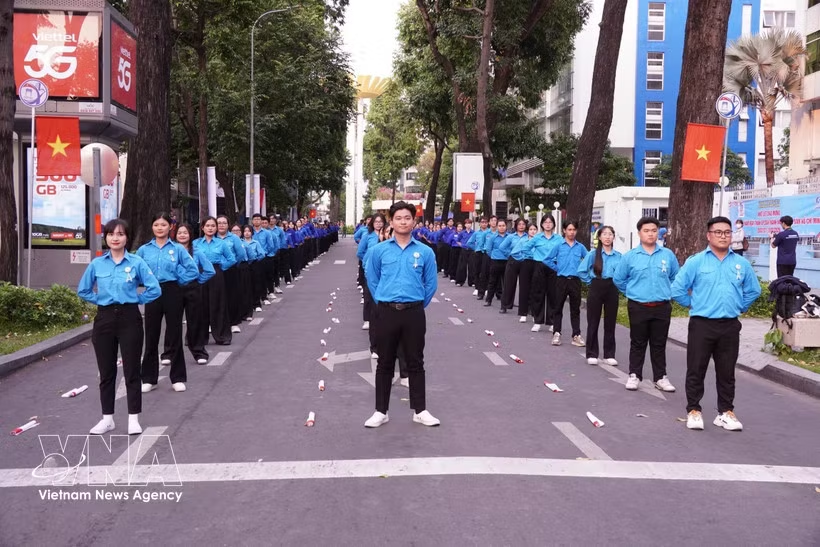
Meanwhile, the Vietnam Youth Development Strategy for 2021–2030 positions youth at the heart of efforts to cultivate and harness human resources, recognising them as a dynamic and pioneering social force in national construction and defence.
The strategy seeks to develop a generation of young Vietnamese who are patriotic, resilient and proud of national identity, while possessing strong ideals, aspirations for national advancement and a high sense of civic responsibility and respect for the law.
It also aims to nurture healthy, culturally grounded and well-educated youth equipped with life and professional skills, capable of mastering science and technology. The strategy further targets the development of high-quality young human resources to meet demands for rapid, sustainable growth and deeper international integration, while promoting volunteerism and social responsibility.
Building a healthy cultural environment for youth
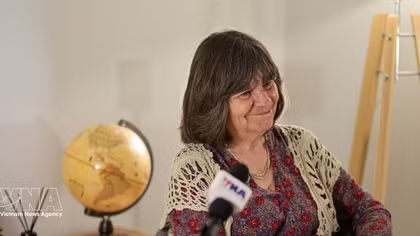
According to Dr Nguyen Thi Quoc Minh from the Faculty of Literature and Linguistics at the University of Social Sciences and Humanities under Vietnam National University – Ho Chi Minh City (VNUHCMC), cultural and educational foundations play a decisive role in shaping responsible and well-rounded young people.
Education, she noted, goes beyond knowledge transmission, helping young people understand themselves, others and society, while culture provides enduring values that guide them through an increasingly complex world.
Thai Hong Khang, a literature teacher at Hoang Dieu Secondary School and a 2024 outstanding young educator of Ho Chi Minh City, emphasised that moral education must extend beyond classroom theory and be integrated into all educational activities. Close cooperation among families, schools and society is essential, as students’ character develops across multiple environments. He described moral education as a long-term, continuous and collective responsibility.
In the current context, building a healthy cultural environment also requires attention to the digital space, which poses new challenges in shaping values, ethics and lifestyles among young people.
Le Nguyen An, a journalism and communications student at the University of Social Sciences and Humanities, VNUHCMC, said rapid advances in digital technology and social media create both opportunities and risks, requiring young users to strengthen awareness and resilience online.
Nguyen Tuan Anh, an employee of Saigon Industry Corporation and former President of the Vietnamese Youth and Student Association in California, said responsible young citizens in the digital era are those who approach knowledge with openness, verify information before sharing, engage in rational dialogue and maintain civility in communication.
In a landscape where positive and negative influences coexist, he stressed, young people’s discernment is vital. A healthy digital-age society depends on knowledgeable, responsible youth capable of maintaining integrity amid the challenges of virtual life.