Sapa to be national tourism area by 2030

The Prime Minister has approved the general master plan for the development for the Sapa National Tourism Area in northern Lao Cai province to 2030, with a goal of developing unique and high-quality tourism products and attracting 5.2 million visitors.

The tourism area covers all of Sapa district, including a 1,500 ha core area. The plan calls for the development of Sapa and four tourism divisions: Ban Khoang - Ta Giang Phin (Ban Khoang and Ta Giang Phinh communes), Ta Phin (Ta Phin commune), Ta Van - Seo My Ty (Ta Van commune), and Thanh Kim (Thanh Kim commune), with a connection to Bat Xat district.

Sapa’s major tourism products are sightseeing and ecotourism as well as resorts.
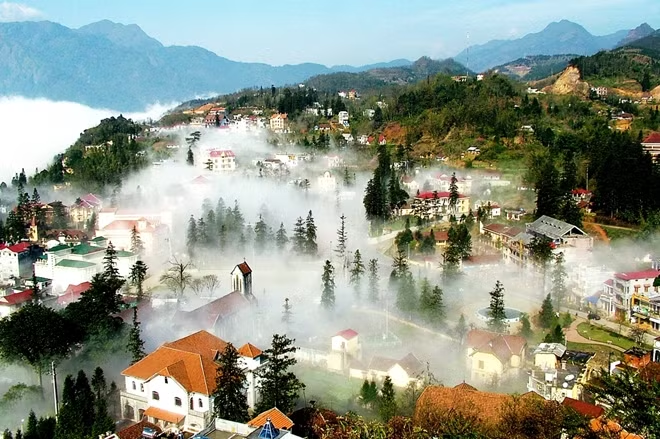
Photo: apttravel.com

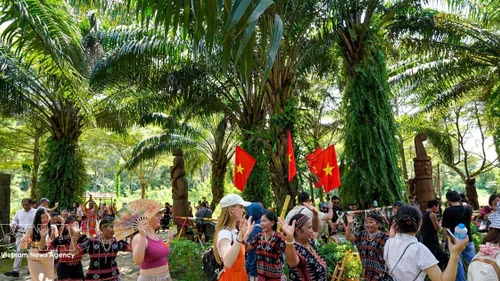
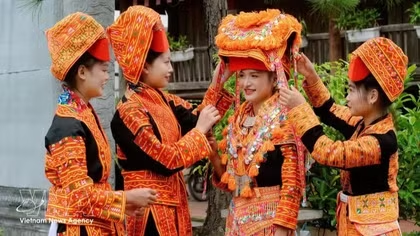
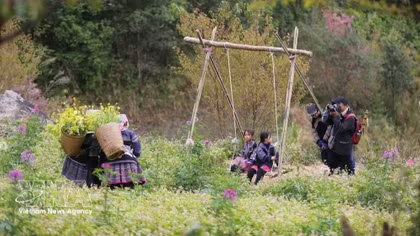
The plan will focus on developing unique tourism products for enjoying natural landscapes and the cultural identities of local people.

Tourism programs include Sapa - the land of hiking tourism and Sapa - the land of experiences and exploring traditional culture, and conquering Mount Fansipan, “The Roof of Indochina”, Ky Quan San and Nhiu Cu San Peaks, and Ta Xua Cloud Paradise.

Other tourism products include spiritual tourism to pagodas and temples in the Mount Fansipan cable car recreation complex, spiritual relic sites, monuments, traditional cultural festivals, sightseeing and shopping, sale of agricultural goods in border areas, environmental education, and adventure sports.

Photo: dulichthanhnien-ytc.com.vn

Sapa will develop an ecosystem connected to environmental education at the Hoang Lien National Garden in Sapa district, the Bat Xat Natural Conservation Area in Bat Xat district, community tourism sites in ethnic minority villages such as Cat Cat, Lao Chai, Den, Nam Cang and Sai in Sapa district, Lung Po II, Xeo, Sang Ma Sao and Den Sang in Bat Xat district, and sightseeing places such as Muong Hoa Valley, Bac Waterfall, Love Waterfall, and Ta Phin Cave in Sapa district and Thien Sinh Bridge, Lung Po Flagpole, and Muong Vi Cave in Bat Xat district.

By 2020 Sapa’s tourism area is to meet the relevant criteria and be recognized as a national tourism area.

Prior to 2030 the area will become a national and international-level resort and cultural tourism center with modern infrastructure and diverse, unique, and high-quality products that are competitive against other countries in the region.

Sapa plans to welcome 2 million arrivals by 2020 and 5.2 million by 2030.
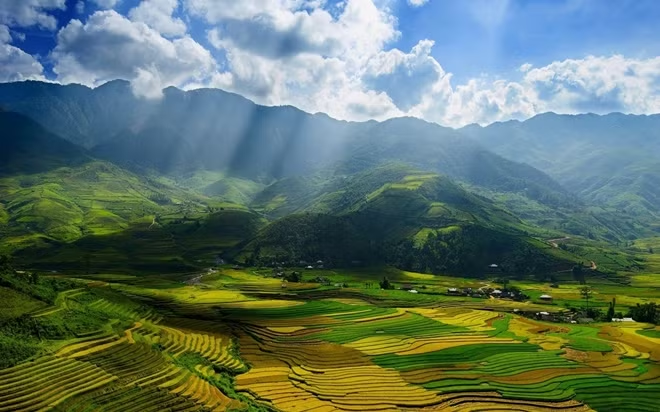
Photo: vnhtm.com
Photo: vnhtm.com

Investment in Sapa’s tourism continues to grow. The Ministry of Transport (MoT) has approved a project connecting the Noi Bai - Lao Cai Expressway and Sapa town, with capital of VND2.5 trillion ($112.5 million).

The project will build a four-lane provincial road passing through Sapa and Bat Xat districts and Lao Cai city and upgrade existing National Highway No. 4D.

The project kicked off in February and is estimated to be completed by early 2019.

MoT also decided to invest in Lao Cai Airport sooner than previously planned. With capital of VND5.8 trillion ($261 million), construction will begin at the end of this year be completed by late 2018.

The airport will have a capacity of 560,000 passengers annually, which will triple over the subsequent decade.


dtnews.vn

Other News

Vietnam secure berth at FIFA U17 World Cup 2026 for first time

Vietnam secure berth at FIFA U17 World Cup 2026 for first time

Vietnam national U17 football team secured a place at the FIFA U17 World Cup 2026 for the first time after defeating United Arab Emirates national U17 football team 3-2 on in the final Group C match of the AFC U17 Asian Cup 2026 in Saudi Arabia on early May 14 (Vietnam time).

Vietnam’s most beautiful railway station twins with French counterpart

Vietnam’s most beautiful railway station twins with French counterpart

A twinning agreement between Da Lat Railway Station in Vietnam and Trouville-Deauville Railway Station in France was signed at the French Embassy in Vietnam on May 7, creating new opportunities for cooperation in station management and operations, as well as cultural and tourism promotion between the two sides.

Hanoi gains two more craft villages in World Crafts Cities network

Hanoi gains two more craft villages in World Crafts Cities network

The recognition of Chuyen My and Son Dong craft villages as members of the World Crafts Cities network represents international acknowledgement of the cultural value, artisanal techniques, creativity and sustainable vitality of Vietnam’s traditional craft villages, he said.

Thang Long - Hanoi Festival 2026 to return in September

Thang Long - Hanoi Festival 2026 to return in September

Co-hosted by the municipal People’s Committee, the Department of Culture and Sports, and domestic and foreign agencies, the whole spectacle is meant to honour the city’s millennia-old heritage while reafffirming its strategy of establishing culture as a development engine.

Spreading Vietnamese cultural identity in digital space

Spreading Vietnamese cultural identity in digital space

In the context of deep international integration, cultural identity serves as both a “shield” against assimilation and a defining marker of a nation’s image. Protecting and promoting uniquely Vietnamese cultural values has therefore become a pressing task, particularly in an increasingly complex digital environment.

ITE HCMC 2026 to promote Vietnam’s tourism on global map

ITE HCMC 2026 to promote Vietnam’s tourism on global map

With its large scale, the ITE HCMC 2026 aims to promote tourism cooperation between Vietnam and priority markets such as Northeast Asia, Western Europe, North America, Southeast Asia, and Oceania while also boosting visitor arrivals from the Indian market

Vietnamese puppetry seeks renewal amid preservation challenges

Vietnamese puppetry seeks renewal amid preservation challenges

Although widely regarded as a cultural “speciality” attracting tourists, Vietnamese puppetry is facing multiple challenges in preservation and development, requiring renewed efforts to both safeguard its identity and adapt to contemporary cultural currents.

Project on digital transformation in cultural sector approved

Project on digital transformation in cultural sector approved

By 2030, the project targets the establishment of shared digital platforms across 100% of cultural sectors. All digitised cultural heritage will be standardised under the national data framework and shared in accordance with regulations, while 80% of public digital heritage assets are expected to receive digital identifiers to clarify ownership and management, encouraging organisations and individuals to do the same and support market development.

Vietnam eyes becoming region’s leading tourism destination

Vietnam eyes becoming region’s leading tourism destination

Vietnam has in recent years undergone a notable transformation in its tourism development strategy, placing a strong emphasis on nature-based and eco-tourism. This shift is not merely aligned with global trends, but represents a necessary step towards safeguarding valuable natural resources, while appealing to a growing segment of environmentally conscious travellers.