 |
King Hung told his brothers to teach the kids many more happy and meaningful songs.
Since then, on the 13th of the last lunar month each year, people make offerings to commemorate the Hung brothers’ legacy. They name King Hung the Eldest Saint.
On the 2nd and 3rd of the first lunar month, Phu Duc villagers conduct a ritual to ask the Eldest Saint to make ‘people prosper, things reproduce, weather favourable, and crops abundant.’
On this occasion, they sing and play folk games to re-enact the scene of King Hung teaching song and dances. Over time, this became a yearly traditional activity of the village.’
This is just one of the many folk tales about the origins of xoan – a genre of folk songs recognized as a World’s Intangible Cultural Heritage.
Xoan includes elements of music, song and dance that UNESCO found ‘deeply communal in the process of creation and passing from one generation to another.’
Culture experts tend to agree that xoan first appeared in the midland region of today’s Phu Tho Province, considered to be the cradle of the nation of Vietnam.
The province has the Special National Relic Zone of Hung Temple, where people worship Hung Kings, the founders of the country of Van Lang (Vietnam today).
‘Folk tales and scientific research show that xoan appeared very early. Xoan tunes took their origins from the ancient half-mountain, half-plain villages at the heart of the Van Lang region of the times of Hung Kings. These were the tunes used in rituals of the prehistoric faith of agricultural communities, who worshipped Heaven, Earth and Gods that granted good weather and good crops."
"That’s why the spiritual aspects of xoan carry elements of the belief in production and reproduction cycles. Xoan is performed in religious ceremonies at village temple and during spring, which is the least busy time in the water rice cultivation cycle," according to the website of the Dept of Culture, Sport and Tourism of Phu Tho Province.
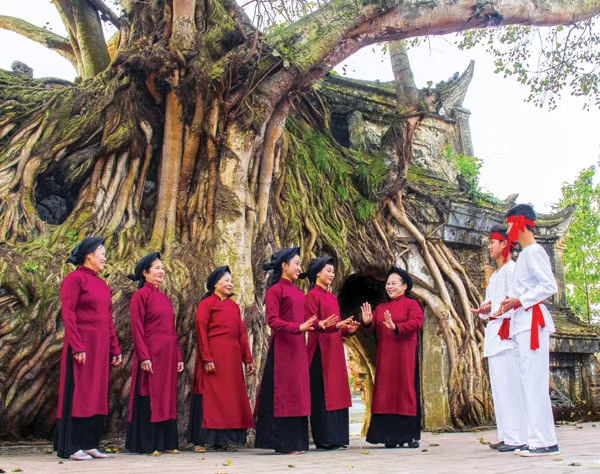
Since ancient times, xoan troops have been formed in many villages of Phu Tho Province. Xoan troop is an organized group of 15-18 xoan singers related by family.
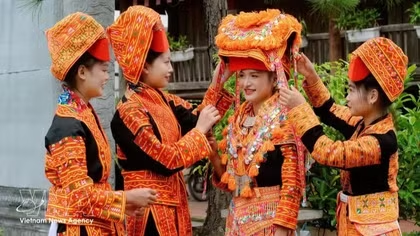
Men wear long dresses, folded turbans, white pants and wooden flip-flops. Women wear five-panel dresses, raven-beak shawls, white shirts, red brassieres, waist bags, silk pants, silver necklace and wooden flip-flops.
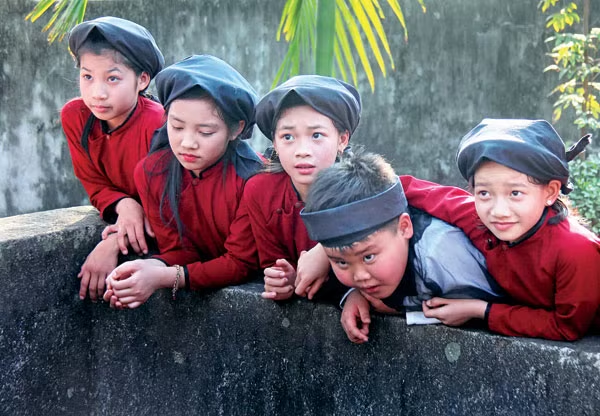
The head of a xoan troop is a coach and show organizer, serviced by young girl apprentices. Xoan troops usually are invited to perform in spring at village temples, and shrines.
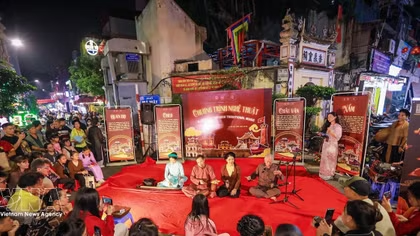
Since 2013, every year on the Commemoration of Hung Kings on the 10th of the 3rd lunar month, the Centre for Tourist Operations of Phu Tho Province always organizes Xoan tours to ancient villages at the square of Hung Temple Relic Zone, in Hung Dynasty Museum in Viet Tri city, and at the ancient xoan villages of Kim Duc, Phuong Lau and Hung Lo.
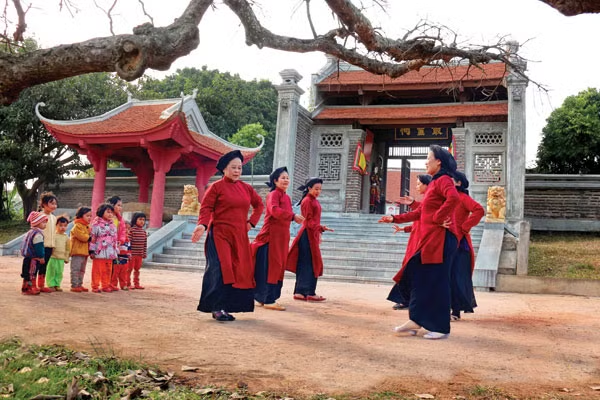 |
On these tours, visitors can also appreciate the age-old edifices of folk faith that have been hosting xoan performances for centuries.
Today in Phu Tho Province, there are still some ancient-style xoan troops such as An Thai, Phu Duc, Kim Doi and Thet in Kim Duc and Phuong Lau Communes.
Phu Tho authorities also say that there remain 10 age-old relic sites, mainly temples and shrines, which serve as stages for xoan performances for centuries, and about 70 traditional xoan performers, among whom 10 persons can pass on the art.
To educate and motivate people about the necessity of preserving and further developing the heritage that ‘urgently needs protection, Phu Tho Province has trained hundreds of xoan performers and introduced xoan into the school curriculum.
In a xoan performance, the male singers usually lead the choir and play the drums, whereas the females sing the repetitions and replies. They all dance to accentuate the lyrics.
There are three forms of xoan: ritual xoan to serve in ceremonies related to Hung Kings and tutelary gods, xoan on stage and festive xoan.
The ritual xoan usually takes place in front of a village temple. The lyrics include many prayers to the kings, deities and the tutelary god, begging for peaceful life, good health and good crops.
Male and female parties sing together and in parts, in accords and disaccords, boisterously and vigorously, creating an air of reverence.
 |
The show xoan has 14 songs and 14 ways of presenting them, as the performing part is freer to include more colourful elements.
The lyrics mostly describe the contemporary life and activities in the countryside, the subtle change in the nature through the four seasons of spring, summer, autumn and winter felt by the people working in the paddy fields. There are also songs telling folk tales.
Festive xoan songs are more lyrical. This is the liveliest and most attractive part of the art of xoan because it brings out the essence of the native Viet philosophy based on Yin and Yang, man and woman, reproduction and prosperity.
Festive xoan art includes singing, dancing, improvised scenes and games to reflect the delicate aspects of love between man and woman.