State-owned agriculture, forestry farm land needs stricter control

The management of land areas previously allocated to the State-run agriculture and forestry farms needs reviewing to avoid disputes and losses for the State, according to experts.

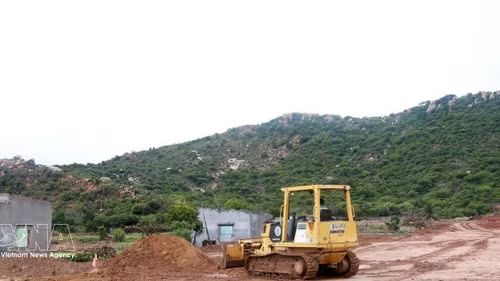
state-owned agriculture, forestry farm land needs stricter control hinh 0
(Source: nguoitieudung.vn)

The land is currently used by agriculture companies, forestry companies, forest management units and other organisations, households and individuals.

In fact, a number of shortcomings have been exposed in the management and use of the land, such as in the implementation of procedures for lease, determination of land prices and collection of land use levy, and granting certificates of land-use rights and changing the land use purposes.

According to a report by the Ministry of Natural Resources and Environment, more than 60% of the State-owned agricultural and forest farms that had switched to company models did not follow procedures of land transfer with payment or land lease as per regulations in the Law of Land 2003.

These farms owned 88% of total land allocated to the State agricultural and forest farms nation-wide, the report said.

Many farms had not closely monitored the land use after transfer to companies or individuals so many areas of land were illegally converted to civil uses such as housing or service facilities, or even sold for high profits.

A typical case is twenty-seven constructions that were illegally built on forest land in Hanoi’s Soc Son district over the past two years. The work includes houses, villas and even an eco-tourism area with a swimming pool, stilt houses and concrete roads.

The main reason originated from a wrong perception that the farms were owned by the State and the managers were State-paid servants so land transfer did not need supervising and monitoring.

Many farms did not have funds for surveying and marking out land boundaries of the areas they are in charge while staff were either incompetent or lacked legal knowledge.

According to Nguyen Van Chien, former deputy director of Land Registration Department (The Land Management Administration), in order to perform the management of State farms well in the future, managers should first change the policies which were not suitable with the reality.

“It was necessary to sufficiently provide funds from State and local budgets for surveying and marking out land boundaries of agricultural and forestry farms to serve as a basis for State management tasks on other types of land,” Chien said.

Also, monitoring and inspection of law compliance to the land originating from agricultural and forestry farms should be enhanced to avoid incorrect land use, he said.

Over 30 years, transferring land of State-owned agriculture and forestry farms has made a significant contribution to socio-economic development in Tay Nguyen (Central Highlands) region.

The land management has been well performed in the province of Dak Lak for many years.

At present, the province has a total of 65 agriculture and forestry companies and forest management boards which were allocated more than 345,703 ha of land. 

Vice Chairman of the provincial People’s Committee Y Giang Gry Niê Knong said the province had made land measurement and drew cadastral maps for nearly 200,000ha of farmland.

The inspection works had discovered and handled violations by companies, organisations and households.

This year, the province had revoked 5,572ha from eight entities found violating land use regulations.

The close watch had helped reduce land disputes and complaints making contribution to security and social stability in the province.

Farm companies had focused on protecting and planting forests, and restructuring agricultural plant patterns suitable with local characteristics.

Along with the achievement of farm land management, the province has been facing a number of difficulties.

According to Bui Thanh Lam, director of the province’s Natural Resources and Environment Department, since 2004 the province had allocated land to communes for management but in fact the land use has not been effective enough.

At present, hundred thousands of hectares of land were misused in several communes.

“Large areas of land transferred caused pressures for communes in management and forest protection”, said Lam.

“Under the regulations, the heads of communes were responsible for land management and forest protection. But in fact, communes did not have enough human resource for the job”, Lam said.

“So, the allocated land was illegally encroached by local people,” he said.

Granting certificates of land use rights also faced obstacles.

In the province, there were 11 villages set up by local ethnic minorities and migrants who were allocated land of State farms.

After 14 years of improving the forest soils for agriculture production, they had stable lives but were not granted the certificates of land use rights due to legal regulations, Lam said.

Therefore the province wanted revisions to legal regulations to help effectively manage and use the land of former State-owned agriculture and forestry farms, Lam added.

VNA

Other News

Vietnam accelerates innovation to boost growth, competitiveness

Vietnam accelerates innovation to boost growth, competitiveness

By 2030, Vietnam aims to rank among the world’s top 40 in the GII; raise total social investment in R&D to at least 2% of GDP, with non-State funding accounting for over 60%; increase international scientific publications by an average of 10% annually; and raise the number of patent applications and granted patents by an average of 16-18% annually.

Vietnam sees high growth prospects

Vietnam sees high growth prospects

Experts from the Institute of Vietnam and World Economy under the Vietnam Academy of Social Sciences noted the quality of recent growth as the high growth rate has been recorded against an increasingly higher comparative base.

Vietnam seeks bigger share of global Halal market

Vietnam seeks bigger share of global Halal market

Vietnam's Halal exports remain modest at around 900 million USD a year, accounting for less than 1% of the global market. Most exports are still raw agricultural and seafood products. Only around 1,000–1,300 Vietnamese businesses obtained or maintained Halal certification during 2024–2026.

Hanoi sets up inter-agency mechanism to operate carbon market

Hanoi sets up inter-agency mechanism to operate carbon market

Under a decision of the municipal People’s Committee on establishing an inter-agency working group, departments and agencies are responsible for identifying facilities subject to greenhouse gas inventories, developing emissions-reduction plans and studying projects capable of generating carbon credits.

Shrimp exports reach 3.3 billion USD in eight months

Shrimp exports reach 3.3 billion USD in eight months

According to data from the Vietnam Customs cited by the Vietnam Association of Seafood Exporters and Producers (VASEP), shrimp exports reached 478.5 million USD in August, up 4.2% from the same month last year. The eight-month total stood at 3.3 billion USD, representing a year-on-year increase of 12%.

Russian investors explore opportunities in Vietnam's real estate market

Russian investors explore opportunities in Vietnam's real estate market

Vietnam is seen as a potential market, with considerable room for growth in real estate, particularly commercial property, compared with some regional markets. Strong Vietnam-Russia ties and opportunities to establish foreign-invested enterprises are also considered favourable for Russian investors.

Phu Quoc airport planning adjusted to serve APEC 2027

Phu Quoc airport planning adjusted to serve APEC 2027

For 2021-2030, the Civil Aviation Authority of Vietnam proposed bringing forward the investment in a parallel taxiway system and a connecting taxiway north of Runway No. 2 at Phu Quoc International Airport, in order to connect with the aircraft maintenance and repair facility (hangar) planned for the northern area of ​​the airport.

Policy, infrastructure emerge as new advantages in FDI attraction

Policy, infrastructure emerge as new advantages in FDI attraction

From policy and infrastructure to industrial real estate, Vietnam’s FDI advantages are broadening towards a more integrated production ecosystem, offering investors a stronger combination of conditions for high-value, technology-intensive and long-term projects.

Logistics upgrade vital to 1-trillion-USD trade target: experts

Logistics upgrade vital to 1-trillion-USD trade target: experts

As trade expands, systemic bottlenecks across transport networks, warehousing, ports, border gates, and industrial zones are becoming more apparent. Experts emphasise the need to shift from a fragmented, project-by-project approach toward strategic management structured around trade corridors and integrated supply chains.

Ample room for Vietnam, US to deepen cooperation

Ample room for Vietnam, US to deepen cooperation

Do Ngoc Hung, Trade Counsellor and head of the Vietnam Trade Office in the US, said what stands out is not only the growth in trade volume but also the increasingly deep economic ties between the two countries.

Flexible fiscal policy helps drive economic growth

Flexible fiscal policy helps drive economic growth

According to the Ministry of Finance, State budget revenue in the first eight months of 2026 was estimated at 2.02 quadrillion VND (77.7 billion USD), equivalent to 80% of the annual estimate and up 16% year-on-year. Domestic revenue reached 1.75 quadrillion VND, accounting for 86.6% of total revenue and rising 16.6%.

Electronic components are produced at a factory in Hanoi. (Photo: VNA)

Hanoi's imports surge 41% in first eight months of 2026

Hanoi aims to achieve average annual export growth of at least 12% during 2026-30, with the city seeking to diversify export markets, boost high-tech and value-added products and reduce reliance on traditional markets.