Summit mulls financial inclusion for all

More organisations are offering new financial products and services that are changing the form and nature of the market and are shaping the future of financial inclusion.

This rapid change presents challenges in terms of management, monitoring and risk of information and system security, said Nguyen Thi Hong, Deputy Governor of the State Bank of Vietnam.

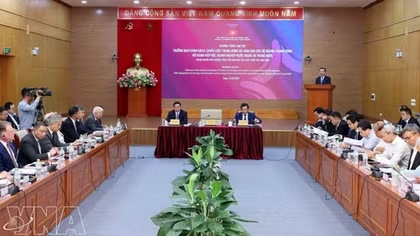
“Therefore, it is critical to harmonize the goals of financial innovation, integration and consumer protection to maximize the benefits of financial inclusion,” Hong told the Asia-Pacific Financial Inclusion Summit 2017 held in Hanoi on March 21.
Despite great progress made over the past decades in financial inclusion worldwide, some two billion adults remained unbanked, more than half of them in the Asia-Pacific region, she said.

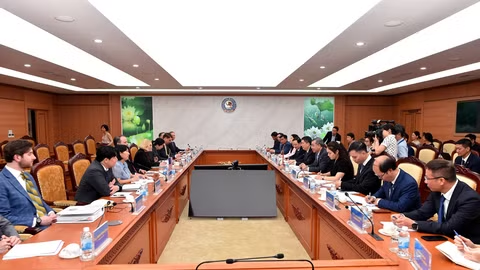
The two-day event brought together over 450 key stakeholders, leaders and practitioners to further the financial inclusion agenda in the region.

Now in its second year, the Summit is organized by the Citi Foundation and the Foundation for Development Co-operation (FDC) in partnership with the Banking with the Poor Network and The Economist Group. This year the State Bank of Vietnam (SBV) is official host of the summit.

Themed “Advancing Financial Inclusion in a Digital Age”, the summit explored the opportunities and challenges of the next generation of financial inclusion, and showcased the latest technology and innovations in financial products and services for the unbanked and underserved.

The deputy governor said Vietnam had been active in common efforts of the international community to promote financial inclusion.

“Vietnam will continue to create a more favourable environment to help people and businesses easily and effectively access financial services, contributing to economic development and sustainable poverty reduction,” she said.

She added that in the process of building national strategy on inclusive finance, the Government has focused on women, farmers, small-and-medium-sized enterprises and micro-scale businesses.

Michelle Curry, CEO of FDC called the impact of the digital age on financial inclusion “arguably the greatest financial reform of our time” and added that it was “both encouraging and inspiring to see such dedication to reform evidenced by the large number of attendees at this sellout summit”.

“The inclusive finance ecosystem is evolving to include not only financial service providers, both banks and non-banks, but new players, like mobile money providers and e-money operators, to name a few,” said Brandee McHale, President of the Citi Foundation and Director of Corporate Citizenship at Citi.

“What we will explore at this year’s summit is the need to balance new innovative technological advances and creative partnerships with policy that will continue to not only help drive financial inclusion for low-income populations but also protect vulnerable populations,” she added.

Vietnam’s efforts to provide preferential credit to the agricultural sector were also discussed at the summit, as was the fact that few households are eligible for bank loans due to lack of a legal framework for the development of microfinance institutions to help poor people access financial resources.

Pham Xuan Hoe, Deputy Head of the SBV’s Bank Strategies Institute, said microfinance institutions were extremely important to the country’s agriculture and rural development.

The Government proposed a VND100 trillion credit package by mobilising from commercial banks to support businesses, high-tech agricultural projects and clean agricultural products with preferential lending conditions.

"However, access to the loans is still limited since banks consider their profits while farmers and households often suffer weather disasters," he said. "Vietnam only has five licensed microfinance institutions while it has more than 12,000 communes."

Hoe said the Government should complete a legal framework to create favourable conditions for development of microfinance institutions.

Le Thi Lan, Director of Community Finance Resource Centre (CFRC) agreed, adding that black credit has been reduced where microfinance activities are available.

“However, the number of institutions has been modest because of capital shortage, an unsuitable legal framework and a lack of special principles for their operation,” Lan said.

For example, the requirement for high liquidity rate is not suitable to microfinance as most loans are small, and bad debts are fewer. High liquidity requirements would burden capital returns.

She suggested policies to help microfinance access by both local and foreign credits, as well as land and technical support policies.

VNA

Other News

Private economic sector poised for breakthrough growth

Private economic sector poised for breakthrough growth

More than a year after the Politburo's Resolution No. 68-NQ/TW on private sector development came into effect, expectations now extend beyond increasing the number of enterprises. The goal is to build a stronger business community with greater resilience, larger ambitions and the capacity to compete in global supply chains.

Vietnam remains ASEAN growth leader in 2026 despite global headwinds: WB

Vietnam remains ASEAN growth leader in 2026 despite global headwinds: WB

Vietnam is expected to remain one of ASEAN’s fastest-growing economies in 2026, supported by resilient exports, strong investment inflows and an ambitious reform agenda, despite mounting global uncertainties, according to the World Bank’s latest Vietnam Economic Update released on May 15.

Ministry establishes monitoring framework for carbon market

Ministry establishes monitoring framework for carbon market

Under a new circular, the exchange of greenhouse gas emission quotas and carbon credits is conducted on the domestic carbon credit exchange through the carbon trading system, which is interconnected with the national registration system.

Biofuel ready for nationwide rollout

Biofuel ready for nationwide rollout

For biofuels, particularly E10, to develop successfully, stronger and more coordinated policies are needed, especially pricing mechanisms capable of creating a sufficiently attractive gap between E10 and mineral-based petrol, an expert has said.

Vietnamese farm produce promoted at African investment, trade forum

Vietnamese farm produce promoted at African investment, trade forum

The 12th Africa Forum for Investment & Commerce (AFIC 12) opened in Algiers, the capital of Algeria, on May 9, drawing around 2,000 participants, including officials, economists, businesses, financial and development organizagtions from 43 African countries and international partners, including Vietnam.

Int'l medical, pharmaceutical expo opens in Hanoi

Int'l medical, pharmaceutical expo opens in Hanoi

The exhibition, which runs until May 9 at the Hanoi International Centre for Exhibition, showcases advanced products and technologies across a range of fields, including pharmaceuticals, drug manufacturing machinery and equipment, medical devices, hospital and clinic services and dental equipment.

Mega projects to transform Ho Chi Minh City urban landscape

Mega projects to transform Ho Chi Minh City urban landscape

Leading the charge in this massive building spree is the new central city square in the core of the Thu Thiem new urban area. Spanning more than 20 ha, it’s the crown jewel of the Central Square and new administrative center complex.

Vietnam establishes itself as one of region’s most dynamic manufacturing and supply bases

Vietnam establishes itself as one of region’s most dynamic manufacturing and supply bases

The country’s stable political and economic environment provides a critical foundation for long-term sourcing strategies. At the same time, Vietnam has demonstrated a strong ability to scale up manufacturing, supported by a continuously expanding industrial base capable of meeting both high-volume demand and increasingly complex technical and quality requirements.

Vietnamese pomelos gain broader access to Australian market

Vietnamese pomelos gain broader access to Australian market

The update by Australia’s Department of Agriculture, Fisheries and Forestry to its Biosecurity Import Conditions system (BICON) on April 10, officially setting out import conditions for Vietnamese pomelos, is regarded as a major milestone in market access efforts.

Vietnam's industry spearheads transition to circular economy

Vietnam's industry spearheads transition to circular economy

The circular economy is no longer just a policy choice. It has become an inevitable trend for delivering sustainable and green growth, sharpening competitiveness at home and abroad, and meeting Vietnam’s net-zero emissions target by 2050. It is now a prerequisite to sustain long-term economic expansion, particularly in industrial production and supporting industries.

Nearly 100 tonnes of Vietnamese fruits, vegetables airlifted to UAE

Nearly 100 tonnes of Vietnamese fruits, vegetables airlifted to UAE

Vietnamese fresh produce and processed foods are increasingly recognised for their quality, with items such as cashew nuts, coffee and spices gaining popularity among Middle East consumers. In 2025, Vietnam’s farm produce exports to the UAE exceeded 445 million USD, up nearly 24% year-on-year.