- Italian Ambassador of Design visits Vietnam
- Dimsum - Delicious tastes touch your heart
- Swedish Fika culture introduced in Vietnam
Every city, at some stage in its history, reaches a tipping point. For Palermo, it was one sweltering afternoon in July 1992, when more than 1,500 soldiers armed with automatic weapons took up positions on every corner of its eerily quiet streets in a show of military force unknown to Italy since the end of the second world war.
On that day, 24 July, the war was against the mafia, and Italy was losing. Six days earlier, a car bomb had killed Paolo Borsellino, the chief justice investigating the godfathers of Cosa Nostra, the Sicilian mafia. The five officers in his police escort also died. In May, the car of another judge, Giovanni Falcone, the mafia bosses’ number one enemy, had been blown up. The 300 kilos of TNT that killed him along with his wife and three escorting officers opened up a 15-metre crater in the motorway connecting the airport to the city.
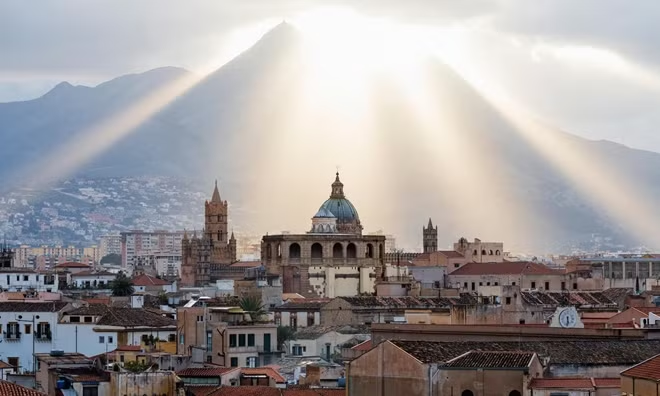 |
| ‘Between the heavens and the flames’ … a view of the city of Palermo. Photograph: Alamy |
“Palermo just like Beirut” was the headline splashed across the front pages of Italy’s leading newspaper at the time. Italy’s mafia wars marked the lowest point in Sicily’s history. Many thought Palermo had reached a point of no return, but its ability to bounce back from crisis has become a trademark of a city that has been invaded more often than any other in the Mediterranean.
The mafia wars of the early 1990s now seem light years away from the gilded corridors of the town hall, where last month journalists eagerly waited to ask mayor Leoluca Orlando about the news that Palermo had been nominated as Italian culture capital 2018. It is the most recent in a list of achievements: in July, Unesco recommended Palermo’s historical centre be declared a world heritage site and next year the city will host Manifesta, Europe’s most important biennial contemporary art exhibition.
“Have you seen this room? Lovely isn’t it?” Orlando says, pointing to 18th-century paintings on the walls of his office. “And isn’t this a fine desk? Do you like these chairs? Before I became mayor, behind this desk, on this chair, sat friends of the mafia. Indeed, some were themselves mafiosi.”
The 69-year-old Orlando is one of Italy’s best known mayors. He has a doctorate in law, speaks five languages and has governed the city for 17 years. If the city has changed, it is in part thanks to him.
In that fateful summer of 1992, Orlando – having two years earlier founded the centre-left party La Rete – was thinking about running for mayor for the second time. Palermo was on its knees. Attilio Bolzoni, a journalist for the Italian national newspaper La Repubblica who lived in Palermo for 25 years, describes the city in those years as a mafia battlefield.
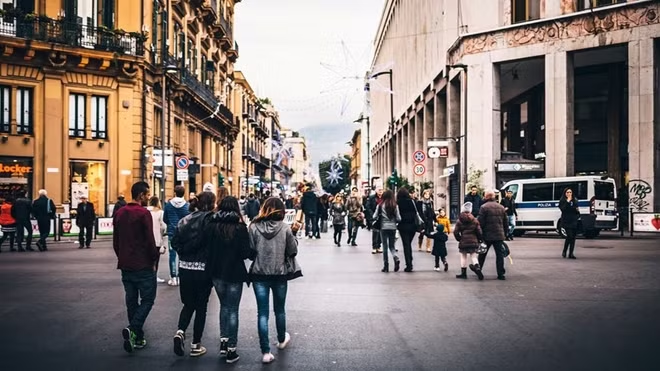 |
| A regenerated pedestrian shopping street in Palermo’s old town area. Photograph: Getty Images |
“I felt like a war correspondent in my own town,” he says. “I had been in Afghanistan, the Balkans, Iraq, but I had never felt so afraid as I did in Palermo during those years. I had to watch my back all the time. You found the mafiosi everywhere, on the streets, in the shops, in the banks. It felt like a curfew was in place, there wasn’t a single cafe where you could sit at a table in the evening. Every time the phone rang at my desk I was afraid they had killed the umpteenth journalist, policeman or judge.”
Elections were held in November 1993, and Orlando, running on an anti-mafia platform and living under police escort (he still does), won 75% of the vote. “Today Palermo is the capital of culture,” Orlando says. “But back then it was the capital of the mafia. Palermo was governed by the mafia, and whoever stood in their way was isolated, or at worst, killed.”
But something in the town was changing. As the army patrolled Palermo, its citizens, aghast at the bombing and killing, came out on to the streets in their thousands to support the judges and protest against the mafia. Marches and banners alone were not likely to worry the Cosa Nostra, though. The state would have to make a move.
“First of all we had to get rid of the mafia bosses,” says Orlando. “Many of them continued undisturbed, sitting comfortably in their luxury homes in the centre of Palermo planning homicides and stuffing their pockets with the mountains of cash from drug trafficking.”
Special laws were passed against mafia heads and their associates, including white-collar municipal employees who worked for them. Penalties and prison conditions were made harsher, encouraging many gangsters to become informers in efforts to obtain lighter sentencing, which in turned led to further arrests.
Salvatore “Totò” Riina, the head of the Sicilian mafia, was the biggest domino to fall. He had been instrumental in starting a war that for 15 years had bloodied the city’s streets, and had been wanted by multiple police forces across Europe since 1969. In January 1993, however, he was arrested. More captures followed: according to government figures, more than 4,000 mafiosi have been arrested in Sicily since the 1990s.
Today, the Sicilian mafia is in decline, giving Palermo a much-needed breather. But true recovery will take time: the wounds inflicted by the mafia are visible in the city’s architecture. Hundreds of desolate, blocky and grey apartment buildings scar the suburbs, the result of the biggest building campaign in Italian history. Politicians tied to the mafia ordered the demolition of splendid art nouveau mansions to make space for brutalist tower blocks. Today, it’s an architectural period remembered in some circles as the “sack of Palermo”.
Maurizio Carta, professor of city planning at the University of Palermo and one of the team behind the regeneration of the city, said the mafia “disfigured the beauty of Palermo by spewing out tonnes of concrete with no regard for the city’s historical or artistic heritage. They demolished wonderful 19th-century villas and deposited the rubble directly on the nearby coastline, ruining the beaches.”
The city council provided public funding to stimulate this process, and homeowners began investing in renovating their properties, some of which had been abandoned since they were damaged during the second world war. In 25 years, more than 60% of the city’s historic buildings have been renovated.
An undisclosed portion of the seizure of goods and property from Sicilian mafia bosses, worth an estimated total of €30bn (£25bn), was invested in new social, environmental and cultural spaces in the city.
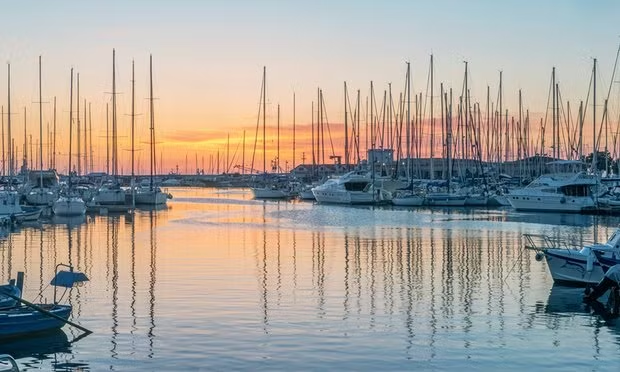 |
| Yachts in the Palermo Marina after its prize-winning regeneration. Photograph: Rob Tilley/Getty Images |
Just outside Palermo in Capaci, where Falcone was killed, a field seized from a local boss has been turned into a play area for disabled children. Another remodelled site on the city’s outskirts is the Giardino della Memoria, or the Garden of the Remembrance. Seized from a mafioso in 1993, it is now into a 25,000 sq m park full of mandarin, lemon and orange trees, many of which stand above a plaque bearing the name of someone who was killed for opposing the Cosa Nostra. Elsewhere, a beautiful villa in the countryside, which once served as a meeting place and business hub for local gangsters, has been turned into the headquarters of a local Scout movement. These are just three of about 800 repurposed sites.
“This type of urban renovation also has a social value,” Carta says. “In cities with high-risk criminality, the abandoned and decaying areas often become territories for criminal activities, areas where the mafia thrives. To return them to ordinary folk we need to clean them up and plan community spaces.”
A case in point is La Cala, Palermo’s yacht harbour and marina, for which Carta won the International Biennial of Architecture prize in 2015 for his regeneration scheme. Until 2005, the area was more or less off-limits, a decaying, rubbish-filled haunt for drug dealers working on behalf of organised crime. “We needed to begin in those places that, beneath the rubble and trash, concealed a flicker of life, the possibility to bounce back,” Carta says. “La Cala was one of these.”
Today, La Cala is emblematic of the rebirth of Palermo. Hundreds of yachts are anchored here now, while greenery and cafes surround the ancient harbour, and tourists, runners and cyclists enjoy a place whose recent past is now only a bad memory.
Palermo has regained its squares, many of which were used by the mafia as illegal car parks, and where it was better to pay up if you wanted to return to find your car in one piece. Although illegal parking attendants still exist in Palermo (as indeed does the mafia, bruised but not broken), many of the historic squares have been pedestrianised or fitted with car sharing and bike sharing stations.
Palermo is also getting greener, with newly installed electric trams and a metro connecting the outskirts to the city centre. All this might seem ordinary in Amsterdam, Zurich and Oslo, but in a city whose streets were patrolled by hundreds of armed soldiers until 1998, it is no small feat.
The obelisk erected on the spot where the mafia killed Falcone is already one of the most visited places on the anti-mafia tour organised by Addiopizzo, the anti-racket association that takes visitors to places that symbolise the war against the Sicilian godfathers. Today, the most authoritative bosses are in jail, and have been replaced by young criminals who don’t seem to have the same authority as their predecessors.
Palermo still has a long way to go. The mafia still controls some businesses here; young people struggle to find jobs; the suburbs remain poor; so do many citizens. Some people say Palermo is now in a sort of purgatory, still to expiate all its sins. “But after all,” says Orlando, “between the heavens and the flames, every day this city is a much better place to live in”.