
Hanoi, the heart of Vietnam, is appreciated by millions of international visitors thanks to its centuries old French style architecture, diverse culture, attractive points of interest, friendly people and superb cuisine. Check out our tips to explore the best Hanoi has to offer.
Best time to travel
Autumn, which falls from early September to late November, is an ideal time to visit Hanoi. The weather is milder and drier, without the scorching sun of summer, making it the perfect time for sightseeing.
However, visiting Hanoi later in the year is also an interesting experience as holidaymakers can enjoy hot and tasty dishes in the chilly winds of winter.

How to get there
There are a lot of airlines providing flights to Hanoi from all around the world, including Vietnam Airlines, Vietjet Air, Jetstar and Qatar. Visitors can also get in by train or sleeper bus.
Where to go and what to do
Hanoi’s Old Quarter is the highlight of the city’s tourism sector. With its dense population and busy trading activities, it is an ideal place to explore the traditional and unique features of Hanoi.
While Ho Chi Minh City is famous for Bui Vien, which is dubbed “Western street” for backpackers, Hanoi’s Old Quarter is known for its “international crossroad” at Luong Ngoc Quyen – Ta Hien intersection, where visitors can have a few cold and fairly cheap fresh beers at the end of the day for a price of only VND10,000 (US$0.43) for a tall glass.
Ho Chi Minh Mausoleum is a place you shouldn’t miss when in Hanoi. This was the place where President Ho Chi Minh read the Declaration of Independence, marking the birth of the Democratic Republic of Vietnam, now the Socialist Republic of Vietnam.
The mausoleum is open to visitors every day, except Mondays and Fridays. Visitors to the site are required to wear appropriate clothes and to act with respect. The site is free for Vietnamese citizens, while foreigners have to pay VND25,000 for a ticket to the Ho Chi Minh Museum and VND25,000 to the President’s stilt house.
Another must-see tourist attraction in Hanoi is the Temple of Literature, Vietnam’s oldest university. Tickets cost VND30,000, people with disabilities and students with ID cards enjoy a 50% discount, while children under 15 can visit free.
Where to eat and drink
Pho (Vietnamese noodles) is a perfect choice to start a new day in Hanoi. With prices ranging from VND25,000 to VND40,000, Pho can be served at any time of the day in Hanoi. Two of the most popular types of pho are beef noodle soup and chicken noodle soup.
Other suggestions for breakfast include banh cuon (steamed rice pancake rolls), mien luon (vermicelli with eels), xoi (sticky rice), and of course, banh mi (fresh bread with tasty fillings).
Bun cha, a delicious and filling dish comprising charred and crispy slices of seasoned pork served with a bowl of fish sauce-heavy broth, a basket of herbs and rice noodles, can cost from just VND25,000 to VND35,000. Bun cha often comes with the delicious nem cua be (fried crab spring rolls).
Afternoon is a great time to have a cup of egg coffee. You might have to pay VND15,000 to VND20,000 to savour the creamy, rich taste of a sweet and eggy custard poured onto the dense Vietnamese coffee.
Fruit juices, smoothies and che (sweet beverages) are available at kiosks along Dinh Tien Hoang and Nguyen Huu Huan streets around Hoan Kiem (Sword lake).
For dinner, cha ca (grilled catfish seasoned with dill and shrimp paste) is a can’t miss dish for visitors to Hanoi. When the dark of night fills the sky, visitors can join Hanoians at the bustling corner of Ta Hien – Luong Ngoc Quyen streets to taste the iconic street food of Hanoi, including nem chua ran (fried fermented pork rolls), nem chua nuong (grilled fermented pork rolls), grilled chicken feet, and roasted quails with honey.
Where to stay
Over recent years, the home stay industry has mushroomed in Vietnam and Hanoi in particular, with prices ranging from VND 550,000 to VND1.5 million per night for a room.
Some suggestions include O'Hanoi (33B Pham Ngu Lao), Tuti Downtown (98 Hang Buo), and Little prince home (8B Yen Hoa).
There are also budget hostels with full accommodation and equipment from VND200,000 to VND800,000. For those who want to enjoy a luxury retreat in Hanoi, there are many five-star hotels such as the Sheraton and Sofitel Metropole.
How to get around Hanoi
You can take a taxi, a xe om biker or a bus to get around Hanoi. If you are brave enough to ride a bike through the hectic streets of Hanoi alone, you can hire a bike for between VND50,000 and VND150,000 a day to save money.
Recently, the city has launched a double-decker city Hop on - Hop off tour, offering visitors three price options, starting at VND 300,000 for a ticket valid for four hours, VND 450,000 for 24 hours, and VND 650,000 for 48 hours.
The red open top buses cover a route of 25 streets with 13 stops, taking visitors to the 30 most popular local tourist attractions. The 13.8 km tour operates from 9am to 5pm daily with a frequency of 30 minutes.




In recent years, Ta Xua, dubbed "the paradise of clouds", has emerged as one of the mountainous destinations attracting strong interest from young travellers, particularly for its spectacular sea of clouds stretching across the mountains in the northwestern region.
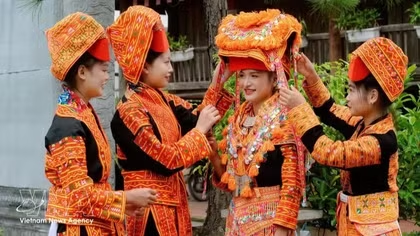
Training local young people in filming, audio recording, digital storytelling, data preservation and responsible use of AI can help build a new generation of cultural custodians. This, in turn, can help transform cultural heritage into a resource for economic development while contributing to the country’s broader development.

The exhibits are presented as historical and legal materials proving Vietnam’s sovereignty over Hoang Sa and Truong Sa in the East Sea.
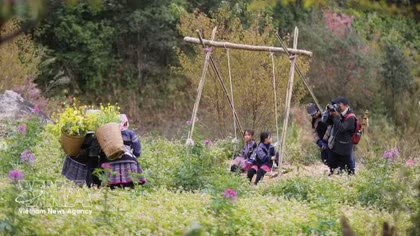
With growing recognition of indigenous knowledge, customs and cultural values as unique assets, ethnic communities in the northern mountainous region are shifting from simply providing tourism services to becoming creators and owners of tourism products, confidently telling their own cultural stories
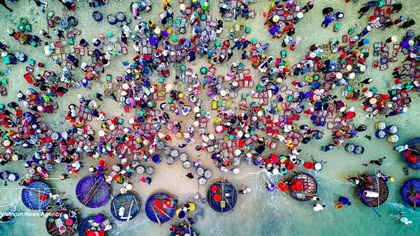
When local people remain the custodians of their resources, tourism can become a reason for them to stay, maintain their livelihoods, and renew community value rather than replacing it.
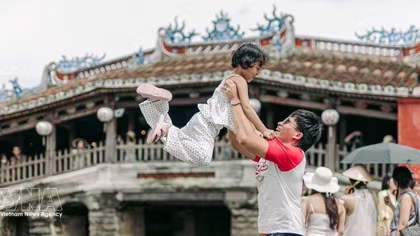
Alongside the RoK, Da Nang has stepped up tourism promotion in India, Japan, China, Russia and CIS countries, Australia, Europe, the Middle East and Southeast Asia.

Jonathan Wallace Baker, UNESCO Representative to Vietnam, noted that the official proclamation of the 2027–2036 period as the "International Decade of Culture for Sustainable Development" comes at a particularly important moment. As the international community works to accelerate progress towards the 2030 Agenda while beginning to consider what comes after 2030, the Decade provides a ten-year framework to strengthen the place of culture in development.
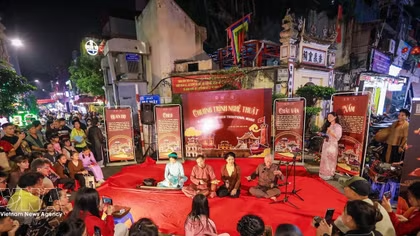
Under Resolution 80-NQ/TW, dated January 7, 2026, November 24 was designated Vietnam Culture Day, to be observed annually. The occasion aims to give the public opportunities to participate in, create and enjoy cultural activities, helping spread positive values and foster pride in Vietnamese culture.
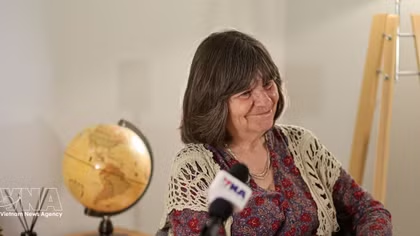
"Vietnam is part of my life," affirmed Patricia Abarzua Munoz, emphasising that the friendship between the Chilean and Vietnamese peoples is built on shared values and mutual respect.

For the MICE tourism sector in both Ho Chi Minh City and Vietnam, growth can no longer be driven merely by increasing the number of events; instead, the focus must shift to enhancing the value of each event and the competitiveness of each destination.

Women’s football movements in local communities have been quietly growing, but they’ve now built up enough momentum to inspire organisers to launch the first Vietnam Ethnic Minority Women’s Football – VTV Cup in 2026.

For 2026, Vietnam's tourism sector is targeting 25 million foreign arrivals, 150 million domestic trips and total revenue of 1.125 quadrillion VND (43 billion USD).

Vietnamese film Quan Ky Nam (Ky Nam Inn) has won several awards at the 25th Imagine India International Film Festival (IIIFF) in Madrid, including Best Director.

According to the magazine, boat trips into Phong Nha Cave and strolls through Paradise Cave (both family-friendly) offer a tantalising glimpse of their astonishing scale, but the real adventure lies deeper within the park, where cavers wade through underground rivers and weave among stalagmites.

Tourism effectiveness should be measured not only by visitor numbers and revenue, but also by spending, length of stay, repeat visits, job quality, visitor satisfaction and environmental carrying capacity, said experts.
The National Statistics Office under the Ministry of Finance reported that Vietnam welcomed nearly 2 million international visitors in August, up 19.7% from July and 18.4% year-on-year. The figure represented 63.6% of the tourism sector’s full-year target of 25 million arrivals.

For the Mong people in Ta Dung, Dak R’mang is not merely a weekly rendezvous, but a space preserving memories of their northwestern hometowns and cultural identity in their new land.

Ngo Phuong Ly, the spouse of General Secretary of the Communist Party of Vietnam Central Committee and President To Lam, said the two countries share similarities in silk weaving and can enrich their cultural heritage through exchanges and experience sharing.

The Ho Chi Minh City Department of Tourism said on late September 2 that the southern metropolis welcomed an estimated 1.65 million domestic visitors and 62,000 foreign tourists over the break.