In its latest update on global and regional economic prospects, the Singapore-based bank noted that the world economy is likely to remain volatile in 2026 as geopolitical conflicts and policy changes continue to shape global markets.
Proposals related to new US tariffs are increasing risks to global trade, while geopolitical tensions in the Middle East, particularly conflicts involving the US, Israel, and Iran, are making energy and commodity markets more sensitive to political developments.
The Executive Director in Global Economics and Markets Research at UOB, Suan Teck Kin, said evolving US tariff policies and escalating tensions in the Middle East are key factors affecting economic stability in Asia.

An escalation of conflict in the Middle East and risks to the Strait of Hormuz have become key macroeconomic threats to Asia, mainly through higher oil prices, rising inflationary pressures, weaker domestic currencies, and deteriorating market sentiment, he said.
Despite these challenges, UOB has maintained its growth and inflation forecasts for most Asian economies, including Vietnam. It acknowledged downside risks to growth and upside risks to inflation.
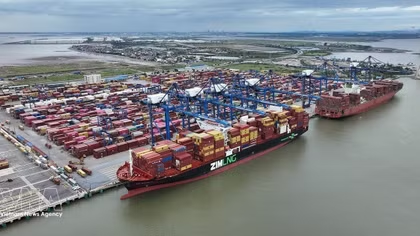
The bank noted that Vietnam entered 2026 on a solid footing after posting economic growth of 8.02% in 2025, reflecting a strong rebound in manufacturing, exports, and domestic consumption.
On that basis, UOB maintained its forecast for Vietnam’s gross domestic product (GDP) growth at 7.5% in 2026, with first-quarter growth projected at around 7%.
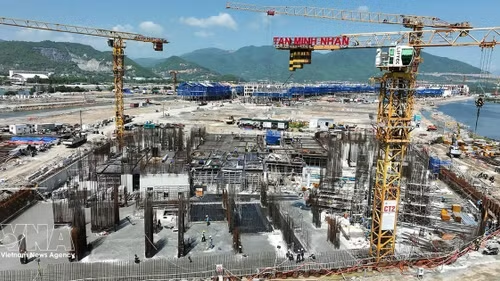
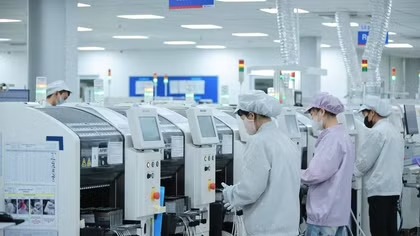
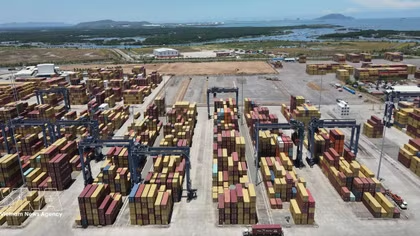
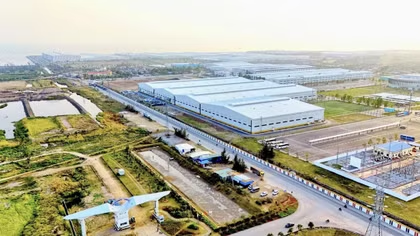
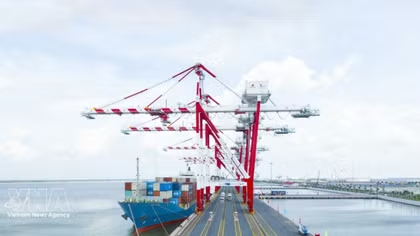
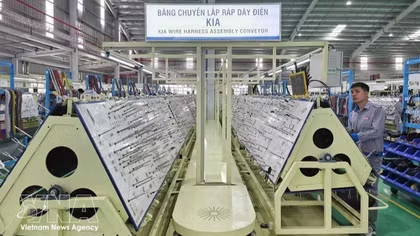
Key growth drivers are expected to include the Government’s commitment to accelerating infrastructure investment, continued expansion of export-oriented manufacturing, and sustained inflows of foreign direct investment (FDI).
However, external uncertainty could still affect the outlook. A proposed global tariff of 10% by the US could impact trade flows and supply chains, while fluctuations in energy prices driven by geopolitical tensions may raise production and logistics costs.
Commenting on the potential impact of Middle East tensions on domestic fuel prices, Dinh Duc Quang, Managing Director of the Currency Business Division at UOB Vietnam, said the conflict remains a major factor influencing global oil prices, which in turn affects domestic fuel costs, an important input for manufacturing, transport, and other sectors.
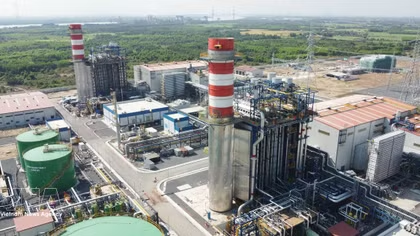
Nevertheless, he noted that Vietnam has been working to diversify its energy supply sources in recent years and, at the same time, enhance energy self-sufficiency through exploiting crude oil, expanding domestic refining capacity, and accelerating the transition to renewable energy such as solar and wind power. These measures could help mitigate the impact of global fuel price volatility.
Regarding the monetary policy, UOB expects the State Bank of Vietnam to keep the refinancing rate unchanged at 4.5% as economic growth remains resilient and inflation is under control.
Vietnam’s inflation eased to 2.53% year-on-year in January 2026, down from 3.48% in December 2025 and lower than the market forecast of 3.1%, with price increases mainly driven by food, housing, and education.
Meanwhile, oil prices may rise in the short term due to tensions in the Middle East. Under UOB’s baseline scenario, Brent crude could climb to around 90 USD per barrel in the second quarter of 2026 before easing to about 80 USD by the end of the year.
Drawing from the experience of 2022, when oil prices surged to 128 USD per barrel following the Russia – Ukraine conflict, UOB estimates that every 10 USD increase in Brent crude could push Vietnam’s consumer price index (CPI) up by 0.3–0.4 percentage points after a lag of two to three months, while reducing GDP growth by about 0.6–0.9 percentage points over the following two to four quarters.
On the currency market, the Vietnamese dong has given up some of its early-year gains amid rising geopolitical tensions, with the USD/VND exchange rate rebounding to around 26,200 VND per USD in early March.
While global risk aversion may continue to pressure the Vietnamese dong in the near term, UOB expects its medium-term outlook to remain stable, supported by strong economic fundamentals, robust FDI inflows, and the possibility of Vietnam being upgraded to emerging market status later this year.
The bank forecasts the USD/VND exchange rate to fluctuate within a range of about 2–3% in 2026, reaching around 26,400 VND per USD in the second quarter, 26,200 VND in the third quarter, and easing to approximately 26,100 VND by the end of the year.
 Vietnam has potential to reshape Southeast Asia’s economic rankings: Foreign media
  Russian paper hails Vietnam’s robust economic growth, social progress