Urgent measures ramped up to stabilise market amid rising costs

Authorities are urgently rolling out measures to stabilise the market as surging input costs place unprecedented pressure on the retail market, with suppliers pushing for price hikes and supermarket systems striving to keep prices in check.

At a recent meeting held by the Ministry of Industry and Trade (MoIT), big retailers warned that price pressures are intensifying. A representative of a retail chain with thousands of outlets nationwide said that 70–80% of suppliers have proposed price increases, the highest level seen in recent years.

The primary driver is the sharp rise in input costs, particularly fuel, raw materials and logistics. Disruptions in global supply chains, compounded by geopolitical tensions, have simultaneously driven up transportation, production and material costs.

In response, retailers are engaged in tough negotiations to limit price increases. However, their ability to keep prices stable is narrowing, with some suppliers even suspending deliveries pending price adjustments. If this trend persists, retail prices of many goods could rise by 5–20% in the time to come.
Urgent measures ramped up to stabilise market amid rising costs -0
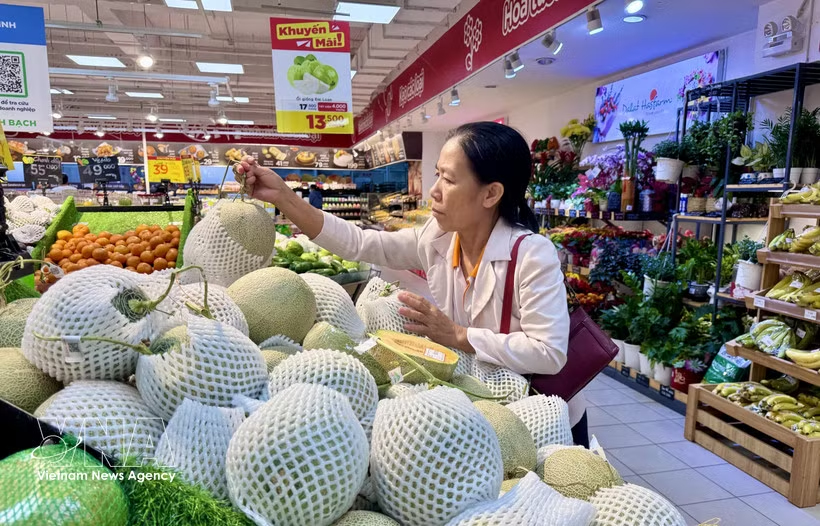
A consumer chooses fruits at a GO! supermarket in Ho Chi Minh City (Photo: VNA)

The ripple effects are also being felt beyond modern retail systems, spreading rapidly to traditional markets, which are often the most sensitive to cost fluctuations. Surveys in Hanoi and Ho Chi Minh City show that prices of food, dining services, vegetables and other essentials are edging up in line with higher transport costs.

In Hanoi, prices at markets such as Cong Vi, Nghia Tan and Ngoc Thuy have begun to inch up, particularly for fresh food. Pork prices, for instance, have risen by around 30,000 VND (1.14 USD) per kilogram compared to previous levels, mainly due to higher transport and input costs linked to fuel price increases.

In addition, prices of budget dining services in Hanoi have begun to climb, with many eateries and coffee shops raising prices by 3,000–10,000 VND per serving or drink to offset higher ingredient and transportation costs.
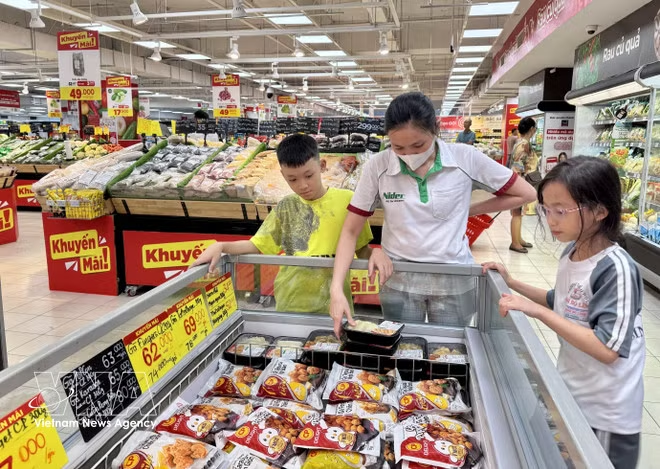
Urgent measures ramped up to stabilise market amid rising costs -0
Supermarkets in Ho Chi Minh City are actively increasing promotions and effectively implementing price stabilisation programmes amidst market fluctuations. (Photo: VNA)

Amid mounting pressure, the MoIT and local authorities are accelerating measures to stabilise the market. Management agencies stressed that the biggest risk is not only rising prices but also potential supply disruptions amid global uncertainties.

Key solutions include closely monitoring supply-demand developments, supporting businesses in connecting with logistics and e-commerce platforms to optimise costs, and maintaining market stabilisation programmes to prolong price stability.

At the local level, Nguyen Nguyen Phuong, Deputy Director of the Ho Chi Minh City Department of Industry and Trade, said the city will continue market stabilisation programmes, support trade promotion activities and help businesses share costs to sustain stable price levels.

Vinh Thanh Dat Food JSC, one of the leading producers and suppliers of clean poultry eggs in the southern region, has pledged to keep egg prices stable despite rising input costs, while rolling out promotional programmes.

Retailers are also taking proactive steps. Many large distribution systems have introduced price-lock programmes, large-scale promotions and expanded sourcing of domestic goods to ease cost pressures.

Saigon Co.op, for instance, has worked with suppliers to maintain reasonable prices for essential goods. From now until March 25, its supermarket network is offering discounts of up to 50% on around 1,000 products for daily consumption.

Similarly, MM Mega Market is implementing a price-lock programme for about 300 essential items through late March to minimise the impact of rising input costs on consumers.

Meanwhile, GO! hypermarkets are running a promotion campaign from March 12 to 25, offering discounts of up to 30% on fresh produce and meat, up to 27% on dairy and nutritional products, and up to 23% on ready-to-eat meals, alongside various buy-one-get-one and bulk discount offers.
VNA

Other News

SBV raises short-term capital lending cap to 40%

SBV raises short-term capital lending cap to 40%

The new circular will help credit institutions have more room to provide capital to businesses and investment projects to support high economic growth in the next few years, while increasing flexibility in the SBV’s monetary policy management.

Business confidence in Vietnam rebounds strongly: UOB

Business confidence in Vietnam rebounds strongly: UOB

The study found that 85% of Vietnamese enterprises reported positive business sentiment, a sharp increase from 48% in 2025, when business confidence was weighed down by uncertainties surrounding US tariff policies and related trade developments.

Bac Ninh seeks high-quality foreign investment for sustainable growth

Bac Ninh seeks high-quality foreign investment for sustainable growth

According to Vice Chairman of the provincial People’s Committee Pham Van Thinh, the province aims to maintain stable and sustainable growth, improve the competitiveness of both the economy and local businesses, and make better use of free trade agreements (FTAs) to expand and diversify export markets.

Green building trend flourishes in Ho Chi Minh City's real estate landscape

Green building trend flourishes in Ho Chi Minh City's real estate landscape

The International Finance Corporation (IFC) highlighted the city's dominance in green-certified building floor space in Vietnam, reflecting the rapid expansion of the green building market with 780 completed green buildings encompassing over 18.69 million sq.m by 2025, predominantly certified by EDGE and LEED.

UK supports Vietnam in wind power and green finance development

UK supports Vietnam in wind power and green finance development

The United Kingdom officially announced two new climate cooperation initiatives to support Vietnam in its energy transition and green growth journey. These programs focus on offshore wind power development and the creation of a sustainable green financial ecosystem.

Ample room remains for Vietnam–India logistics cooperation

Ample room remains for Vietnam–India logistics cooperation

The GTTCI expert noted that alongside logistics and integrated warehousing, e-commerce is expected to be a particularly high-growth sector in the coming years. He described it as a multi-billion-dollar market with significant untapped opportunities for cooperation between Vietnam and India.

Exports gain momentum from high-tech growth drivers

Exports gain momentum from high-tech growth drivers

According to the Ministry of Industry and Trade, Vietnam’s exports reached 215.66 billion USD in the first five months of 2026, up 19.5% year-on-year. Twenty-six export items generated more than 1 billion USD in revenue each, including seven with turnover exceeding 10 billion USD.

Vietnam–China crossings see spike in ASEAN fresh produce

Vietnam–China crossings see spike in ASEAN fresh produce

Since the start of the summer harvest season, China's two major border gates with Vietnam, Youyi Guan in Pingxiang and Beilun 2 Bridge in Dongxing, have entered their peak period for handling imports of fresh agricultural and seafood products from member states of the Association of Southeast Asian Nations (ASEAN).

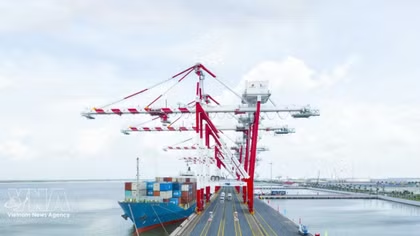
Cargo handling operations at Berths 3 and 4 of the Hai Phong International Gateway Port. (Photo: VNA)

AI reshapes logistics, raising bar for workforce skills

According to the Vietnam Logistics Business Association (VLA), the logistics sector will require around 2.2 million workers by 2030, including 1.6 million employees for logistics service providers and nearly 600,000 personnel supporting logistics operations in manufacturing and trading enterprises.

Robust dispute resolution framework key to Vietnam's IFC ambitions

Robust dispute resolution framework key to Vietnam's IFC ambitions

The development strategy for VIFC-HCMC envisions a comprehensive financial ecosystem encompassing green finance, carbon credits, financial technology (fintech), blockchain technology, digital assets, digital banking and other innovative business models. These highly internationalised sectors involve complex cross-border transactions and sophisticated legal structures.