 |
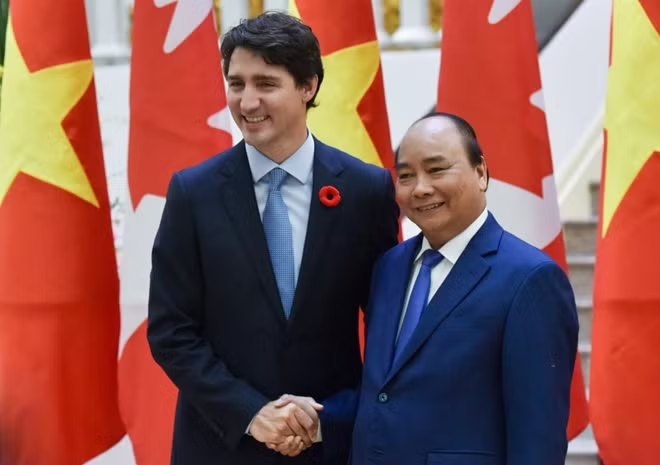
| Vietnamese PM Nguyen Xuan Phuc and his Canadian counterpart Justin Trudeau |
Q: Prime Minister Trudeau has invited you to attend the G7 Summit in Canada this June, one of the themes of which is climate change, oceans and clean energy. Since the international investment community sees Vietnam as one of the best growth areas in terms of renewables, could you please tell us how Vietnam aims to enable and support the development of and investment in clean energy and renewables? For example, Vietnam has large rare earth reserves. Could those be used to manufacture batteries that would back up solar energy production in Vietnam, and does Vietnam therefore have a plan to explore and extract these rare earth reserves?
A: Vietnam is blessed with immense potential for clean renewable energy development. The potential capacity of Vietnam’s wind energy is estimated at 500 – 1000 kWh/m2 per year, and its annual average hours of sunshine ranges from 2500 – 3000, at an average temperature above 21 degrees Celsius. The report released by the German Federal Enterprise for International Cooperation (GIZ) in June 2017 estimated the technical potential for wind and solar energy in Vietnam at 215,000 MW and 340,000MW, respectively. Furthermore, as a major producer of agricultural products, Vietnam is also rich in biomass. With such immense potential, Vietnam is well positioned to strongly develop renewable energy and gradually reduce the use of fossil fuels.
Vietnam has been implementing the Strategy of Renewable Energy Development to 2030, with a vision until 2050. Accordingly, Vietnam engages all of its social resources for investment in renewable energy development, encourages the development and use of renewable energy, and strives to raise the share of renewable energy in the national energy sector.
A number of concrete objectives in this Strategy are as follows: (i) reduce GHG emissions, as pledged under the Paris COP21 Agreement, by 5% by 2020 and, with international assistance and support, by 25% by 2030; (ii) further reduce the use of coal and petroleum products by 40 million tonnes and 3.7 million tonnes, respectively, by 2030; (iii) increase the electricity output produced by renewable sources from approximately 58 billion kWh in 2015 to 101 billion kWh by 2020, and 186 billion kWh by 2030; (iv) increase the rate of households owning solar energy equipment from 4.3% in 2015 to approximately 12% and 26% by 2020 and 2030, respectively; (v) increase the biofuel output to meet roughly 13% of the transportation demand by 2030.
To this end, the Vietnamese Government has put in place incentive mechanisms and policies with regards to land, taxation, pricing, guarantees and public-private partnerships (PPP) in order to promote investment from both within and outside the country into the development of renewable energy, including solar power projects. According to decisions by the Government, solar power projects (i) are eligible for import duty waivers for a number of items constituting the project's fixed assets; (ii) may be considered for exemption or reduction of land use fees, land rent, and water surface rent (ii) electricity tariffs can be adjusted with fluctuations of the VND/USD exchange rate. The Government is considering the possibility of adjusting the tariff for electricity produced from wind energy in order to encourage investment in the years ahead.
In addition to renewable sources, Vietnam is also blessed with mineral wealth, including rare earth. Vietnam ranks among the top three in the world with estimated reserves of more than 20 million tonnes of rare earth. We wish to cooperate in the research, development and transfer of advanced technologies in the mining and in-depth processing of rare earth in order to create high value-added and environment-friendly products. It is important that we do not pursue economic growth at the expense of the environment.
Q: On the subject of clean energy, how could strategic investment in renewables help Vietnam to both offset its falling oil and gas reserves and develop cleaner energy projection? And is Vietnam looking to therefore attract more investment from G7 countries, either in renewable energy or more generally? If so, how is Vietnam planning to do this?
A: The Vietnamese government has put in place mechanisms and policies to encourage investors from both within and outside of the country to invest and do business in renewable energy on the basis of harmonising the interests of the state, the investors and the community.
Vietnam is enjoying effective cooperation with many countries, including the G7 members, in the field of renewable energy development. In fact, the G7 countries are implementing major renewable energy projects in Vietnam. I can cite a few examples: the Mui Dinh wind power plant (total output 37.6 MW) worth VND 1,272 billion, developed by Germany's EAB; Tuy Phong wind power plant (output 30 MW) using German technologies; Phu Lac wind power plant (output 24 MW), using German and Danish technologies and finance.
We stand ready to cooperate with and facilitate all partners in this regard. I trust that the renewable energy market in Vietnam may offer immense opportunities for G7 investors, who have a strong financial position, and technological know-how and experience, to become strategic partners on the journey.