Vietnam holds advantages in race to attract EV investment: Indonesian newspaper

Vietnam has adopted a more comprehensive approach to developing its EV industry by maintaining long-term investment incentives, investing in industrial infrastructure, developing human resources, and gradually building a high-tech manufacturing ecosystem, according to a recent article on The Jakarta Post.

Jakarta (VNA) – Vietnam is emerging as an attractive destination for the electric vehicle (EV) industry thanks to its stable investment environment, consistent industrial policies, skilled workforce, and well-developed manufacturing ecosystem, according to a recent opinion article published by Indonesia's The Jakarta Post.
download-18.png
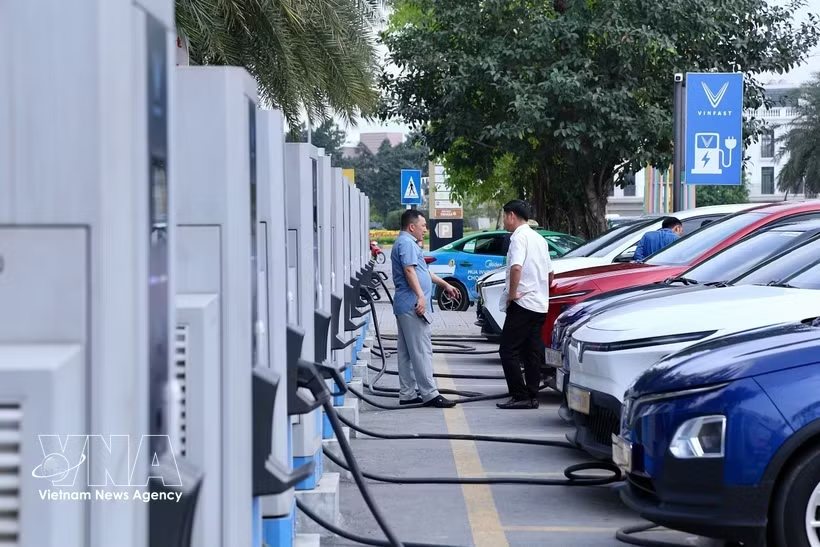
People charge their electric vehicles at a charging station in western Hanoi. (Illustrative photo: VNA)

In the commentary, the two authors – Victoria Fanggidae, Executive Director of the Indonesian policy research centre The PRAKARSA, and Yuanda Pangi Harahap, the centre's project coordinator, said Vietnam has adopted a more comprehensive approach to developing its EV industry by maintaining long-term investment incentives, investing in industrial infrastructure, developing human resources, and gradually building a high-tech manufacturing ecosystem.

They argued that the consistency and predictability of the country’s policies have strengthened investor confidence in making long-term investment decisions.

According to them, Vietnam has implemented a range of coordinated policies, including long-term corporate income tax incentives, import duty exemptions for components, and land rent reductions, while aligning these incentives with strategies to develop supply chains and train workers. This consistent approach has enabled domestic companies such as VinFast to grow rapidly while attracting increasing foreign direct investment to the EV sector and high-tech industries.

The article also highlighted human resources development as one of Vietnam's key strengths. The country's vocational training system has been expanded to meet business demand, with a particular focus on priority sectors such as EV, semiconductors, and high-tech manufacturing, helping satisfy the increasingly sophisticated requirements of global supply chains.
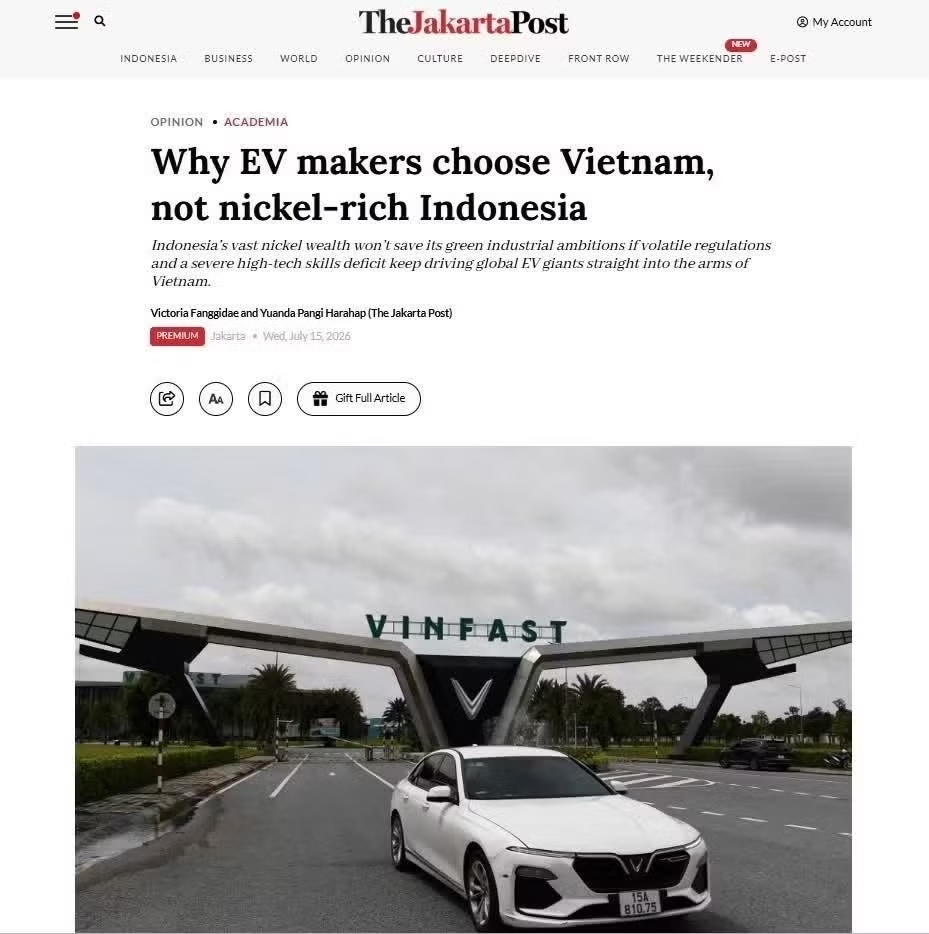
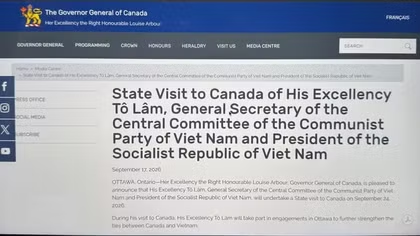
A screenshot of the opinion article published by Indonesia's The Jakarta Post.

Citing the Economic Complexity Index (ECI), the authors noted that Vietnam has improved its ranking from 69th to 45th over the past decade, reflecting its growing capability to manufacture products with higher technological content and greater added value.

They concluded that Vietnam's experience demonstrates that natural resources are only one aspect of competitive advantage. More importantly, the country has succeeded in building an industrial ecosystem based on stable policies, a high-quality workforce, and innovation capacity – factors that are strengthening Vietnam's appeal in the race to attract EV investment across Southeast Asia./.


VNA
en.vietnamplus.vn

Other News

Cambodia ranked world's top country for natural environment in 2026

Cambodia ranked world's top country for natural environment in 2026

Cambodia currently manages 73 protected natural areas covering more than seven million hectares, equivalent to about 41% of the country’s total land area. These protected areas play a vital role in forest conservation, wildlife habitat protection and biodiversity preservation through stricter law enforcement and conservation measures.

ASEAN chief spotlights Vietnam’s role in shaping bloc’s future

ASEAN chief spotlights Vietnam’s role in shaping bloc’s future

Vietnam is expected to maintain active contributions across ASEAN’s three pillars - the political-security community, the economic community, and the socio-cultural community; while further enhancing regional connectivity through infrastructure projects and stronger economic linkages.

Vietnam supports UNESCO's people-centred approach, multilateral cooperation: official

Vietnam supports UNESCO's people-centred approach, multilateral cooperation: official

Van affirmed Vietnam’s support for the UNESCO80 reform roadmap, focusing on the organisation’s core mandate, priority areas, interdisciplinary approach, and the special status of the Vietnam National Commission for UNESCO, and UNESCO representative offices, alongside efforts to diversify resources and strengthen global partnerships to enhance the organisation’s effectiveness.

Regional media highlight significant step in Vietnam’s leadership structure

Regional media highlight significant step in Vietnam’s leadership structure

Under General Secretary and President Lam’s leadership, Vietnam is expected to maintain a balanced foreign policy, strengthen its regional standing and accelerate economic development, thereby improving living standards and creating new opportunities for international investors, according to the India-based platform Devdiscourse.

Laos identifies 10 key tasks to build independent, self-reliant economy

Laos identifies 10 key tasks to build independent, self-reliant economy

Laos will step up agricultural production to ensure food security, meet domestic demand and expand exports; encourage the development of agro-processing industries, including those related to rubber, aquatic products, cassava and sugarcane, as well as fertiliser and animal feed production, in order to increase added value and create jobs in rural areas.

Malaysia steps up cyber security resilience

Malaysia steps up cyber security resilience

To ensure accountability, Malaysia plans to finalise the Cybercrime Bill this year which addresses both cyber-dependent and cyber-enabled offences, introducing stricter penalties and prison terms to enhance deterrence.