Russia-Vietnam economic relations in 2026 illustrate that the bilateral relationship is entering a more substantive phase, according to an-depth analysis recently published on the “Russia’s Pivot to Asia” website.
It said the important change is not simply that bilateral trade has recovered to reach almost 5 billion USD, it is that Moscow and Hanoi are increasingly building the infrastructure around trade. The central argument is straightforward: the next stage of Russia-Vietnam cooperation will be determined less by how much each side can export to each other, and more by how deeply Russian and Vietnamese companies can enter each other’s production and logistics chains.

Bilateral meetings that have just taken place this August provide unusually strong evidence of this shift. Specifically, two-way trade neared 4.77 billion USD in 2025, an increase of 4% from 2024. This trade is well balanced as Vietnam’s exports to Russia were worth around 2.26 billion USD, while imports from Russia reached about 2.51 billion USD.
In January-May, bilateral trade was around 2.16 billion USD, up 6.6%. The overall direction is clear: trade continues to expand, while Vietnam is Russia’s largest trading partner in ASEAN.
The commodity structure is highly complementary. Vietnam supplies Russia with coffee, textiles, seafood, cashews, pepper, rubber, footwear, mobile phones and processed food. Russia supplies Vietnam with oil and gas, coal, fertilisers, metals, machinery, chemicals and other industrial inputs.
The 2025 export figures demonstrated considerable potential. Vietnamese textile exports to Russia reached 504 million USD, or 22.3% of total Vietnamese exports to Russia, while coffee achieved 462.3 million USD, about 20%. Iron and steel exports surged 582.8%, coffee increased 51%, and footwear 43.4%, Yet the two Governments are aiming for 10 billion USD in two-way trade on the back of the Vietnam-Eurasian Economic Union Free Trade Agreement.
At the Vietnam-Russia Business Networking Conference in Ho Chi Minh City on August 5, the Ho Chi Minh City Supporting Industries Association already connected nearly 300 buyers and suppliers from the two countries. The meeting was not principally about selling Russian goods into Vietnam. It was increasingly about Russian companies finding Vietnamese manufacturing, distribution and technology partners.
In early 2026, Russia had about 220 projects worth 996 million USD in Vietnam, while Vietnam had around 18 projects valued at some 1.64 billion USD in Russia.
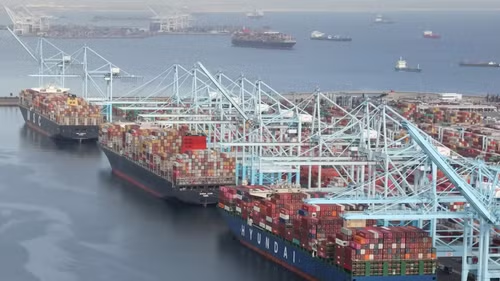
Goods transported between Russia and Vietnam reached some 688,300 tonnes in 2025, up 38% from 2024. On March 27, Russia’s Delo Group and Vietnam Maritime Corporation (VIMC) signed an MoU to develop maritime transport and logistics cooperation. Vietnam and Russia cooperate through the Organisation for Cooperation between Railways, maintain a permanent Vietnam Railways-Russian Railways mechanism and are developing a Vietnam-China-Russia inter-ministerial working group.
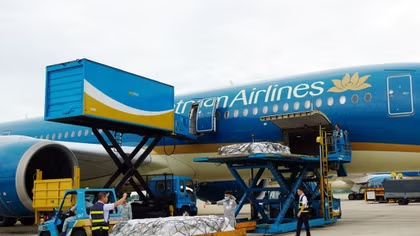
Eight airlines currently operate Vietnam-Russia routes, including two Vietnamese and six Russian carriers. During the first half of 2026, air traffic between the countries reached about 1.07 million passengers, up 32% year on year.
Vietnam welcomed over 863,000 Russian tourists during January-July, up 174% from the same period last year and more than double the 2019 figure. Russia has become Vietnam’s third-largest tourism source market overall and its largest European market, beating out even the traditional French market.
The industrial agenda is supported by energy cooperation. Russian companies, including Novatek and Zarubezhneft, continue to be associated with cooperation in LNG, oil and gas, while Moscow and Hanoi have agreed to cooperate in the Ninh Thuan 1 nuclear power project, intended to become a new symbol of bilateral strategic cooperation.
In closing, the article said the significance of 2026 is therefore structural. The relationship is moving from “Russia sells, Vietnam buys” toward “Russia and Vietnam build together”. The forthcoming 26th session of the Vietnam-Russia Intergovernmental Committee on Economic, Trade and Scientific-Technical Cooperation, expected to be held in Vietnam later this year will show whether this transition is becoming measurable in investment projects and contracts.