ASEAN+3 better positioned to weather energy shocks: report

In its ASEAN+3 Regional Economic Outlook (AREO) 2026, AMRO projected regional growth of 4.0% in both 2026 and 2027.
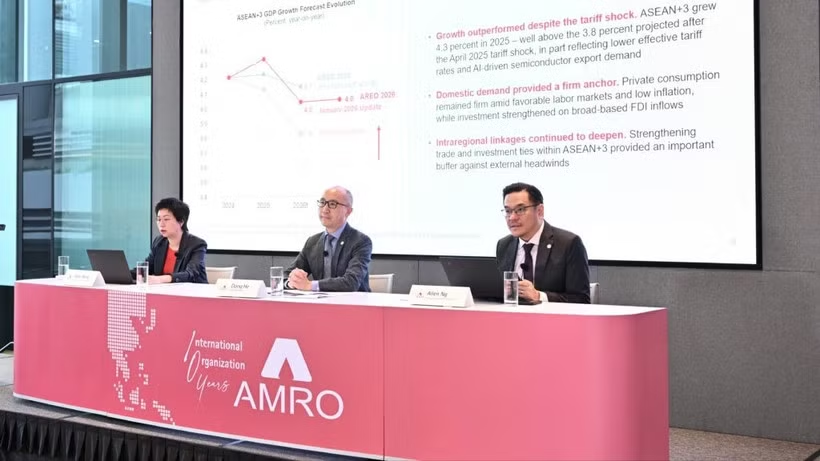
The ASEAN+3 region, which includes 11 ASEAN member states and China, Japan and the Republic of Korea, is better placed than in earlier episodes to navigate an energy shock, the ASEAN+3 Macroeconomic Research Office (AMRO) assessed in its annual flagship report released on April 6.

In its ASEAN+3 Regional Economic Outlook (AREO) 2026, AMRO projected regional growth of 4.0% in both 2026 and 2027.

ASEAN+3 better positioned to weather energy shocks: report -0
At the event to release the ASEAN+3 Regional Economic Outlook 2026. Photo: AMRO

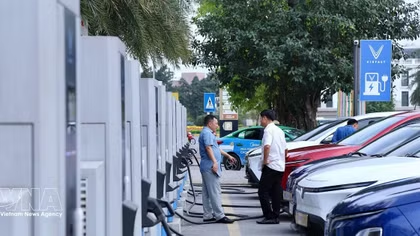
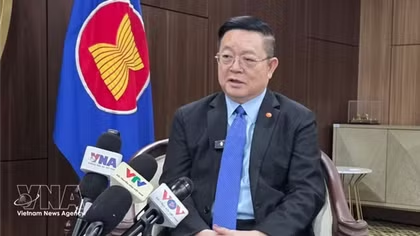
AMRO Chief Economist Dong He said that the region entered 2026 from a position of strength, but the Middle East conflict has shifted the balance of risks to the downside. However, it is better positioned to navigate an energy shock, as its economies are more energy-efficient and less oil-dependent, entered this period with low inflation, and most retain meaningful policy space to respond.

The region expanded by 4.3% in 2025, well above the 3.8% projected in the immediate aftermath of the April 2025 tariff shock. Economic activity remained supported by firm domestic demand, robust exports, boosted by AI-driven semiconductor demand, sustained investment, and strengthening intraregional economic linkages.

Amid higher global energy prices, AREO 2026 forecasts headline inflation to rise from 0.9% in 2025 to 1.4% in 2026 and 1.5% in 2027.

Dong He stressed that as the global economy is battered by one shock after another, preserving policy flexibility is critical to preventing worse outcomes such as stagflation.

Central banks should maintain orderly market conditions and financial stability, and act decisively should supply shocks lead to sustained inflation. On the fiscal side, governments should prioritise targeted support for vulnerable groups, while avoiding broad-based measures that could fuel inflation or undermine fiscal sustainability, he advised.

The report also highlights a fundamental structural transformation underpinning the region’s resilience. Over the past two decades, ASEAN+3 has become more regionally anchored, with denser and more interconnected production networks and a decisive shift toward intraregional sources of demand. The share of the region’s value-added exports to the US has declined from about one-third to 20%, while the share absorbed within the region has risen to nearly 30%.

ASEAN+3 is now the world’s largest market, accounting for 28% of global final demand.
VNA

Other News

Vietnam supports UNESCO's people-centred approach, multilateral cooperation: official

Vietnam supports UNESCO's people-centred approach, multilateral cooperation: official

Van affirmed Vietnam’s support for the UNESCO80 reform roadmap, focusing on the organisation’s core mandate, priority areas, interdisciplinary approach, and the special status of the Vietnam National Commission for UNESCO, and UNESCO representative offices, alongside efforts to diversify resources and strengthen global partnerships to enhance the organisation’s effectiveness.

Regional media highlight significant step in Vietnam’s leadership structure

Regional media highlight significant step in Vietnam’s leadership structure

Under General Secretary and President Lam’s leadership, Vietnam is expected to maintain a balanced foreign policy, strengthen its regional standing and accelerate economic development, thereby improving living standards and creating new opportunities for international investors, according to the India-based platform Devdiscourse.

Laos identifies 10 key tasks to build independent, self-reliant economy

Laos identifies 10 key tasks to build independent, self-reliant economy

Laos will step up agricultural production to ensure food security, meet domestic demand and expand exports; encourage the development of agro-processing industries, including those related to rubber, aquatic products, cassava and sugarcane, as well as fertiliser and animal feed production, in order to increase added value and create jobs in rural areas.

Malaysia steps up cyber security resilience

Malaysia steps up cyber security resilience

To ensure accountability, Malaysia plans to finalise the Cybercrime Bill this year which addresses both cyber-dependent and cyber-enabled offences, introducing stricter penalties and prison terms to enhance deterrence.

US public opinion positive about PM Pham Minh Chinh’s visit

US public opinion positive about PM Pham Minh Chinh’s visit

Public opinion in the US is generally positive about Vietnamese Prime Minister Pham Minh Chinh’s trip to the US from September 17-23 to attend the 78th session of the United Nations General Assembly, which took place immediately after the upgrading of the Vietnam - US relations to a comprehensive strategic partnership on the occasion of US President Joe Biden’s official visit to Vietnam.