Shangri-La Dialogue: Vietnam's vision praised as strategic, practical, forward-looking

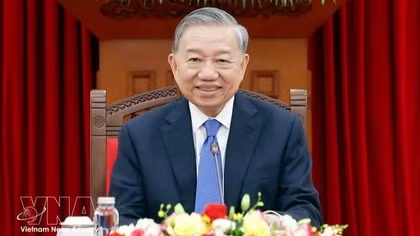
Associate Professor Dr. Neak Chandarith said General Secretary and President To Lam demonstrated a clear understanding of global challenges and presented a balanced voice that advocates sovereignty, equality and fairness for small and middle-sized nations amid an increasingly uncertain international environment.

Hanoi (VNA) – General Secretary of the Communist Party of Vietnam Central Committee and President of Vietnam To Lam’s keynote address at the 23rd Shangri-La Dialogue in Singapore has been widely praised for its strategic depth, practical approach and long-term vision for the region, according to a prominent Cambodian scholar who attended the event.

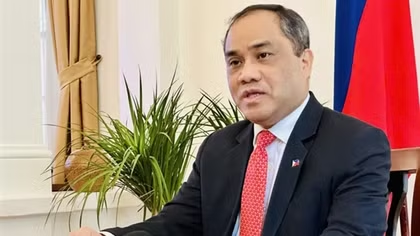
Associate Professor Dr. Neak Chandarith, Director of the Institute for International Studies and Public Policy (IISPP) at the Royal University of Phnom Penh (RUPP), stressed that it was the first time Vietnam’s Party and State leader had been invited to deliver a keynote address at the opening session of the Shangri-La Dialogue, one of the leading security forums in the Asia-Pacific and the world.

1-9412.jpg
Associate Professor Dr. Neak Chandarith, Director of the Institute for International Studies and Public Policy (IISPP) at the Royal University of Phnom Penh (RUPP), in an interview granted to the Vietnam News Agency. (Photo: VNA)

According to the Cambodian scholar, one of the most notable aspects of the speech was its representation of the perspectives and concerns of small and middle-sized countries. He said General Secretary and President Lam demonstrated a clear understanding of global challenges and presented a balanced voice that advocates sovereignty, equality and fairness for small and middle-sized nations amid an increasingly uncertain international environment.

Chandarith particularly agreed with the leader’s assessment that the world is currently facing three interconnected crises: a crisis of the international order, a crisis of development models and a crisis of strategic trust. These challenges, he noted, are placing growing pressure on smaller countries, making them more vulnerable to economic, technological and security-related pressures.

The scholar highlighted Vietnam’s emphasis on the importance of respecting international law, particularly the Charter of the United Nations and the 1982 United Nations Convention on the Law of the Sea (UNCLOS).

He also praised Vietnam’s focus on responsibly managing competition and preventing risks from emerging early and from afar. He noted that the Vietnamese leader proposed practical confidence-building measures, including early-warning mechanisms, emergency hotlines and incident-management procedures.

Regarding the East Sea issue, the Cambodian expert said Vietnam has consistently advocated the peaceful settlement of disputes in accordance with international law, particularly the 1982 UNCLOS, as well as the respect for the rights and legitimate interests of all parties. He added that Vietnam’s pragmatic approach to trust-building offers a valuable model for smaller countries seeking to prevent small misunderstandings from escalating into broader conflicts.

Held in Singapore from May 29 to 31, the 23rd Shangri-La Dialogue gathered more than 550 delegates from research institutions and defence and security agencies across 44 countries./.


en.vietnamplus.vn

Other News

ASEAN chief spotlights Vietnam’s role in shaping bloc’s future

ASEAN chief spotlights Vietnam’s role in shaping bloc’s future

Vietnam is expected to maintain active contributions across ASEAN’s three pillars - the political-security community, the economic community, and the socio-cultural community; while further enhancing regional connectivity through infrastructure projects and stronger economic linkages.

Vietnam supports UNESCO's people-centred approach, multilateral cooperation: official

Vietnam supports UNESCO's people-centred approach, multilateral cooperation: official

Van affirmed Vietnam’s support for the UNESCO80 reform roadmap, focusing on the organisation’s core mandate, priority areas, interdisciplinary approach, and the special status of the Vietnam National Commission for UNESCO, and UNESCO representative offices, alongside efforts to diversify resources and strengthen global partnerships to enhance the organisation’s effectiveness.

Regional media highlight significant step in Vietnam’s leadership structure

Regional media highlight significant step in Vietnam’s leadership structure

Under General Secretary and President Lam’s leadership, Vietnam is expected to maintain a balanced foreign policy, strengthen its regional standing and accelerate economic development, thereby improving living standards and creating new opportunities for international investors, according to the India-based platform Devdiscourse.

Laos identifies 10 key tasks to build independent, self-reliant economy

Laos identifies 10 key tasks to build independent, self-reliant economy

Laos will step up agricultural production to ensure food security, meet domestic demand and expand exports; encourage the development of agro-processing industries, including those related to rubber, aquatic products, cassava and sugarcane, as well as fertiliser and animal feed production, in order to increase added value and create jobs in rural areas.

Malaysia steps up cyber security resilience

Malaysia steps up cyber security resilience

To ensure accountability, Malaysia plans to finalise the Cybercrime Bill this year which addresses both cyber-dependent and cyber-enabled offences, introducing stricter penalties and prison terms to enhance deterrence.