Vietnam is more attractive than ASEAN-4 as a manufacturing alternative to China

Over the last decade, Vietnam has become a top destination for investment in manufacturing – more desirable than other Southeast Asian nations like the ASEAN-4 countries, according to tradefinanceglobal.com (TFG).

Accordingly, TFG pointed out overarching themes behind the reasons why Vietnam is more attractive to investors than the ASEAN-4 countries namely Indonesia, Malaysia, Thailand, and the Philippines.These are lower labor costs, simpler supply chain integration, better free trade access, and relative political stability.
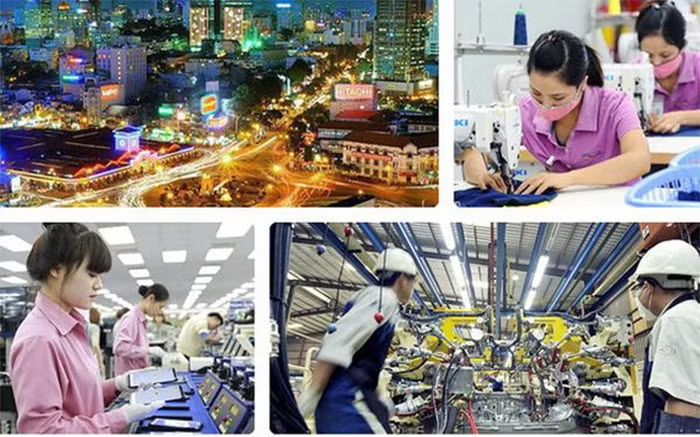
Vietnam is more attractive than ASEAN-4 as a manufacturing alternative to China -0
Vietnam is more attractive than ASEAN-4 as a manufacturing alternative to China.

While not the lowest in Southeast Asia, Vietnam’s average monthly wage is around one-third lower than wages in the ASEAN-4 nations, and around half of those in China, according to data from the National Wages and Productivity Commission.

For manufacturers whose labor costs can often comprise 20-30% of the total gross sales value of their finished goods, making use of low wages can lead to a significant business advantage.

Low wages are the top reason why Asia grew to become the world’s manufacturing hub in the latter half of the twentieth century and they are a large reason why so much manufacturing has moved to Vietnam in the last decade.

However, wages are not the only determinant of the decision on where to establish production. Firms also must consider factors like supply chain integration.

Incorporating Vietnamese producers into supply chains is relatively straightforward both upstream and downstream. In terms of upstream supply chains, it is near impossible for any Southeast Asian manufacturer to fully escape China’s gravitational field.

With over $3.8 trillion worth of manufacturing output per year comprising 28.7% of the global total, odds are that any manufacturer will be relying on Chinese components at some point in its upstream supply chain. 

Unlike the ASEAN-4 nations, Vietnam shares a border with China. This common border makes it easier for manufacturing firms in Vietnam to integrate into China’s vast network, reducing friction by eliminating the need for component parts to pass through multiple countries – potentially eliminating tariffs along the way.

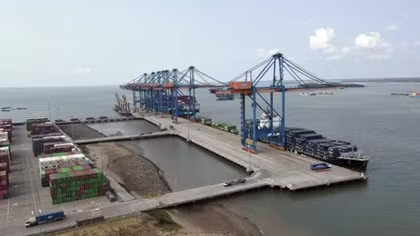
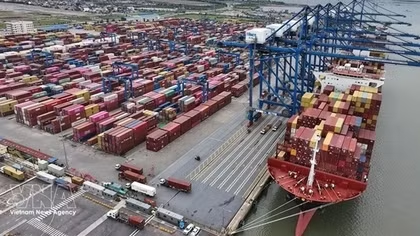
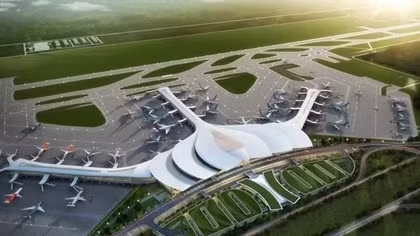
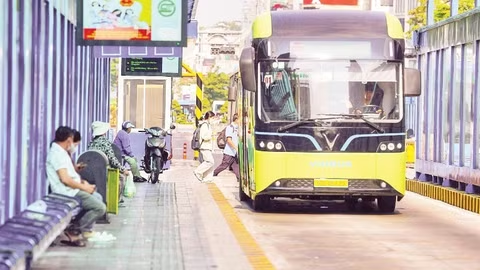
On the downstream side, incorporating Vietnam into the supply chain is also a relatively unencumbering process. This is because Vietnam is home to two international airports, several major ports, reliable power, and easy internet access.

In addition to this, since the country is small in geographic size, most suppliers are located close to an airport or major seaport. This makes it easy to get the finished goods from the factory floor and into the hands of waiting customers.

Being able to easily produce goods at a low cost is not the end of the story – businesses must also be able to sell these goods to customers and this often involves keeping prices low.

Relative to a lot of other Southeast Asian countries, Vietnam makes it very easy to sell domestically produced goods in other countries without unnecessary added costs.

This is because the country is party to 15 different free trade agreements that encompass more than 50 countries around the world.

Most notably, these include the EU-Vietnam Free Trade Agreement (EVFTA), the Comprehensive and Progressive Agreement for Trans-Pacific Partnership (CPTPP), the Regional Comprehensive Economic Partnership (RCEP), and the UK-Vietnam Free Trade Agreement (UKVFTA).

For manufacturers, this means that a good produced in Vietnam can be sold to other markets – including many wealthier western markets – without needing to pay prohibitively expensive tariffs along the way. 

Another reason why investors may lean more towards Vietnam rather than some of the ASEAN-4 nations is Vietnam’s relative security and political stability.

According to The World Bank’s index, Vietnam ranks well above many of its Southeast Asian peers, including three of the ASEAN-4 countries, in terms of political stability a lack of violence.

While none of these factors on their own may be particularly enticing for foreign investors, the combination of all four is clearly enough to make an impact. 

Vietnam has weathered the COVID-induced supply chain disruptions well, still being regarded as a key and growing manufacturing hub. 

As the government continues to strike free trade agreements around the world and invest in domestic transportation and communication infrastructure, Vietnam’s prominence as a rising manufacturing centre seems poised to continue to grow.
By TM

Other News

Private economic sector poised for breakthrough growth

Private economic sector poised for breakthrough growth

More than a year after the Politburo's Resolution No. 68-NQ/TW on private sector development came into effect, expectations now extend beyond increasing the number of enterprises. The goal is to build a stronger business community with greater resilience, larger ambitions and the capacity to compete in global supply chains.

Vietnam remains ASEAN growth leader in 2026 despite global headwinds: WB

Vietnam remains ASEAN growth leader in 2026 despite global headwinds: WB

Vietnam is expected to remain one of ASEAN’s fastest-growing economies in 2026, supported by resilient exports, strong investment inflows and an ambitious reform agenda, despite mounting global uncertainties, according to the World Bank’s latest Vietnam Economic Update released on May 15.

Ministry establishes monitoring framework for carbon market

Ministry establishes monitoring framework for carbon market

Under a new circular, the exchange of greenhouse gas emission quotas and carbon credits is conducted on the domestic carbon credit exchange through the carbon trading system, which is interconnected with the national registration system.

Biofuel ready for nationwide rollout

Biofuel ready for nationwide rollout

For biofuels, particularly E10, to develop successfully, stronger and more coordinated policies are needed, especially pricing mechanisms capable of creating a sufficiently attractive gap between E10 and mineral-based petrol, an expert has said.

Vietnamese farm produce promoted at African investment, trade forum

Vietnamese farm produce promoted at African investment, trade forum

The 12th Africa Forum for Investment & Commerce (AFIC 12) opened in Algiers, the capital of Algeria, on May 9, drawing around 2,000 participants, including officials, economists, businesses, financial and development organizagtions from 43 African countries and international partners, including Vietnam.

Int'l medical, pharmaceutical expo opens in Hanoi

Int'l medical, pharmaceutical expo opens in Hanoi

The exhibition, which runs until May 9 at the Hanoi International Centre for Exhibition, showcases advanced products and technologies across a range of fields, including pharmaceuticals, drug manufacturing machinery and equipment, medical devices, hospital and clinic services and dental equipment.

Mega projects to transform Ho Chi Minh City urban landscape

Mega projects to transform Ho Chi Minh City urban landscape

Leading the charge in this massive building spree is the new central city square in the core of the Thu Thiem new urban area. Spanning more than 20 ha, it’s the crown jewel of the Central Square and new administrative center complex.

Vietnam establishes itself as one of region’s most dynamic manufacturing and supply bases

Vietnam establishes itself as one of region’s most dynamic manufacturing and supply bases

The country’s stable political and economic environment provides a critical foundation for long-term sourcing strategies. At the same time, Vietnam has demonstrated a strong ability to scale up manufacturing, supported by a continuously expanding industrial base capable of meeting both high-volume demand and increasingly complex technical and quality requirements.

Vietnamese pomelos gain broader access to Australian market

Vietnamese pomelos gain broader access to Australian market

The update by Australia’s Department of Agriculture, Fisheries and Forestry to its Biosecurity Import Conditions system (BICON) on April 10, officially setting out import conditions for Vietnamese pomelos, is regarded as a major milestone in market access efforts.

Vietnam's industry spearheads transition to circular economy

Vietnam's industry spearheads transition to circular economy

The circular economy is no longer just a policy choice. It has become an inevitable trend for delivering sustainable and green growth, sharpening competitiveness at home and abroad, and meeting Vietnam’s net-zero emissions target by 2050. It is now a prerequisite to sustain long-term economic expansion, particularly in industrial production and supporting industries.

Nearly 100 tonnes of Vietnamese fruits, vegetables airlifted to UAE

Nearly 100 tonnes of Vietnamese fruits, vegetables airlifted to UAE

Vietnamese fresh produce and processed foods are increasingly recognised for their quality, with items such as cashew nuts, coffee and spices gaining popularity among Middle East consumers. In 2025, Vietnam’s farm produce exports to the UAE exceeded 445 million USD, up nearly 24% year-on-year.