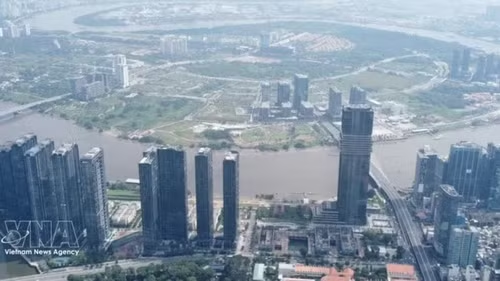
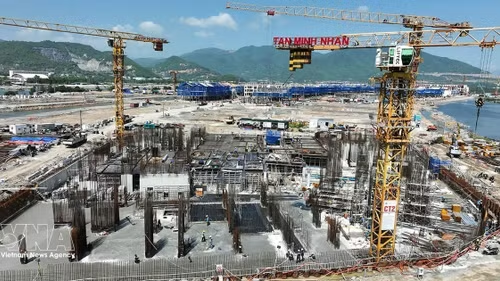
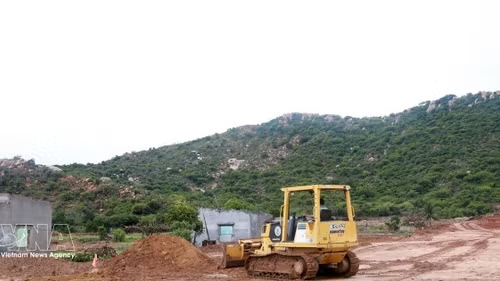
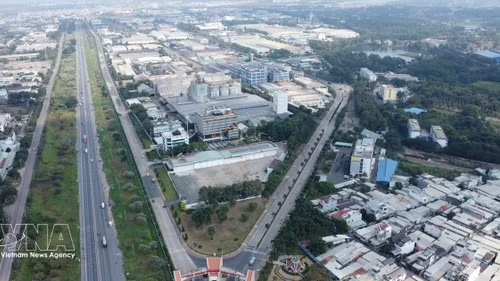
- Hanoi attracts 445 FDI projects
- Bac Ninh Industrial Park attracts US$455 million in FDI
- FDI-invested gypsum board plant inaugurated in Hai Phong
Though 2016 is still not over, experts forecast that FDI disbursement for the whole year will surpass that in 2015, making it the third consecutive increase year on year.
According to Chairperson Nguyen Mai of Vietnam's Association of Foreign Invested Enterprises, amidst reduced FDI registered capital, it is a good sign showing that FDI capital has brought about more practical benefits.
 |
This year’s FDI registered capital will not reach the set target and is expected to only reach a mere US$20-21 billion, thus not surpassing the figure of US$24 billion recorded in 2015. However, this figure should not be a major concern as it has always only remained a minor commitment.
If investors only commit to allocating money, then the figure is only on paper, having little significance to the economy. In reality, registered capital in some years has even reached US$72 billion but it was far away from the actual FDI disbursement.
For that reason, attracting “virtual” numbers has resulted in the fact that FDI registered capital to date has been up to US$300 billion but disbursement has only stood at US$160 billion.
Looking back over several years, FDI flows into Vietnam have seen a halt but also recorded positive changes as there has only been a minimal difference between registered and disbursed capital. In particular, FDI disbursement has increased strongly since 2014 and continuously maintained this trend since then.
It means that investors have kick-started their projects immediately when they received licences from local authorities. It also demonstrates tight management from the State administration over appraisal and approval of FDI projects.
Previously, FDI disbursement only fluctuated around the benchmark of US$11-12 billion. In 2014, the figure was at a high level of US$12.5 billion but was still significantly lower than the registered amount of US$22 billion. In 2015, disbursement increased to US$14.5 billion, narrowing the gap against registered capital at US$24.1 billion.
Notably, in the first 11 months of 2016, FDI disbursement reached US$14.3 billion, only US$4 billion less than FDI registered capital, up 8.3% against the same period last year.
In the last month of 2016, disbursement is expected to increase by US$2 billion, bringing the total up to US$16-17 billion, an increase of 13-14% year on year. The figure for 2017 is forecast to increase by 10% against 2016’s level.
Dang Xuan Quang, Deputy Head of the Foreign Investment Agency under the Ministry of Planning and Investment affirmed that the increased disbursement showed that FDI flows into Vietnam have developed sustainably, even recording breakthroughs.
On the contrary, the halted registered capital proved that the State has shifted attracting FDI flows from quantity to quality, with a focus on hi-tech and clean technologies. To date, the reality has shown that Vietnam has retained investors with long-term investment strategies in the country.
However, according to Vu Tien Loc, Chairman of the Vietnam Chamber of Commerce and Industry, the FDI sector has existed as an “oasis.” To facilitate links between the private sector and the FDI sector, it is important to upgrade small and medium sized enterprises.
2017 is forecast to be a difficult year for the business community due to the unstable future of Trans-Pacific Partnership Agreement, the anti-globalisation trend and the approaching Fourth Industrial Revolution.
Such factors could lead to a reversal in international trade and investment and affect emerging economies with high openness that consider exports and FDI as their main drivers of growth.
In that context, the requirement of pushing institutional renovation, attracting internal forces, facilitating the domestic private sector’s development and connecting the sector with a global value chain and the FDI sector is the key to sustainable development.
Over recent years, Vietnam has achieved success in attracting FDI but failed to create technological spillovers from the FDI sector and forge links between private and FDI sectors. These reasons partially stem from Vietnam’s weak linkage policies and inactiveness from FDI businesses in connecting with domestic ones.
Another issue is the role of the environment in investment projects that has become a costly lesson for not only the State and the society but also for enterprises. The environment and environmental protection are core conditions for sustainable development but such issues also cause concerns for the business community.
After previous environmental incidents, the business community has shown their support to the State’s policies on strengthening environmental protection during development. Enterprises that have violated environmental regulations should be punished with stiffer penalties. The government should also develop measures to realise commitments on ensuring credibility of the business investment environment.
This message is very important and also a source of great pressure, but everyone must follow the law while keeping faith in business and investment as it is a vital requirement for a healthy business environment.