Vietnamese stocks tipped for a sluggish week

Despite a strong rebound on November 3, Vietnamese shares are expected to remain sluggish this week given a lack of business information and market dependence on large-cap shares.
Despite a strong rebound on November 3, Vietnamese shares are expected to remain sluggish this week
Despite a strong rebound on November 3, Vietnamese shares are expected to remain sluggish this week 

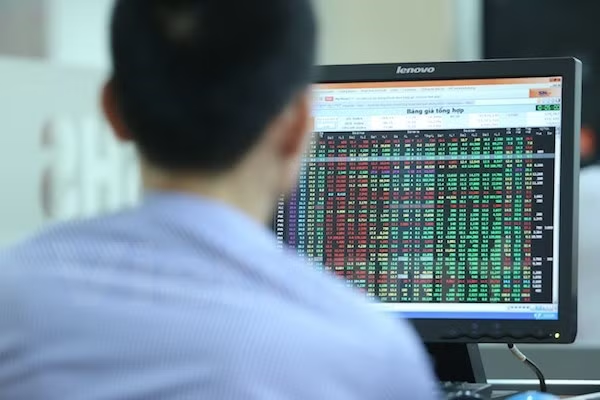
The benchmark VN Index on the HCM Stock Exchange (HOSE) rose 1.28 percent to finish November 3 at 843.73 points. It made a weekly gain of 0.4 percent.

The HNX Index on the Hanoi Stock Exchange rose 0.91 percent to end the trading week at 104.36 points. The northern market index dropped a total of 1.9 percent last week.

Each session saw an average of 206.3 million shares traded, worth 3.91 trillion VND (173.7 million USD).

The trading figures posted an increase of 4.1 percent in volume and 4.9 percent in value compared to the previous week.

Large-cap stocks remained the most influential factor on the market last week.

FLC Faros Construction (HOSE: ROS) was the large-cap share that created the strongest effects on the benchmark index.

The VN Index gained in three sessions and closed down in two, with gaining days alternating with losing days.

ROS also had the same movement, closing up a total 9.2 percent last week.

“The dependence on a particular stock means market sentiment is in higher risk of reversal if ROS loses steam,” Viet Dragon Securities Co (VDSC) said in a note.

In addition, November always lacks supportive information, forcing investors to be cautious.

According to Hoang Thach Lan, head of individual investor division at VDSC, the stock market had not reflected its true strength in the past two weeks.

“The indices posted either slight growth or decline, while share prices continued to fall and investors remained losers,” he told tinnhanhchungkhoan.vn last week.

The decline of the stock market suggested investors should start selling, which would send the indices lower, and triggered securities firms to make “margin calls” for investors that had taken big loans for investment, Lan said.

A margin call is a broker’s demand on an investor using margin to deposit additional money or securities so that the margin account is brought up to the minimum maintenance margin. Margin calls occur when the account value depresses to a value calculated by the broker’s particular formula.

An investor receives a margin call from a broker if one or more of the securities he had bought with borrowed money decreases in value past a certain point. The investor must either deposit more money in the account or sell off some of his assets.

According to VDSC, the total margin lending of all securities firms had reached about 36.15 trillion VND by September 30. The figure increased by 9.2 percent from the second quarter and 22 percent year on year.

Margin lending grew at the fastest in the second quarter of the year with a quarterly growth rate of 12 percent. Most brokerage firms took advantage of strong market performance in the first seven months to encourage investors to borrow more.

However, those firms began to tighten margin lending when the stock market showed signs of slower growth in August, with daily average trading liquidity falling from 4.36 trillion VND in the second quarter to around 3.9 trillion VND.

Margin calls are expected to push stocks down further, making the market continue to suffer.

In spite of negative impacts that margin calls could have on the market, it helps send stocks to lower price ranges that are attractive enough to boost bottom picking and liquidity, Lan said.

Low-priced stocks would help improve investor confidence and draw investment back to the market, boosting the indices after one gloomy week, he added.

In addition, Vietnam is hosting the APEC Economic Leaders’ Week, which takes place from today to November 11 and is expected to be good news for the stock market, Lan said.

“The APEC Economics Leaders’ Week could create a wave that supports the stock market,” he said. “People are looking for agreements and contracts that are signed between Vietnam and other APEC member economies, benefiting the country’s economy and businesses.”


VNA

Other News

Vietnam accelerates innovation to boost growth, competitiveness

Vietnam accelerates innovation to boost growth, competitiveness

By 2030, Vietnam aims to rank among the world’s top 40 in the GII; raise total social investment in R&D to at least 2% of GDP, with non-State funding accounting for over 60%; increase international scientific publications by an average of 10% annually; and raise the number of patent applications and granted patents by an average of 16-18% annually.

Vietnam sees high growth prospects

Vietnam sees high growth prospects

Experts from the Institute of Vietnam and World Economy under the Vietnam Academy of Social Sciences noted the quality of recent growth as the high growth rate has been recorded against an increasingly higher comparative base.

Vietnam seeks bigger share of global Halal market

Vietnam seeks bigger share of global Halal market

Vietnam's Halal exports remain modest at around 900 million USD a year, accounting for less than 1% of the global market. Most exports are still raw agricultural and seafood products. Only around 1,000–1,300 Vietnamese businesses obtained or maintained Halal certification during 2024–2026.

Hanoi sets up inter-agency mechanism to operate carbon market

Hanoi sets up inter-agency mechanism to operate carbon market

Under a decision of the municipal People’s Committee on establishing an inter-agency working group, departments and agencies are responsible for identifying facilities subject to greenhouse gas inventories, developing emissions-reduction plans and studying projects capable of generating carbon credits.

Shrimp exports reach 3.3 billion USD in eight months

Shrimp exports reach 3.3 billion USD in eight months

According to data from the Vietnam Customs cited by the Vietnam Association of Seafood Exporters and Producers (VASEP), shrimp exports reached 478.5 million USD in August, up 4.2% from the same month last year. The eight-month total stood at 3.3 billion USD, representing a year-on-year increase of 12%.

Russian investors explore opportunities in Vietnam's real estate market

Russian investors explore opportunities in Vietnam's real estate market

Vietnam is seen as a potential market, with considerable room for growth in real estate, particularly commercial property, compared with some regional markets. Strong Vietnam-Russia ties and opportunities to establish foreign-invested enterprises are also considered favourable for Russian investors.

Phu Quoc airport planning adjusted to serve APEC 2027

Phu Quoc airport planning adjusted to serve APEC 2027

For 2021-2030, the Civil Aviation Authority of Vietnam proposed bringing forward the investment in a parallel taxiway system and a connecting taxiway north of Runway No. 2 at Phu Quoc International Airport, in order to connect with the aircraft maintenance and repair facility (hangar) planned for the northern area of ​​the airport.

Policy, infrastructure emerge as new advantages in FDI attraction

Policy, infrastructure emerge as new advantages in FDI attraction

From policy and infrastructure to industrial real estate, Vietnam’s FDI advantages are broadening towards a more integrated production ecosystem, offering investors a stronger combination of conditions for high-value, technology-intensive and long-term projects.

Logistics upgrade vital to 1-trillion-USD trade target: experts

Logistics upgrade vital to 1-trillion-USD trade target: experts

As trade expands, systemic bottlenecks across transport networks, warehousing, ports, border gates, and industrial zones are becoming more apparent. Experts emphasise the need to shift from a fragmented, project-by-project approach toward strategic management structured around trade corridors and integrated supply chains.

Ample room for Vietnam, US to deepen cooperation

Ample room for Vietnam, US to deepen cooperation

Do Ngoc Hung, Trade Counsellor and head of the Vietnam Trade Office in the US, said what stands out is not only the growth in trade volume but also the increasingly deep economic ties between the two countries.

Flexible fiscal policy helps drive economic growth

Flexible fiscal policy helps drive economic growth

According to the Ministry of Finance, State budget revenue in the first eight months of 2026 was estimated at 2.02 quadrillion VND (77.7 billion USD), equivalent to 80% of the annual estimate and up 16% year-on-year. Domestic revenue reached 1.75 quadrillion VND, accounting for 86.6% of total revenue and rising 16.6%.

Electronic components are produced at a factory in Hanoi. (Photo: VNA)

Hanoi's imports surge 41% in first eight months of 2026

Hanoi aims to achieve average annual export growth of at least 12% during 2026-30, with the city seeking to diversify export markets, boost high-tech and value-added products and reduce reliance on traditional markets.