Vietnam's 100-year vision must reflect development aspirations: Top leader

The vision should answer major questions about what kind of developed nation Vietnam seeks to become, what foundations must be preserved, what new growth drivers should be cultivated, what breakthroughs are required, what risks the country must prepare for, and what values should be protected and promoted.

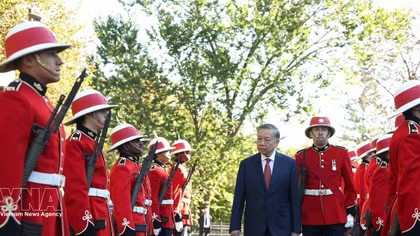
Hanoi (VNA) - Party General Secretary and State President To Lam on June 17 stressed that Vietnam’s development vision for 2030–2130 must continue to embody the nation’s aspirations for growth and prosperity, while being grounded in theory and practical experience and long-term strategic thinking.
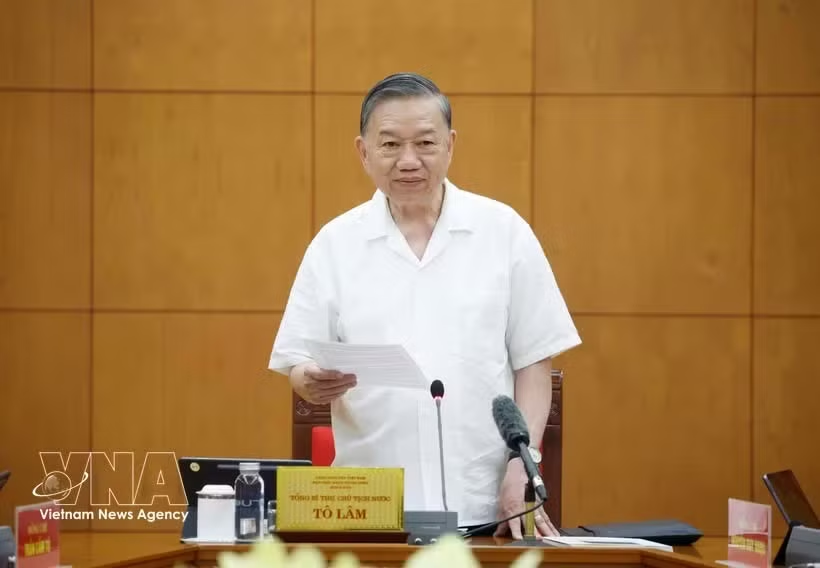
potal-tong-bi-thu-chu-tich-nuoc-to-lam-lam-viec-voi-thuong-truc-ban-chi-dao-tong-ket-100-nam-dang-lanh-dao-cach-mang-viet-nam-8832697-1.jpg
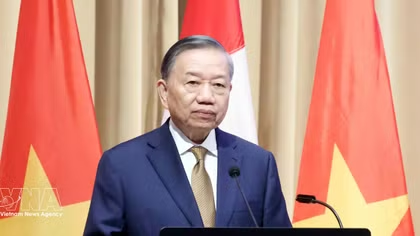
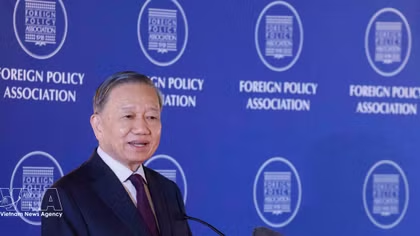
Party General Secretary and State President To Lam addresses the meeting (Photo: VNA)

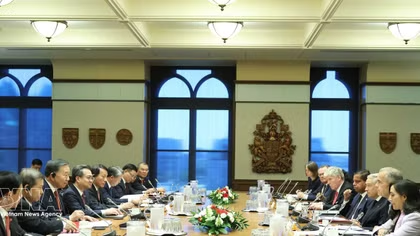
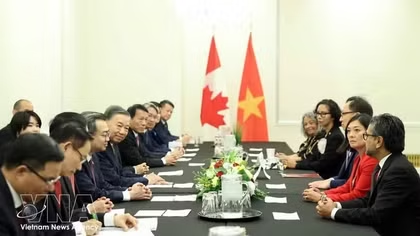
Chairing a meeting of the permanent members of the Steering Committee responsible for reviewing 100 years of the Communist Party of Vietnam’s leadership of the Vietnamese revolution (1930–2030), defining leadership orientations for the following century (2030–2130), and assessing 40 years of implementing the Platform for national construction during the transition to socialism, General Secretary and State President Lam, who heads the committee, highlighted the significance of the task.

He noted that despite limited time, a large workload and demanding political, theoretical and practical requirements, initial draft documents and detailed outlines had been completed, providing an important foundation for the next stages of work.

The leader urged the drafting team to fully incorporate feedback and continue refining the documents in a scientific, objective and responsible manner.

He emphasised that the review of 100 years of Party leadership is a task of exceptional importance and must be firmly grounded in historical truth.

However, he said, the exercise should go beyond recounting events or compiling a chronological record. More importantly, it should identify overarching lessons, key conclusions and enduring patterns that help explain Vietnam’s revolutionary path, the Party’s leadership role, the strength of the people and national unity, and the country’s future development trajectory.

According to the Party and State leader, the review must generate new insights and theoretical contributions beyond previous assessments. It should clarify how the Party’s theoretical understanding has evolved during the 1930–2030 period, what lessons have been elevated to a higher level of generalisation, what new theoretical issues have emerged, and what strategic orientations should guide the country’s development over the next 100 years.
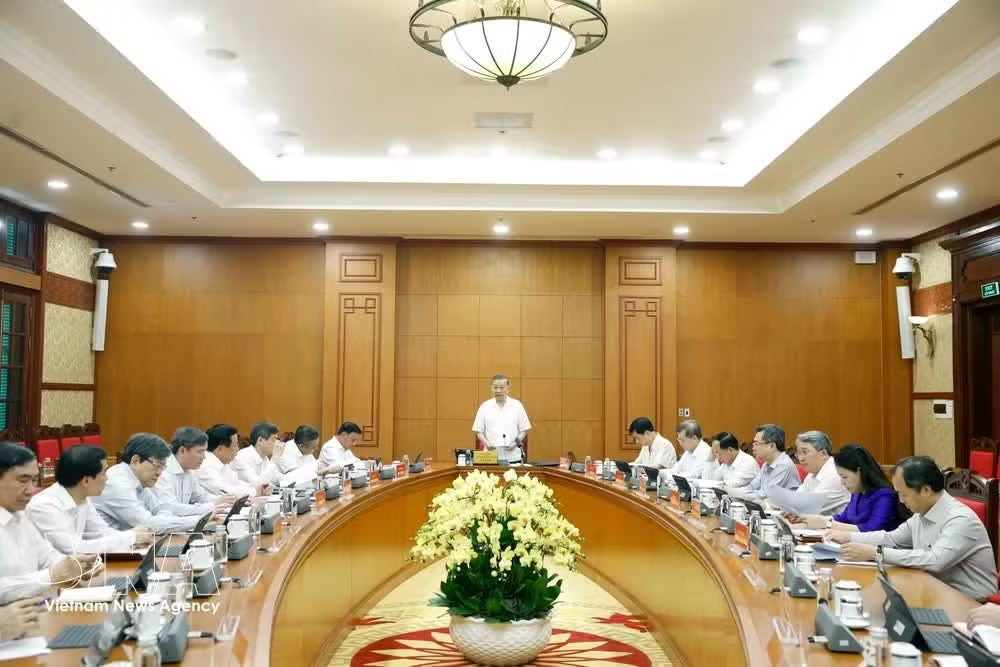
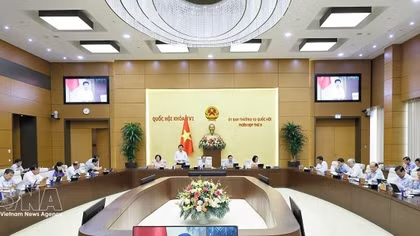
Party General Secretary and State President To Lam chairs the meeting of the permanent members of the Steering Committee responsible for reviewing 100 years of the Communist Party of Vietnam’s leadership of the Vietnamese revolution (1930–2030), defining leadership orientations for the following century (2030–2130), and assessing 40 years of implementing the Platform for national construction during the transition to socialism in Hanoi on June 17 (Photo: VNA)

He stressed the need for a clear articulation of the relationship between the review of 100 years of Party leadership and the assessment of 40 years of implementing the national development platform, stressing that the two processes are closely linked but should neither be treated separately nor merged in a way that obscures their distinct objectives.

The review of the platform’s implementation, he said, should be placed within the broader context of the Party’s century-long leadership, identifying which principles have been validated by practice, which require further refinement and which new issues demand theoretical innovation.

While highlighting achievements, it should candidly address shortcomings, limitations and unresolved challenges, drawing lessons from both successes and failures.

He called for a deeper examination of the fundamental factors that enabled the Party to lead the country to victories amidst difficult circumstances, and for the distillation of lessons with genuine theoretical and strategic value.

Particular emphasis, he said, must be placed on defining a long-term vision and development orientation for the next century.

“The vision for the next 100 years must continue to reflect the aspirations of the Vietnamese nation,” he said. It should answer major questions about what kind of developed nation Vietnam seeks to become, what foundations must be preserved, what new growth drivers should be cultivated, what breakthroughs are required, what risks the country must prepare for, and what values should be protected and promoted.

On implementation, the Party and State leader instructed review groups to work proactively and simultaneously rather than sequentially. Each group should establish clear plans, responsibilities, deadlines and coordination mechanisms.

He also stressed the importance of collecting and analysing historical documents, data and testimonies.

The process should draw on the knowledge and experience of researchers, scientists, experts, practitioners, historical witnesses, veteran revolutionaries and generations of leaders and managers, with the combination of archival records, witness accounts, academic research and practical experience, and effective use of domestic and international archives, existing research and specialised reviews, he underscored./.
en.vietnamplus.vn

Other News

Vietnam to remain active player in shaping ASEAN's future: minister

Vietnam to remain active player in shaping ASEAN's future: minister

Entering a new era of national development with the aspiration of building a strong and prosperous country, the mindset of "growing alongside ASEAN" will guide Vietnam’s more proactive, positive, and substantive contributions to the ASEAN Community and the co-creation of the region’s shared future, noted Minister of Foreign Affairs Le Hoai Trung.

Thailand's parliamentary leader concludes official visit to Vietnam

Thailand's parliamentary leader concludes official visit to Vietnam

Thailand attaches great importance to its Comprehensive Strategic Partnership with Vietnam, and the two countries share a solid foundation of friendship, many common strategic interests and significant potential for cooperation, said President of the National Assembly and Speaker of the House of Representatives of Thailand Sophon Zaram.

33rd Diplomatic Conference wraps up in Hanoi

33rd Diplomatic Conference wraps up in Hanoi

Foreign relations are no longer viewed simply as relations with the outside world but as an integral component of national comprehensive strength and a responsibility shared by the entire Party, people, armed forces and political system.

Vietnam, Laos step up cooperation in social sciences

Vietnam, Laos step up cooperation in social sciences

Against the backdrop of complex and rapidly evolving regional and international developments, cooperation in social sciences and political theory between the Vietnam Academy of Social Sciences and the Lao National Academy of Politics and Public Administration is expected to provide solid scientific evidence and databases to support the formulation of orientations, policies and strategies for socio-economic development.

Party Statutes must be practical, future-ready: Top leader

Party Statutes must be practical, future-ready: Top leader

Party General Secretary and State President To Lam said the current Party Statutes remain fundamentally valid but must also respond to emerging issues such as administrative apparatus restructuring, the two-tier local administration model, decentralisation, control over the exercise of power and digital transformation.

Politburo member and Permanent member of the Party Central Committee’s Secretariat Tran Cam Tu (centre) and leaders of the Ministry of Foreign Affairs at the plenary session on Party and people-to-people diplomacy on August 5, part of the 33rd Diplomatic Conference. (Photo: VNA)

Party, people-to-people diplomacy urged to contribute more effectively to national development

Party diplomacy has made breakthroughs in expanding and deepening relations with political parties around the world, helping consolidate political foundations and orient State-level relations. Meanwhile, people-to-people diplomacy has seen positive changes in its thinking, content and methods, with an expanding network of partners and more active and substantive participation in regional and international people-to-people mechanisms.

NA Chairman urges 'revolution' in legal information access

NA Chairman urges 'revolution' in legal information access

NA Chairman Tran Thanh Man said the requirement that “every citizen live and work in accordance with the Constitution and the law” remains hollow unless people can fully access, understand, and actually use the rules that govern their lives.

National Assembly approves Nguyen Tien Hai as Minister of Home Affairs

National Assembly approves Nguyen Tien Hai as Minister of Home Affairs

The NA held a secret ballot on the appointment and later adopted a resolution approving Nguyen Tien Hai as Minister of Home Affairs. The resolution was passed with 483 votes in favour out of 484 deputies participating in the electronic vote, accounting for 96.60% of those present.

Institutional reform key to unlocking new development model: experts

Institutional reform key to unlocking new development model: experts

Resolution No. 19-NQ/TW, adopted at the third plenum of the 14th Party Central Committee, identifies breakthroughs in institutions and reforms as the starting point for renewing Vietnam’s development model, alongside reforms in national governance, organisation and operations to build new development capacity.

Lawmakers discuss customs reform linked to digital transformation, risk management

Lawmakers discuss customs reform linked to digital transformation, risk management

Continuing the agenda of its ongoing first extraordinary session, the 16th National Assembly (NA) on August 3 heard proposals and verification reports on two bills, including the Law amending and supplementing several articles of the Law on Customs, and the Law revising Article 6 and Appendix IV on the list of conditional business lines under the Law on Investment.

First extraordinary session of 16th National Assembly opens

First extraordinary session of 16th National Assembly opens

The first extraordinary session of the 16th National Assembly (NA) kicked off in Hanoi on August 3, with lawmakers set to consider and decide on a series of items, including 15 draft laws, four draft normative resolutions and a range of major issues concerning national development.

Over 43,000 legal normative documents reviewed

Over 43,000 legal normative documents reviewed

As of July 30, ministries, agencies and localities had conducted a preliminary review of more than 43,000 legal normative documents nationwide, identifying provisions that need to be amended, supplemented, replaced or annulled.