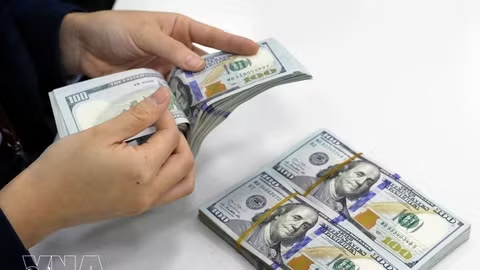
Vietnam needs a gradual sustainable increase in forex reserves, rather than a shocking increase as seen in the last two years, according to analysts.
The State Bank (SBV) report shows that by the end of the third quarter of 2017, the forex reserves had reached $45 billion, an increase of $6 billion over the end of 2016.
As such, SBV bought $11 billion in 2016 and $6 billion in the first nine months of the year.
 |
| The State Bank (SBV) report shows that by the end of the third quarter of 2017, the forex reserves had reached $45 billion, an increase of $6 billion over the end of 2016. |
The movements in the monetary market in the last two years explain why Vietnam’s forex reserves have been increasing rapidly.
First, Vietnam has joined a number of FTAs, both bilateral and multilateral, which gives foreign investors one more reason to relocate their production shops from China to Vietnam to take full advantage of tariff cuts.
This has helped FDI in Vietnam gain two-digit growth rates in recent years.
Second, SBV has been pursuing a policy on managing the exchange rate in accordance with market rules. Non-market exchange rate fluctuation is one of the risks that foreign investors are most concerned with.
Third, the government is speeding up the equitization of SOEs and divestment from enterprises in key business fields (electricity, banking, logistics and aviation), thus having attracted foreign portfolio investment capital flow.However, analysts say that cash abundance is always a ‘double-edged knife’.
The rapid increase of forex reserves means that a big amount of foreign currencies have been flowing into Vietnam, and that a large amount of dong has been pumped into circulation by the central bank.
With $17 billion inflowing into Vietnam from early 2016 to now, the dong/dollar exchange rate has been controlled, ensuring stability and support of exports.
The interbank interest rate has been maintained at a reasonably low level, while bank liquidity is high. These are all important factors that have prompted foreign investors to flock to Vietnam to seek opportunities.
However, analysts warned that the massive landing for foreign investors in Vietnam may also bring risks.
When Vietnam joined the WTO in 2007, it witnessed a wave of foreign investors flocking to the country.
This helped Vietnam’s GDP soar by 8.46 percent. However, this was associated with the high inflation rate, at 2-digit rate. The inflation rate climbed to a record high of 18.58 percent in 2011.
The finance market boom at that moment led to capital, both domestic and foreign, flowing to risky sectors such as real estate and securities. This caused a crisis with a huge amount of bank bad debts, which has still not been settled.
Vietnam’s forex reserves soared sharply in 2007 and 2014, but later fell rapidly.
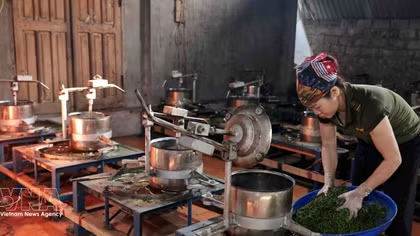
More than a year after the Politburo's Resolution No. 68-NQ/TW on private sector development came into effect, expectations now extend beyond increasing the number of enterprises. The goal is to build a stronger business community with greater resilience, larger ambitions and the capacity to compete in global supply chains.
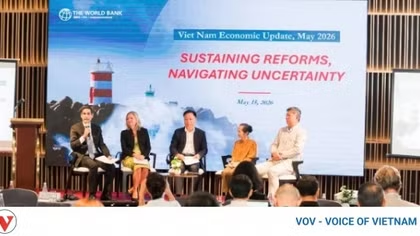
Vietnam is expected to remain one of ASEAN’s fastest-growing economies in 2026, supported by resilient exports, strong investment inflows and an ambitious reform agenda, despite mounting global uncertainties, according to the World Bank’s latest Vietnam Economic Update released on May 15.

Under a new circular, the exchange of greenhouse gas emission quotas and carbon credits is conducted on the domestic carbon credit exchange through the carbon trading system, which is interconnected with the national registration system.
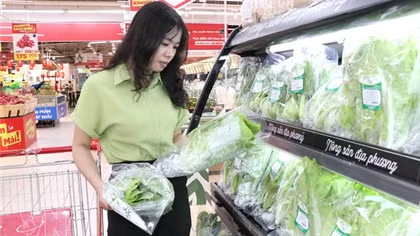
As many agricultural businesses continue to face challenges in finding stable outlets, modern retail systems are increasingly becoming key distribution channels helping Vietnamese products access the market more professionally.
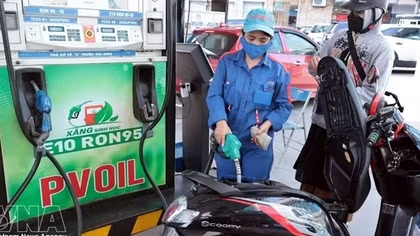
For biofuels, particularly E10, to develop successfully, stronger and more coordinated policies are needed, especially pricing mechanisms capable of creating a sufficiently attractive gap between E10 and mineral-based petrol, an expert has said.
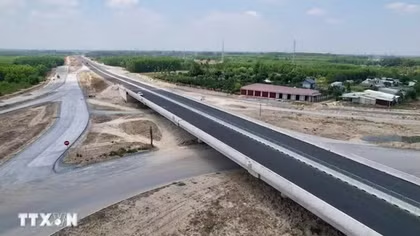
A recent PM directive set a May 10 deadline for ministries, agencies and localities to complete detailed allocations of the 2026 public investment capital plan.

A Party official has urged the Vietnamese business community to improve corporate governance, technological capacity, production standards, workforce quality and international connectivity to strengthen ties with the FDI sector.

The White Book provides a comprehensive overview of Vietnam’s current tax system in line with international practices, including direct taxes, indirect taxes and sector-specific levies.

The 12th Africa Forum for Investment & Commerce (AFIC 12) opened in Algiers, the capital of Algeria, on May 9, drawing around 2,000 participants, including officials, economists, businesses, financial and development organizagtions from 43 African countries and international partners, including Vietnam.
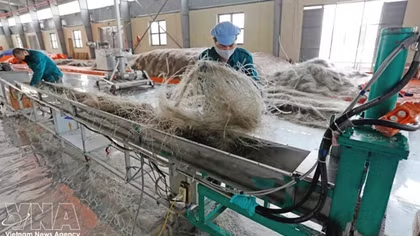
According to Dr. Bui Thanh Minh, Deputy Director of the Office of the Private Economic Development Research Board under the Prime Minister’s Advisory Council for Administrative Procedure Reform, Resolution 68 has helped foster a stronger entrepreneurial spirit through a series of concrete policy measures.
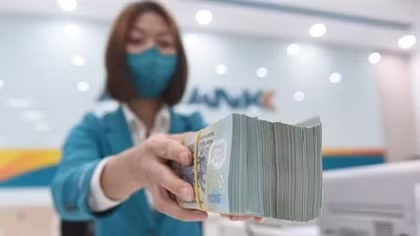
Consolidated first-quarter 2025 statements from Vietcombank, VietinBank and BIDV showed that the Treasury’s total deposit balance at the three lenders rose by nearly 39% compared with the end of 2025.

Vietnam targets 1 million one-person businesses, 5 million business entities, 10,000 tech startups, 45 startup support networks, a position among the world’s top 40 innovation ecosystems, and 1.5 billion USD in venture capital by 2030.

The exhibition, which runs until May 9 at the Hanoi International Centre for Exhibition, showcases advanced products and technologies across a range of fields, including pharmaceuticals, drug manufacturing machinery and equipment, medical devices, hospital and clinic services and dental equipment.
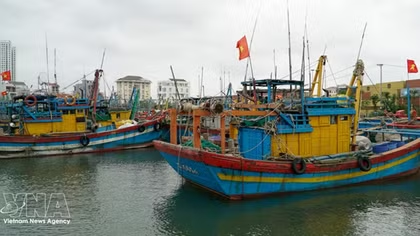
The province is tightening maritime governance, with a focus on May–June 2026 to finalise a more robust legal framework and close loopholes for illegal fishing.
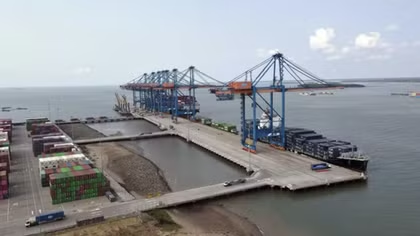
Leading the charge in this massive building spree is the new central city square in the core of the Thu Thiem new urban area. Spanning more than 20 ha, it’s the crown jewel of the Central Square and new administrative center complex.
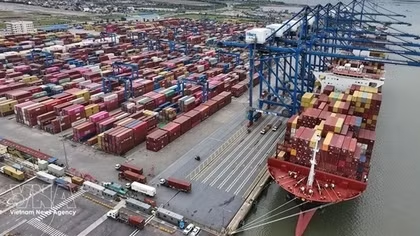
The country’s stable political and economic environment provides a critical foundation for long-term sourcing strategies. At the same time, Vietnam has demonstrated a strong ability to scale up manufacturing, supported by a continuously expanding industrial base capable of meeting both high-volume demand and increasingly complex technical and quality requirements.
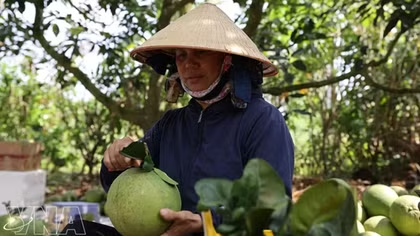
The update by Australia’s Department of Agriculture, Fisheries and Forestry to its Biosecurity Import Conditions system (BICON) on April 10, officially setting out import conditions for Vietnamese pomelos, is regarded as a major milestone in market access efforts.
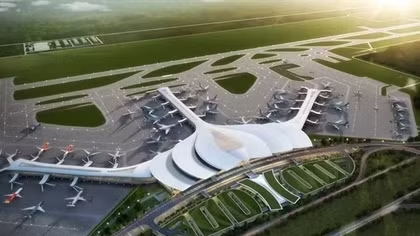
Structured in two steps and three phases, the roadmap envisions a gradual shift from partial to full relocation of international flights, aligned with infrastructure readiness and the long-term ambition of building a regional aviation hub.
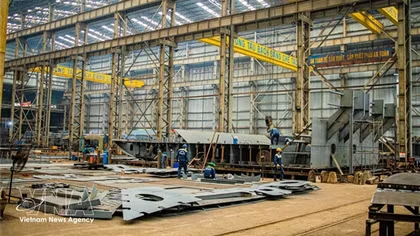
The circular economy is no longer just a policy choice. It has become an inevitable trend for delivering sustainable and green growth, sharpening competitiveness at home and abroad, and meeting Vietnam’s net-zero emissions target by 2050. It is now a prerequisite to sustain long-term economic expansion, particularly in industrial production and supporting industries.

Vietnamese fresh produce and processed foods are increasingly recognised for their quality, with items such as cashew nuts, coffee and spices gaining popularity among Middle East consumers. In 2025, Vietnam’s farm produce exports to the UAE exceeded 445 million USD, up nearly 24% year-on-year.