Integrity, vision and adaptability essential for representatives
At a discussion on the role of voters’ ballots in shaping a new era, organised by Dai Bieu Nhan Dan (People’s Representative) Newspaper, Tran Van Lam, a full-time member of the National Assembly’s Committee for Deputies’ Affairs, said the legal criteria for National Assembly deputies remain unchanged under current legislation, specifically Article 22 of the Law on the Organisation of the National Assembly.
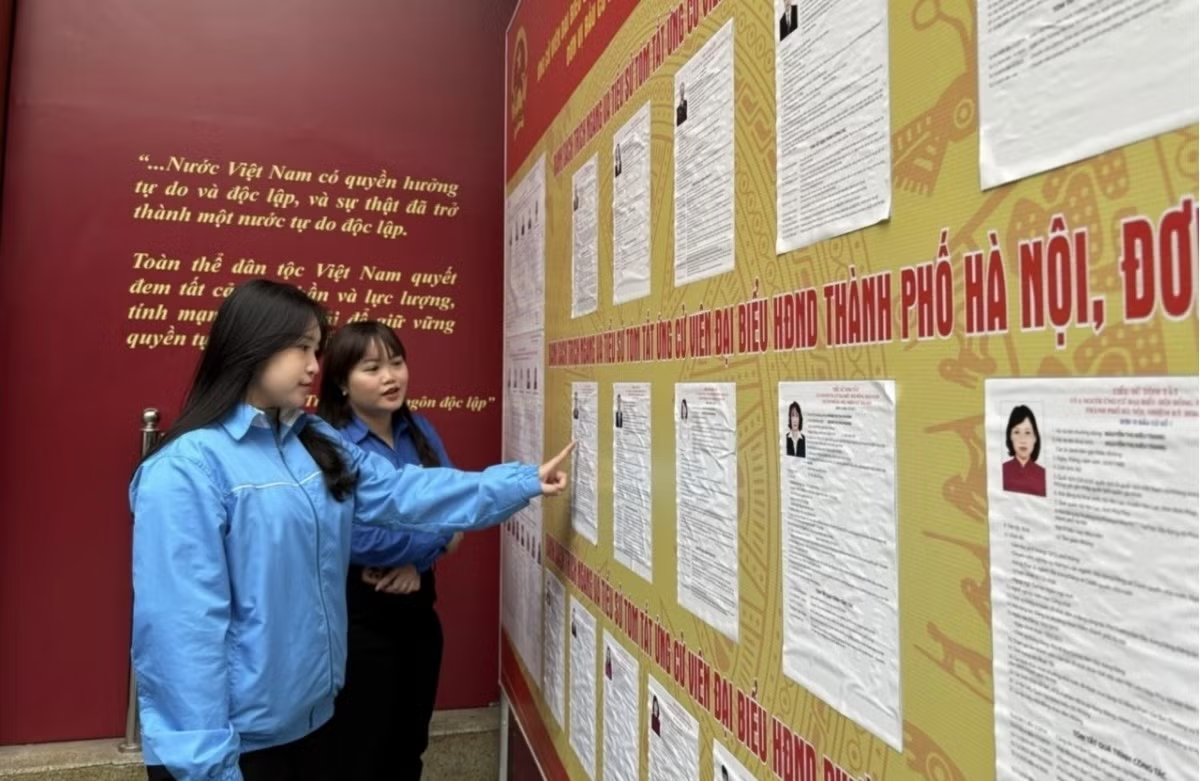
According to the law, deputies must be loyal to the Fatherland, the people and the Constitution and hold only Vietnamese citizenship. They must possess good moral qualities - diligence, thrift, integrity and impartiality- along with sufficient education, professional knowledge, work experience, health and public credibility to carry out their duties. Deputies are also required to maintain close ties with the people and have the conditions necessary to take part in the activities of the National Assembly.
Lam noted that in the current context of digital transformation, voters are increasingly concerned about the ability of deputies to handle issues arising in the digital era. This includes the capacity to formulate policy in a rapidly changing technological environment, understand major trends shaping the digital economy and digital society, and contribute to developing and refining legal frameworks and policies suited to the country’s development needs.
Another important requirement is the ability to use digital tools in parliamentary work, such as operating specialised software, using digital platforms to communicate and interact with voters, filtering information from online sources and ensuring information security when carrying out legislative, supervisory and decision-making tasks.
“These criteria do not replace traditional values but clarify them further, helping voters choose representatives who combine strong political commitment and moral integrity with innovative thinking and the ability to adapt to the country’s development needs in the new period,” Lam said.
At another discussion titled “Ensuring the quality of deputies in a new development era,” Nguyen Van Phuc, former vice chairman of the National Assembly’s Economic Committee, said each deputy should meet five key requirements: political vision to contribute to major national decisions; solid professional knowledge and expertise; practical experience; the skills needed to turn vision and expertise into concrete outcomes such as laws, resolutions or high-quality supervisory reports; and the confidence to debate and persuade fellow deputies.
According to Professor Phan Xuan Son, former senior lecturer at the Ho Chi Minh National Academy of Politics, professionalism among both full-time and part-time deputies needs to be strengthened. Regardless of their status, deputies must work in a professional manner, express clear views and take responsibility for their duties.
Another issue concerns the structure of deputies. Citizens currently have several channels to nominate candidates at the local level, including through the Vietnam Fatherland Front, socio-political organisations and professional associations. However, the quality of some self-nominated candidates remains uneven, making the consultative process an important step in screening nominees.
The current consultative process is conducted in three stages. Over the long term, further study is needed to refine this mechanism so that it operates more substantively and avoids formality.
“In the current context, as the country enters a new phase of development with rapid changes, deputies must possess long-term vision, capability and responsibility to meet the nation’s development requirements,” Son said.
Public supervision supports credible election
Lam said that for an election to be genuinely democratic, transparent and conducted in accordance with the law, a strong legal framework must go hand in hand with effective public supervision.
Vietnam’s election legislation already sets out clear principles for democratic voting, including universal suffrage, equality, direct voting and secret ballots. The law regulates each stage of the process, from consultation and nomination of candidates to voter registration, campaigning, polling, vote counting and the announcement of results.
It also assigns responsibilities for supervision and inspection to institutions involved in the election process at different levels, with mechanisms in place to guide, monitor and handle violations if they arise.
Alongside the legal framework, social supervision plays a crucial role in safeguarding transparency and objectivity. The Vietnam Fatherland Front, socio-political organisations, media outlets and other relevant bodies all participate in supervising different stages of the election process in accordance with the law.
Most importantly, the participation of voters themselves serves as a key safeguard to ensure that the election is conducted openly and reflects the will of the people.
“When the legal framework is implemented strictly and social supervision is exercised effectively, each ballot becomes not only a civic right but also a responsible choice for the country’s future development, demonstrating the genuine democratic value of the election,” Lam said.
According to Dr. Tran Van, a former National Assembly deputy of the 12th and 13th terms, ensuring a democratic and transparent election requires close coordination between a comprehensive legal framework and an effective system of social supervision.
He said the current legal framework governing elections has been largely completed, providing the basis for a unified and lawful process from candidate nomination to the organisation of voting. For these regulations to work effectively in practice, however, public supervision plays a crucial role.
In this process, the Vietnam Fatherland Front plays a central role in organising and supervising elections, collecting opinions from voters at candidates’ places of residence and workplaces, and organising meetings where voters can comment on and evaluate candidates’ action programmes.
These steps help ensure that candidates meet the required standards and enjoy public trust before being nominated. In addition, the media, inter-agency supervisory teams and voters themselves monitor different stages of the process, from reviewing candidate dossiers and conducting consultation rounds to overseeing campaign activities.
Another notable development is the expansion of consultation and supervision activities to the commune and ward levels, bringing the process closer to voters. Supervisory methods have also evolved, combining traditional approaches with digital tools to detect and address potential violations more quickly.
“Thanks to the combination of a solid legal framework, multi-layered supervision and the active participation of social organisations and voters, the election process is becoming more transparent and more closely aligned with the will of the people. This provides an important foundation for selecting deputies who truly deserve the trust of voters,” Tran Van said.