World Bank urges Vietnam to overhaul agriculture sector

'Lead less and facilitate more' was the message directed at the government.

Vietnam has emerged from a poor country in the last two decades where the government used to ration rice and other staples to a lower middle-income nation.

The country’s success, however, has come at a price, said the World Bank in its newly released Vietnam Development Report 2016, titled “Transforming Vietnamese Agriculture: Gaining More from Less”.

“The country’s agricultural output is exacting a price on the environment,” Ousmane Dione, World Bank’s Country Director for Vietnam, said at a press conference Tuesday in Hanoi.
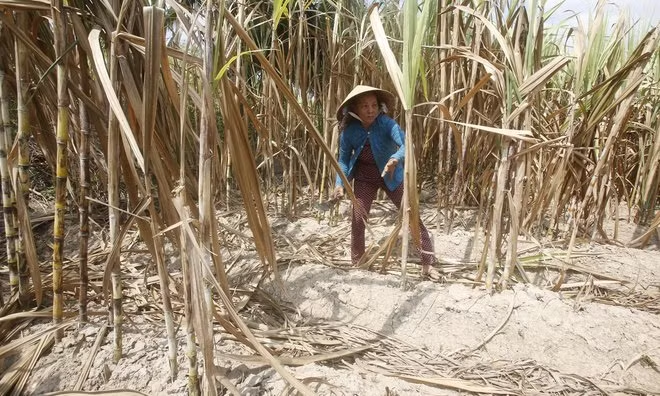
A farmer harvests dried sugarcane on her drought-stricken farm in Soc Trang Province in the Mekong Delta in Vietnam. Photo by Reuters/Kham

“'Business-as-usual' is no longer an option for the sector–growth has slowed down, it is vulnerable to climate hazards, and leaves a large environmental footprint,” he added.

The Vietnamese government has been consistent with agricultural intensification to achieve its food security targets as well as to boost profits from export earnings in the short term, said Steve Jaffee, the World Bank’s lead agricultural economist.

Vietnam is a relatively heavy user of fertilizer and pesticides. The report estimated that Vietnamese rice farmers use more than 6.7 million tons of fertilizer per year. To put the figure into perspective, the use of fertilizer in Vietnam is from 30–200 percent higher than in other Southeast Asian countries.

Pesticide use in Vietnam has increased sharply since the mid-2000s when the government encouraged more intensive production. Frequent spraying of crops has contributed to growing concerns about pesticide residue. Due to past violations, various Vietnamese products entering developed markets including the U.S. and the European Union are now subject to more frequent sampling and testing.

Vietnam has tolerated some environmental consequences to keep up the momentum of its agricultural sector, and policies have been primarily geared towards expanding output in order to meet food security, economic growth and trade targets.

However, things have not turned out the way they were expected.

Statistics show that between 1994 and 2000, the average rate of annual growth of Vietnam’s agriculture sector was an impressive 4.5 percent. Between 2001 and 2007 the average growth rate fell to 3.3 percent per year, and from 2008 to 2013, it dipped to 2.6 percent.

In the first half of this year, the agriculture sector took a hard hit from the worst drought and saltwater intrusion in nearly a century, said the Ministry of Agriculture and Rural Development, indicating the sector recorded negative growth of 0.18 percent.

Most of Vietnam's agricultural trade is in the form of raw commodities, typically sold at prices lower than those of leading competitors due to quality, said Jaffee.

According to the World Bank’s report, Vietnam’s agriculture sector is at a turning point.

“It’s now not the matter of choice. It’s the matter of must,” said Henning Pederson, the International Fund for Agricultural Development’s Country Director for Vietnam, saying Vietnam cannot afford to wait any longer for agricultural reform.

Higher production volume naturally requires more farm land

In an attempt to transform the sector, Vietnam should increase its investment in the sector that contributes 25 percent of the country’s GDP and employs 35 percent of the total workforce, said Nguyen Do Anh Tuan, the director of the Institute of Policy and Strategy for Agriculture and Rural Development.

Official figures show currently only 5-6 percent of Vietnam’s total investment goes to the agricultural sector, and only about 1 percent of foreign direct investment is flowing into the sector, Tuan said.

He added that large-scale farming and well-developed infrastructure are the best way of drawing foreign investors into the agricultural sector.

The government can also play a crucial role by combining fragmented farmland and developing infrastructure, he said.

Experts and economists at the press conference proposed several solutions to transforming the agricultural sector. And the solution, agreed by all, was to call on the government to “lead less and facilitate more”.

VnExpress

Other News

Private economic sector poised for breakthrough growth

Private economic sector poised for breakthrough growth

More than a year after the Politburo's Resolution No. 68-NQ/TW on private sector development came into effect, expectations now extend beyond increasing the number of enterprises. The goal is to build a stronger business community with greater resilience, larger ambitions and the capacity to compete in global supply chains.

Vietnam remains ASEAN growth leader in 2026 despite global headwinds: WB

Vietnam remains ASEAN growth leader in 2026 despite global headwinds: WB

Vietnam is expected to remain one of ASEAN’s fastest-growing economies in 2026, supported by resilient exports, strong investment inflows and an ambitious reform agenda, despite mounting global uncertainties, according to the World Bank’s latest Vietnam Economic Update released on May 15.

Ministry establishes monitoring framework for carbon market

Ministry establishes monitoring framework for carbon market

Under a new circular, the exchange of greenhouse gas emission quotas and carbon credits is conducted on the domestic carbon credit exchange through the carbon trading system, which is interconnected with the national registration system.

Biofuel ready for nationwide rollout

Biofuel ready for nationwide rollout

For biofuels, particularly E10, to develop successfully, stronger and more coordinated policies are needed, especially pricing mechanisms capable of creating a sufficiently attractive gap between E10 and mineral-based petrol, an expert has said.

Vietnamese farm produce promoted at African investment, trade forum

Vietnamese farm produce promoted at African investment, trade forum

The 12th Africa Forum for Investment & Commerce (AFIC 12) opened in Algiers, the capital of Algeria, on May 9, drawing around 2,000 participants, including officials, economists, businesses, financial and development organizagtions from 43 African countries and international partners, including Vietnam.

Int'l medical, pharmaceutical expo opens in Hanoi

Int'l medical, pharmaceutical expo opens in Hanoi

The exhibition, which runs until May 9 at the Hanoi International Centre for Exhibition, showcases advanced products and technologies across a range of fields, including pharmaceuticals, drug manufacturing machinery and equipment, medical devices, hospital and clinic services and dental equipment.

Mega projects to transform Ho Chi Minh City urban landscape

Mega projects to transform Ho Chi Minh City urban landscape

Leading the charge in this massive building spree is the new central city square in the core of the Thu Thiem new urban area. Spanning more than 20 ha, it’s the crown jewel of the Central Square and new administrative center complex.

Vietnam establishes itself as one of region’s most dynamic manufacturing and supply bases

Vietnam establishes itself as one of region’s most dynamic manufacturing and supply bases

The country’s stable political and economic environment provides a critical foundation for long-term sourcing strategies. At the same time, Vietnam has demonstrated a strong ability to scale up manufacturing, supported by a continuously expanding industrial base capable of meeting both high-volume demand and increasingly complex technical and quality requirements.

Vietnamese pomelos gain broader access to Australian market

Vietnamese pomelos gain broader access to Australian market

The update by Australia’s Department of Agriculture, Fisheries and Forestry to its Biosecurity Import Conditions system (BICON) on April 10, officially setting out import conditions for Vietnamese pomelos, is regarded as a major milestone in market access efforts.

Vietnam's industry spearheads transition to circular economy

Vietnam's industry spearheads transition to circular economy

The circular economy is no longer just a policy choice. It has become an inevitable trend for delivering sustainable and green growth, sharpening competitiveness at home and abroad, and meeting Vietnam’s net-zero emissions target by 2050. It is now a prerequisite to sustain long-term economic expansion, particularly in industrial production and supporting industries.

Nearly 100 tonnes of Vietnamese fruits, vegetables airlifted to UAE

Nearly 100 tonnes of Vietnamese fruits, vegetables airlifted to UAE

Vietnamese fresh produce and processed foods are increasingly recognised for their quality, with items such as cashew nuts, coffee and spices gaining popularity among Middle East consumers. In 2025, Vietnam’s farm produce exports to the UAE exceeded 445 million USD, up nearly 24% year-on-year.