Worship of Kitchen Gods - beautiful custom of Tet

Worshipping “Ong Cong, Ong Tao” (Land Genie and Kitchen Gods) is a long-standing custom of great significance as it symbolises the farewell to all bad things of the old year to help people relaxedly enter a new year of peace and happiness.

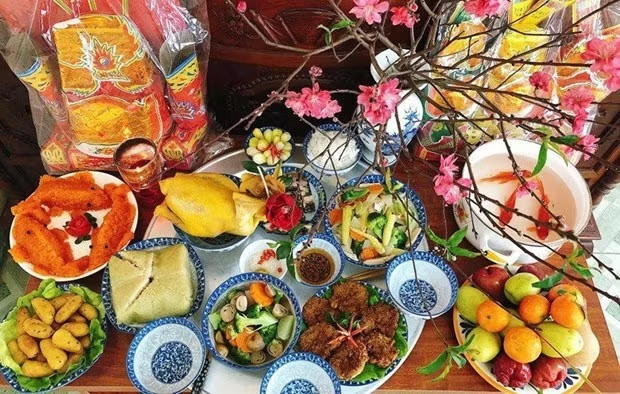
Offerings to the Land Genie and Kitchen Gods on the 23rd day of the 12th lunar month (Photo: laodong.vn)

Offerings to the Land Genie and Kitchen Gods on the 23rd day of the 12th lunar month (Photo: laodong.vn)

The Land Genie and Kitchen Gods worshipping ritual is held on the 23rd day of the 12th lunar month, which falls on January 25 this year. It is also considered the start of the Lunar New Year (Tet) festival - the biggest and most important traditional holiday for Vietnamese.

As the legend goes, “Ong Cong” (Land Genie) is the one in charge of land while “Ong Tao” (Kitchen Gods), consisting of two males and one female, are those who keep a watch over kitchen affairs of a family. They take note of a family’s issues in a year and will ride carps back to the Heaven on the 23rd day of the 12th lunar month to report all the good and bad things of that family to the God of Heaven.

Given this, Vietnamese people believe that the Land Genie and Kitchen Gods are decisive to the good or bad luck and blessing for their families.

Besides, people also view the image of a carp swimming upstream and then leaping over the falls to turn into a dragon as a symbol of steadfastness in surmounting challenges to secure success.
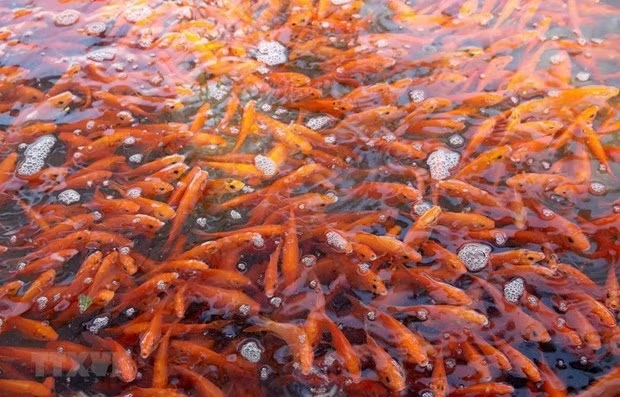
Golden carps farmed in Thuy Tram village of Tuy Loc commune, Cam Khe district (Phu Tho province), to serve the worship of the Land Genie and Kitchen Gods

Golden carps farmed in Thuy Tram village of Tuy Loc commune, Cam Khe district (Phu Tho province), to serve the worship of the Land Genie and Kitchen Gods

Wishing for good luck in the new year, people hold a ceremony on the 23rd day of the 12th lunar month to send off the Land Genie and Kitchen Gods to the Heaven. Rituals are not necessarily complicated but need to be solemn and show the family’s sincerity.

Rituals and offerings vary according to region. Typically, apart from lamps, incense, votive papers, fresh flowers, and a five-fruit tray, there is also a tray of traditional dishes such as steamed sticky rice, chicken, pork pie, fried spring rolls, and bamboo shoot soup. However, depending on each family’s conditions, people can also prepare vegetarian dishes as offerings.

The offerings also include a set of votive paper clothes and, especially, golden carps - the “vehicle” for the gods to return to the Heaven. People often prepare two or three live carps and then release them into a river or lake after the worshipping ritual with the belief that the fish will carry the gods to the Heaven. Nowadays, live carps can also be replaced with paper ones, which will be burned together with other paper offerings after the ritual.

The worshipping ceremony is conventionally held at any times from the noon of the 22nd day of the 12th lunar month to the noon of the next day because people believe the gods will leave for the Heaven after midday and thus, if the ritual is conducted after that, they would be unable to receive offerings.

With the appropriate practice of the Land Genie and Kitchen Gods worship, people can help uphold and pass down traditional cultural values in the modern life.
VNA

Other News

Vietnam secure berth at FIFA U17 World Cup 2026 for first time

Vietnam secure berth at FIFA U17 World Cup 2026 for first time

Vietnam national U17 football team secured a place at the FIFA U17 World Cup 2026 for the first time after defeating United Arab Emirates national U17 football team 3-2 on in the final Group C match of the AFC U17 Asian Cup 2026 in Saudi Arabia on early May 14 (Vietnam time).

Vietnam’s most beautiful railway station twins with French counterpart

Vietnam’s most beautiful railway station twins with French counterpart

A twinning agreement between Da Lat Railway Station in Vietnam and Trouville-Deauville Railway Station in France was signed at the French Embassy in Vietnam on May 7, creating new opportunities for cooperation in station management and operations, as well as cultural and tourism promotion between the two sides.

Hanoi gains two more craft villages in World Crafts Cities network

Hanoi gains two more craft villages in World Crafts Cities network

The recognition of Chuyen My and Son Dong craft villages as members of the World Crafts Cities network represents international acknowledgement of the cultural value, artisanal techniques, creativity and sustainable vitality of Vietnam’s traditional craft villages, he said.

Thang Long - Hanoi Festival 2026 to return in September

Thang Long - Hanoi Festival 2026 to return in September

Co-hosted by the municipal People’s Committee, the Department of Culture and Sports, and domestic and foreign agencies, the whole spectacle is meant to honour the city’s millennia-old heritage while reafffirming its strategy of establishing culture as a development engine.

Spreading Vietnamese cultural identity in digital space

Spreading Vietnamese cultural identity in digital space

In the context of deep international integration, cultural identity serves as both a “shield” against assimilation and a defining marker of a nation’s image. Protecting and promoting uniquely Vietnamese cultural values has therefore become a pressing task, particularly in an increasingly complex digital environment.

ITE HCMC 2026 to promote Vietnam’s tourism on global map

ITE HCMC 2026 to promote Vietnam’s tourism on global map

With its large scale, the ITE HCMC 2026 aims to promote tourism cooperation between Vietnam and priority markets such as Northeast Asia, Western Europe, North America, Southeast Asia, and Oceania while also boosting visitor arrivals from the Indian market

Vietnamese puppetry seeks renewal amid preservation challenges

Vietnamese puppetry seeks renewal amid preservation challenges

Although widely regarded as a cultural “speciality” attracting tourists, Vietnamese puppetry is facing multiple challenges in preservation and development, requiring renewed efforts to both safeguard its identity and adapt to contemporary cultural currents.

Project on digital transformation in cultural sector approved

Project on digital transformation in cultural sector approved

By 2030, the project targets the establishment of shared digital platforms across 100% of cultural sectors. All digitised cultural heritage will be standardised under the national data framework and shared in accordance with regulations, while 80% of public digital heritage assets are expected to receive digital identifiers to clarify ownership and management, encouraging organisations and individuals to do the same and support market development.

Vietnam eyes becoming region’s leading tourism destination

Vietnam eyes becoming region’s leading tourism destination

Vietnam has in recent years undergone a notable transformation in its tourism development strategy, placing a strong emphasis on nature-based and eco-tourism. This shift is not merely aligned with global trends, but represents a necessary step towards safeguarding valuable natural resources, while appealing to a growing segment of environmentally conscious travellers.