Armenian, Azeri forces clash again, at least 21 reported killed

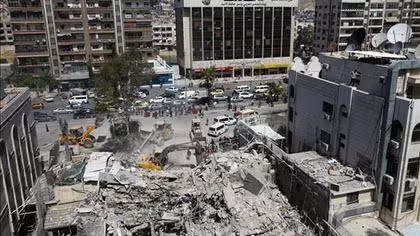
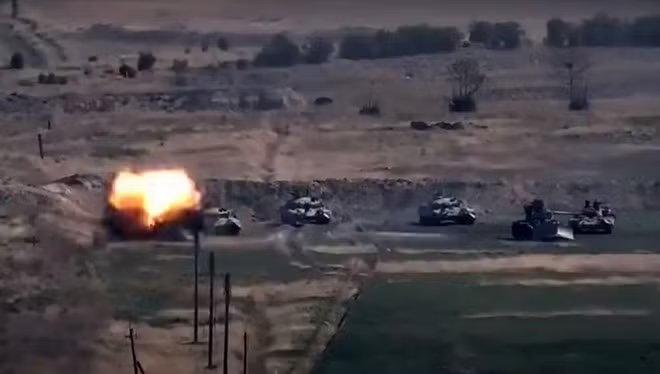
Armenian and Azeri forces exchanged fierce fire for a second day on Monday over the territory of Nagorno-Karabakh, with the sides accusing each other of using heavy artillery amid reports of at least 21 deaths and hundreds of people being wounded.

The clashes between Armenia and Azerbaijan, the heaviest since 2016, have rekindled concern over stability in the South Caucasus region, a corridor for pipelines carrying oil and gas to world markets.
Armenian, Azeri forces clash again, at least 21 reported killed ảnh 1
Armenian, Azeri forces clash again, at least 21 reported killed

The two former Soviet republics have clashed periodically in a decades-long conflict over Nagorno-Karabakh, a breakaway region that is inside Azerbaijan but is run by ethnic Armenians.

Azerbaijan’s president declared a partial military mobilisation, and his foreign minister said six Azeri civilians had been killed and 19 injured since the fighting began. Interfax news agency quoted an Armenian defence ministry representative as saying 200 Armenians had been wounded.

Nagorno-Karabakh reported that 15 more of its soldiers had been killed. It had said on Sunday 16 of its servicemen had been killed and more than 100 wounded after Azerbaijan launched an air and artillery attack.

Nagorno-Karabakh also said it had recovered some territory that it had lost control of on Sunday, and said Azerbaijan had been using heavy artillery to shell areas.

Azerbaijan’s defence ministry said Armenian forces were shelling the town of Terter.

China and Russia urged both sides to show restraint.

The clashes have spurred a flurry of diplomacy to defuse the reignited tensions between majority Christian Armenia and mainly Muslim Azerbaijan. Russia called for an immediate ceasefire and another regional power, Turkey, said it would support Azerbaijan, its traditional ally.

Armenia’s ambassador to Russia said on Monday Turkey had sent around 4,000 fighters from northern Syria to Azerbaijan, Interfax news agency reported, an accusation denied by Baku.

Under international law, Nagorno-Karabakh is recognised as part of Azerbaijan. But the ethnic Armenians who make up the vast majority of the population reject Azeri rule.

They have run their own affairs, with support from Armenia, since Nagorno-Karabakh broke away from Azerbaijan in a conflict that erupted as the Soviet Union collapsed in 1991.

Although a ceasefire was agreed in 1994, after thousands of people were killed and many more displaced, Azerbaijan and Armenia frequently accuse each other of attacks around Nagorno-Karabakh and along the separate Azeri-Armenian frontier.

Pipelines shipping Caspian oil and natural gas from Azerbaijan to the world pass close to Nagorno-Karabakh.

At least 200 people were killed in a flare-up of the conflict between Armenia and Azerbaijan in April 2016. At least 16 people were killed in clashes in July.
Reuters

Other News

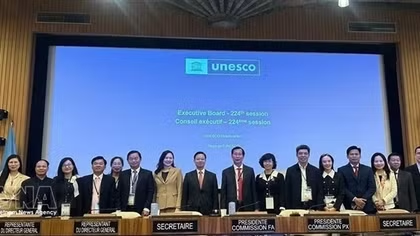
Vietnam supports UNESCO's people-centred approach, multilateral cooperation: official

Vietnam supports UNESCO's people-centred approach, multilateral cooperation: official

Van affirmed Vietnam’s support for the UNESCO80 reform roadmap, focusing on the organisation’s core mandate, priority areas, interdisciplinary approach, and the special status of the Vietnam National Commission for UNESCO, and UNESCO representative offices, alongside efforts to diversify resources and strengthen global partnerships to enhance the organisation’s effectiveness.

Regional media highlight significant step in Vietnam’s leadership structure

Regional media highlight significant step in Vietnam’s leadership structure

Under General Secretary and President Lam’s leadership, Vietnam is expected to maintain a balanced foreign policy, strengthen its regional standing and accelerate economic development, thereby improving living standards and creating new opportunities for international investors, according to the India-based platform Devdiscourse.

Laos identifies 10 key tasks to build independent, self-reliant economy

Laos identifies 10 key tasks to build independent, self-reliant economy

Laos will step up agricultural production to ensure food security, meet domestic demand and expand exports; encourage the development of agro-processing industries, including those related to rubber, aquatic products, cassava and sugarcane, as well as fertiliser and animal feed production, in order to increase added value and create jobs in rural areas.

Malaysia steps up cyber security resilience

Malaysia steps up cyber security resilience

To ensure accountability, Malaysia plans to finalise the Cybercrime Bill this year which addresses both cyber-dependent and cyber-enabled offences, introducing stricter penalties and prison terms to enhance deterrence.

US public opinion positive about PM Pham Minh Chinh’s visit

US public opinion positive about PM Pham Minh Chinh’s visit

Public opinion in the US is generally positive about Vietnamese Prime Minister Pham Minh Chinh’s trip to the US from September 17-23 to attend the 78th session of the United Nations General Assembly, which took place immediately after the upgrading of the Vietnam - US relations to a comprehensive strategic partnership on the occasion of US President Joe Biden’s official visit to Vietnam.