Army stands firmly under Party’s leadership: top leader

The Vietnam People’s Army (VPA) has always served as the core force to, together with the Party and the people, achieve splendid accomplishments in national liberation and construction and defence throughout its 75-year history, Party General Secretary and President Nguyen Phu Trong has said.

In an article published on the occasion of the 75th founding anniversary of the VPA (December 22, 1944), the Party and State leader stressed that those accomplishments were the results of multiple factors, of which the Communist Party of Vietnam (CPV)’s comprehensive, absolute and sound leadership is a decisive one.

Trong, who is also Secretary of the Central Military Commission, said the Party has flexibly applied Marxism-Leninism and President Ho Chi Minh’s thought to build a new-style army that suits the specific situation in Vietnam. The Party also affirmed the inevitable need to turn the army into the key force in the cause of national liberation and defence.
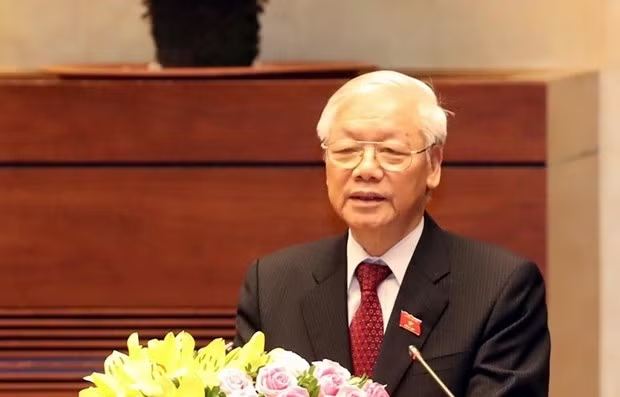
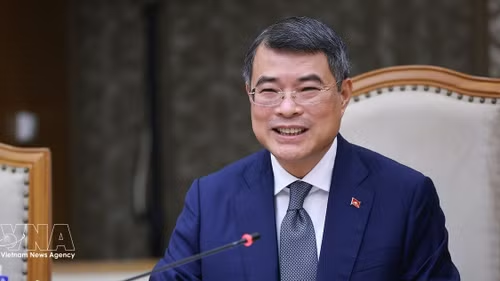
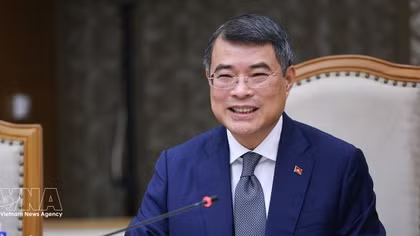
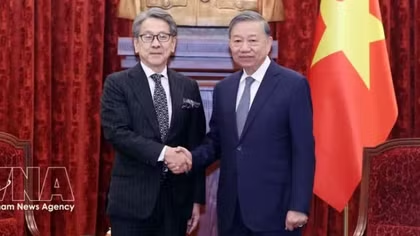
Party General Secretary and President Nguyen Phu Trong (Photo: VNA)

During the resistance war against the invading French colonialists, the VPA won glorious feat of arms, including the 1953-1954 Winter-Spring Campaign with the peak of the Dien Bien Phu victory that forced the French government to sign the Geneva Accords in 1954, ending the war and restoring peace in Indochina.

This was the first time in the contemporary history that an army equipped with rudimentary weapons had defeated a professional counterpart, which marked the beginning of the collapse of colonialism and provided a strong boost to the national liberation movement in the world, he stressed.

In the anti-US war, the VPA, along with the entire Party and people consecutively foiled war strategies. Such great victories won by the Vietnamese army and people drove the US to sign the Paris Peace Accords that committed to put an end to the war, and created a premise for the Spring General Offensive and Uprising in 1975, culminating with the historic Ho Chi Minh Campaign, leading to the full liberation of South Vietnam, national reunification and the end of the 30-year resistance war, the top leader said.

Not only fighting to liberate their own country, with a pure proletarian international spirit, the VPA has also stood side by side with armed forces of Laos and Cambodia in the fight against common enemies.

Right after the anti-US war ended, the VPA immediately embarked on another fierce battle to protect the national border and performed its international mission of helping Cambodian people escape from genocide.

During the cause of national construction and defence in the renewal period, the army has carried forward its role in combat and production, while serving as an advisor of the Party and the State in military, national defence and drafting strategic guidelines for national protection.

At the same time, it has made outstanding performance in defence diplomacy, contributing to building a peaceful and stable environment for national building and development, Trong said.

Over the past 75 years, in any revolutionary period, even the toughest time, the CPV has maintained its comprehensive, absolute and direct leadership over the VPA.

This is an important factor for the success of national building and safeguarding, and also the decisive factor for the growth, combat capacity and triumph of the army, he said.

The Party General Secretary pointed out that unforeseeable and complex developments are lying ahead in the regional and global situation, along with increasing traditional and non-traditional security challenges and fierce strategic competition between world powers.

The East Sea issue also contains many unexpected risks, he said, adding that the trend of connectivity, globalisation and the Fourth Industrial Revolution have been exerting profound impacts on all countries in various spheres.

Inside the country, the macro economy has been stabilised but not quite sustainably. Although Vietnam’s internal strength has been consolidated and its prestige and position in the international arena has been rising, the country still faces a range of difficulties and challenges.

The Party leader also called attention to the fact that hostile forces have stepped up the so-called “peace process,” “self-evolution,” “self-transformation,” “non-politicalisation,” and “civilisation” of the army, especially after, during and before all-level Party congresses and the 13th National Party Congress.

The cause of national construction and defence goes with heavy requirements, with the struggle to safeguard the country’s sovereignty over its sea, islands and territorial integrity forecast to be a tough, long-term and complex one.

In 2020 and the years to come, the VPA will have to take tougher tasks, he said, requiring the Party maintain and enhance its absolute, direct and comprehensive leadership over the VPA in order to help the army complete its missions.  

“We believe that with its 75-year history of building and fighting under the Party leadership, the VPA will continue to write more glorious historical pages for the nation,” he concluded./.
VNA

Other News

National Assembly Chairman urges renovation in leadership, working style

National Assembly Chairman urges renovation in leadership, working style

The NA's Committee for Cultural and Social Affairs has moved fast to reshuffle its organisation after the 14th National Party Congress and the election of deputies to the 16th NA, updating its work agenda to match new directives set out in the resolutions of the 14th National Party Congress and the first Congress of the NA Party Organisation for the 2025–2030 term.

Vietnam treasures ties with Croatia: PM

Vietnam treasures ties with Croatia: PM

Vietnam and Croatia should strive to double bilateral trade turnover from the current level of 161 million USD; study the establishment of a Joint Committee on Economic Cooperation to create a long-term, stable, and effective framework for collaboration, said Prime Minister Le Minh Hung.

President Ho Chi Minh's enduring legacy highlighted at Venezuela commemoration

President Ho Chi Minh's enduring legacy highlighted at Venezuela commemoration

Vice President of the United Socialist Party of Venezuela (PSUV) Jesús Faria expressed deep admiration for President Ho Chi Minh and Vietnam’s indomitable struggle for national independence. He described President Ho Chi Minh as an immortal symbol of 20th-century national liberation movements, whose legacy continues to inspire leftist parties, progressive movements, and peoples across Latin America, including Venezuela.

Vietnam proposes key cooperation orientations at BRICS Foreign Ministers' Meeting

Vietnam proposes key cooperation orientations at BRICS Foreign Ministers' Meeting

Deputy Foreign Minister Nguyen Minh Hang shared Vietnam’s approach to building an independent and self-reliant economy linked to deep international integration, while proposing several key areas for enhanced cooperation between BRICS and partner countries at the Expanded BRICS Foreign Ministers' Meeting that opened on May 14 in India.

Vietnam asks parties to respect its sovereignty over Truong Sa

Vietnam asks parties to respect its sovereignty over Truong Sa

PSNews - The spokesperson stated that the dispatch of personnel by relevant parties to features belonging to Truong Sa without Vietnam’s permission constitutes a violation of Vietnam’s sovereignty under international law. She stressed that such actions run counter to the Declaration on the Conduct of Parties in the East Sea (DOC) as well as ongoing efforts by countries to negotiate a Code of Conduct in the East Sea (COC).

Hanoi to host ASEAN Future Forum 2026 in mid-June

Hanoi to host ASEAN Future Forum 2026 in mid-June

PSNews - Vietnam’s proposals placed the highest priority on ensuring a peaceful and stable environment conducive for continued sustainable development and improving the well-being and happiness of the ASEAN people. They were praised by member states and incorporated into the core contents of the ASEAN Leaders’ Statement on the response to the Middle East crisis.

Vietnam promotes cooperation with United Nations on crime prevention

Vietnam promotes cooperation with United Nations on crime prevention

Vietnam highly values the support of the United Nations Office on Drugs and Crime (UNODC) in strengthening national capacity in crime prevention and criminal justice, drug control, and addressing emerging challenges, particularly cybercrime, said Ambassador Vu Le Thai Hoang.

Party, State leader calls for consolidation of central steering committees on legal, judicial reform

Party, State leader calls for consolidation of central steering committees on legal, judicial reform

Consolidating the central steering committees for institutional and legal reform and for judicial reform is necessary in order to streamline organisational structures without reducing responsibilities, while ensuring clear accountability, measurable outputs and concrete results. Following the restructuring, the body will be renamed the central steering committee for institutional improvement and law enforcement, with the Party General Secretary and State President serving as its head.

Vietnam strives for substantive outcome at NPT review conference

Vietnam strives for substantive outcome at NPT review conference

At the meeting this week, Ambassador Viet briefed the UNGA President on developments during the first two weeks of the conference. He stressed that the current international geopolitical landscape poses numerous complex challenges, while reaffirming Vietnam’s determination, together with other member states, to promote substantive and balanced outcomes at the conference.

Top leader of Vietnam receives Vientiane official in Hanoi

Top leader of Vietnam receives Vientiane official in Hanoi

The host leader stressed that cooperation between localities, particularly between the capitals of Hanoi and Vientiane, plays an especially important role as a pioneering force in effectively implementing the foreign polices of the two Parties and States, while also serving as a bridge between politics and development, as well as between strategy and concrete action.