Austria’s ousted chancellor, Sebastian Kurz, has insisted that his political career is far from over in spite of having to vacate his office at least until fresh elections in September following a no-confidence vote.
 |
| Austria's ousted chancellor vows to return despite no-confidence vote |
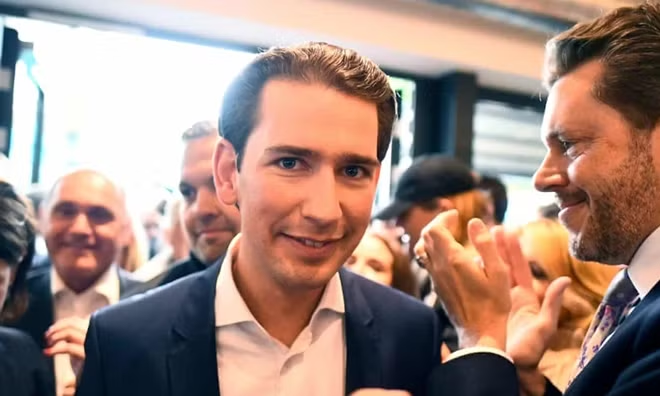
“I am still here”, Kurz told a crowd of enthusiastic supporters at an event for members of the centre-right Austrian People’s Party (ÖVP) on Monday night.
The 32-year-old, who has become the last politician to be toppled over the so-called Ibiza scandal, said he accepted the outcome of the no-confidence vote, supported by the centre-left Social Democrats (SPÖ) and far-right Freedom Party (FPÖ), “without anger, hatred and sadness”.
In light of his party’s resounding triumph in Sunday’s European election, Kurz voiced optimism about being re-elected as leader of the Alpine state in the autumn: “We have seen that they can vote us out, but they cannot stop the change that we are driving”, he said at the event at the ÖVP’s educational institution.
Austria’s president Alexander Van der Bellen on Tuesday appointed a provisional government headed by former finance minister Hartwig Löger, also of the ÖVP.
The provisional government will in return be replaced by a technocratic interim cabinet made up of experts and civil servants that will govern the country until elections in early September. Appointing a new government was “not a matter to carried out lightly or in haste”, Van der Bellen said on Tuesday.
Austria’s political landscape has been upended in the space of just over a week following the publication of a video clip showing Kurz’s deputy Heinz-Christian Strache promising lucrative public contracts to a woman posing as a Russian backer, in return for help in his election campaign.
Following the resignation of Freedom party leader Strache and the firing of FPÖ interior minister Herbert Kickl, Austria’s youthful chancellor himself was toppled in a vote of no confidence after opposition politicians said they had lost faith in his handling of the corruption scandal.
Kurz’s former coalition partners on the far-right accused him of having tried to use the scandal to consolidate his power at the top of government, while the SPÖ said he had not shown enough willingness to enter into a dialogue with parliament.
Yet Kurz, who became Austria’s foreign minister aged only 27, could still benefit from the current turmoil in government. In Sunday’s European elections, his conservative party emerged as the strongest party on the night on 34.5% of the vote, up 7.5 percentage points on the previous elections. The FPÖ only took a minor hit, losing 2.2 percentage points to come third with 17.5%.
The SPÖ came second on 23.5% but performed slightly less well than in 2014. Kurz’s biographer Paul Ronzheimer, a journalist for German tabloid Bild, predicted that the chancellor’s toppling could yet prove a bigger problem for the Austrian centre left after they had been seen joining forces in parliament with the far right.
Meanwhile ex–FPÖ leader Strache, whose conduct had set off the avalanche sweeping away the last government, could already be on the verge of his own comeback. On Sunday Strache received enough preferential votes across the country that he could be headed to the European parliament if he were to accept the mandate.
The origin of the sting remains the subject of fevered speculation in the Austrian press. According to tabloid Kronen Zeitung, the villa where Strache and his party colleague Johann Gudenus were filmed was used by intelligence agencies for similar sting operations in the past.
One independent Austrian news website is claiming that seven separate clips from the video were sold for €600,000 to the Centre for Political Beauty, an art collective known for its provocative and meticulously planned interventions.
The report claims that the payment was made with Krugerrand gold coins, and that a Berlin-based legal practice acted as a middleman between the Centre for Political Beauty and the seller, a private detective known as “Julian H”. The video allegedly then found its way from the art group to the two German media outlets who published its contents, weekly Der Spiegel and daily Süddeutsche Zeitung.
The Centre for Political Beauty has denied the reports, stating on Twitter: “No money was paid for the Ibiza video, nor did we leak it to Süddeutsche or Spiegel”.