State government officials, who had threatened striking police officers with criminal charges, said police were expected to return to work by 7 a.m. (0900 GMT) on Saturday.
It was still unclear if most policemen would stand by the deal and return to work, as the federal government dispatched more troops to the southeastern coastal state to try to quell the unrest.
Some relatives of striking police officers told Reuters the police unions who clinched the deal with the government did not represent them.
Espirito Santo is one of several Brazilian states grappling with a budget crisis that is crippling essential public services for millions of citizens. The police strike over pay during the past week has left a security vacuum and led to rampant assaults, robberies and looting, often in broad daylight.
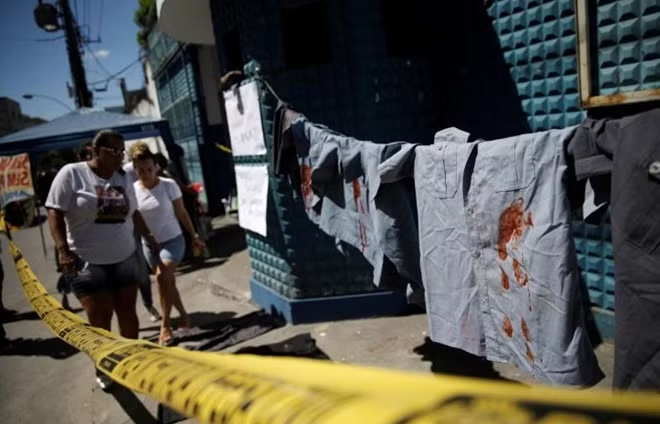 |
| Uniforms placed by family members of police officers in protest for better salaries, are pictured in front of the entrance of the military police battalion in Rio de Janeiro, Brazil February 10, 2017. REUTERS |
Limited protests by police in nearby Rio de Janeiro alarmed residents of the metropolitan area of 12 million people, many of whom live in fear of violence between rival drug gangs and other criminals. Some mayors in Rio de Janeiro state even announced plans to help make up for unpaid police salaries by using city finances to cover the state's shortfalls.
In Espirito Santo, a spokesman for a local police union said the death toll from a week of unrest had risen to 122. State officials have not confirmed the toll but have said many of those killed are believed to belong to competing gangs.
If accurate, the toll would be more than six times the average daily homicide rate in the state last year.
President Michel Temer, addressing the crisis publicly for the first time, in a statement on Friday called the strike "illegal" and said, "The right to protest cannot take the Brazilian people hostage."
The federal government, he said, "will make every effort for Espirito Santo to return to normal as soon as possible."
Temer's comments came as the defense ministry mobilized hundreds more soldiers and federal police to help stem the chaos, focused mostly in the metropolitan region of Vitoria, the state's capital. After an initial deployment of 1,200 troops earlier in the week, the ministry on Thursday said as many as 3,000 would be in place by the weekend.
Rio's state security secretary late Friday said the limited strike there had caused a small uptick in reported crimes but nothing like the violence gripping Espirito Santo. He said the state did not foresee a full-fledged strike.
Espirito Santo officials said charges of rebellion against 700 striking state officers, who in Brazil are organized with military-style ranks and rules, could be dropped for those who returned to work by Saturday morning.
SCHOOLS, SHOPS SHUT
Local officials have closed schools, clinics and public transportation, while shops and other businesses have remained shuttered, causing about $30 million in losses, according to a state retail association.
In Rio, where the state government has been struggling to pay salaries, family members of some officers early on Friday blocked entrances to several police stations in an effort to keep officers from patrolling.
The tactic, which on a much larger scale has paralyzed Espirito Santo, affected just a few districts.
States across Brazil are facing budget and debt problems due to a recession that is the country's worst on record. The federal government has negotiated debt relief with some states and now finds itself shoring up public security too.
The mayor of Niteroi, located across a long bay from state capital Rio, said his city would make a one-time payment of 3,500 reais ($1,129) to police working there. The city of Macae, near Rio's offshore oil fields, said it would help cover the cost of a paycheck from last year that the state still owes.
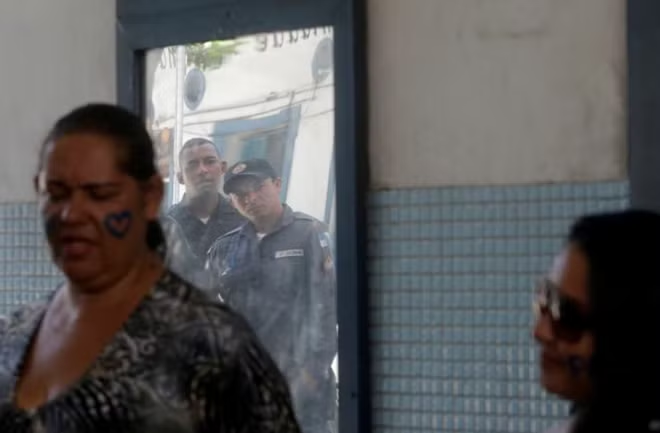 |
| Policemen observe a protest organised by family members of police officers, in front of the entrance of the 6th Military Police Battalion, in Rio de Janeiro, Brazil February 10, 2017. REUTERS |
State police officials, who said they detained one Rio officer for encouraging a strike online, said the slowdown never affected more than 10 percent of the police force but that officials would remain on guard in case the protest grew.
A bigger strike "could threaten the lives of all of us," said Roberto Sa, the state security secretary told reporters Friday evening.