- Iraqi forces launch operation to seize last Islamic State enclave in Mosul
- Manchester bomber had 'proven' links to Islamic State: French minister
- Head of Islamic State in Afghanistan confirmed killed
- Iraqi TV says Islamic State's second-in-command killed in airstrike
While the U.S. military's shootdown of a Syrian jet on Sunday was a rarity in modern warfare, the first in 18 years, it was not an isolated incident.
The United States has taken a series of actions over the past three months demonstrating its willingness to carry out strikes, mostly in self-defense, against Syrian government forces and their backers, including Iran.
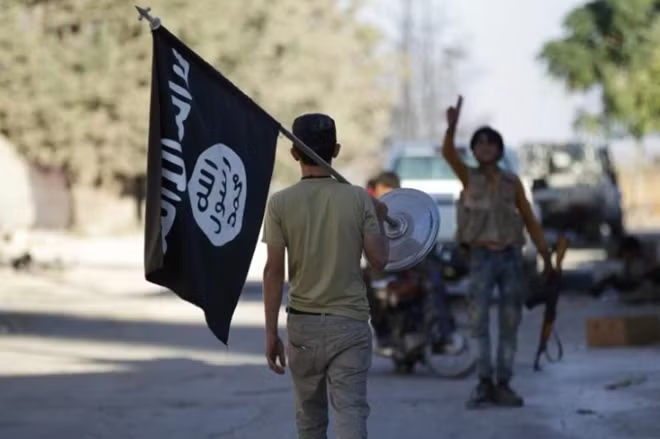 |
| FILE PHOTO - A rebel fighter takes away a flag that belonged to Islamic State militants in Akhtarin village, after rebel fighters advanced in the area, in northern Aleppo Governorate, Syria, October 7, 2016. REUTERS/Khalil Ashawi |
In April, Trump ordered cruise missile strikes against a Syrian airfield from which Washington said a deadly chemical weapons attack was launched. Since then, the United States has repeatedly struck Iranian-backed militia and last week even shot down a drone threatening U.S.-led coalition forces.
These incidents, however, are tactical, not part of any U.S. strategy in Syria, analysts said.
Both the administration of former President Barack Obama and Trump's have focused exclusively on defeating Islamic State, but with the militants' self-proclaimed caliphate shrinking, U.S.-backed and Syrian-backed forces appear to be competing for territory.
"There isn't an over-arching U.S. strategy driving this," said Charles Lister of the Middle East Institute.
"This is just the result of tactical decisions by a commander on the ground whose only focus is a specific theater in Syria. He is acting to protect his assets ... This is purely a series of tactical decisions that are creating a series of very serious strategic consequences."
Russia and Iran both support Syrian President Bashar al-Assad in Syria's civil war.
The larger problem, the officials and analysts said, is that Trump and his national security team have not advanced a long-term political strategy for Syria's future.
Like Obama, Trump has focused on Islamic State, leaving for later the question of Assad's fate and the region's mangled alliances.
"We have never had a coherent Syrian strategy," said one U.S. official, speaking on condition of anonymity. "We oppose Assad, but our main enemy is ISIS, which also opposes Assad. Our most capable allies are the (Kurdish) peshmerga, but Turkey, who is a NATO ally and host to an airbase that is central to our efforts, considers the Kurds enemies."
Jennifer Cafarella, of the Institute for the Study of War, said the U.S. strikes are unlikely to deter Assad and his backers.
"The absence of a civilian-led U.S. strategy in Syria and the narrow U.S. military focus on ISIS will continue to provide an open invite for the pro-Assad regime coalition to extend and escalate," Cafarella said.
A White House spokesman did not respond to calls and an email seeking comment. A senior White House official said: "The strategy for Syria is to defeat ISIS and first and foremost achievement of a de-escalation of the conflict so we can work toward a political resolution. We’re not close to that, but that's the strategy."