China says air pollution worsens in October

Air quality in China's smog-hit northern regions, which include the capital Beijing, worsened in October despite overall improvements over the course of the year, the environment ministry said in a notice late on Monday.

The Ministry of Environmental Protection said concentrations of small breathable particles known as PM2.5, a key smog indicator, fell 12.5 percent to an average of 42 micrograms per cubic meter from January to October. World Health Organization guidelines recommend an annual average of 10 micrograms.

But in October alone, smog concentrations in the Beijing-Tianjin-Hebei region, a front line in China's war on pollution, were worse than the same period last year, the ministry said.
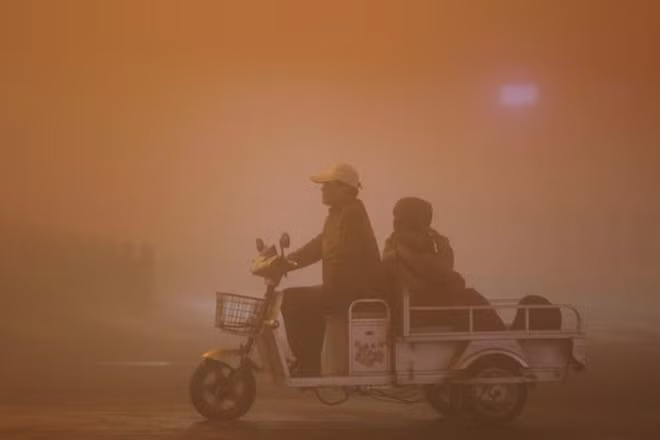
People ride during heavy smog in Lianyungang, Jiangsu province, China, November 13, 2016. (Photo: Reuters)

The ministry said six of the worst performing cities over the first 10 months were located in the industrial province of Hebei, which surrounds Beijing. Xian, the location of China's famous Terracotta Army, also appeared in the top 10 smoggiest cities over the period.

Smog normally worsens in winter as China's largely coal-fired urban heating systems are activated in northern regions, but the ministry has warned that the situation could be more challenging this year as a result of unfavorable weather conditions.

During several recent smog build-ups, the ministry dispatched inspection teams to establish whether emergency smog alert systems in Beijing and Hebei were being implemented correctly. It found that local governments were not cracking down hard enough on firms that broke rules.

The alert systems allow authorities to limit traffic, suspend construction activities and force firms to cut production during heavy smog.

China's capital Beijing has closed down dozens of industrial enterprises, shut down coal-fired power plants and replaced coal heating with natural gas in a bid to tackle smog. Cities in Hebei have also been under the pressure to cut coal consumption and impose tougher punishments on firms that exceed emission limits.

Environment group Greenpeace said in a research report published on Monday that Beijing's efforts to cut coal burning has led to a 90.4 percent decline in arsenic concentration levels since 2013, meaning that the city now meets national standards.
Reuters

Other News

Vietnamese community in Venezuela backs rescue team on humanitarian mission

Vietnamese community in Venezuela backs rescue team on humanitarian mission

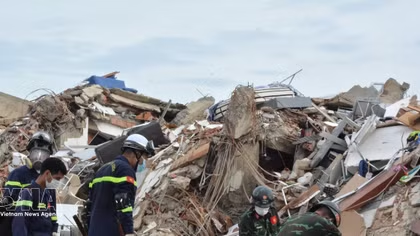
All members of the Vietnamese rescue team in Venezuela have maintained strict discipline, a strong sense of responsibility and unwavering focus when carrying out search, rescue and disaster recovery tasks, with the determination to successfully fulfil the international humanitarian mission entrusted by the Party, State and military.

Key issues ex high agenda at the ASEAN Future Forum 2026

Key issues ex high agenda at the ASEAN Future Forum 2026

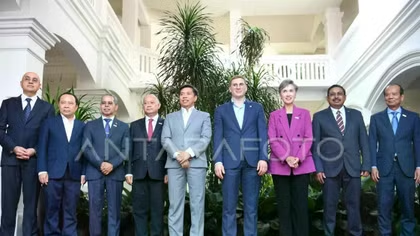
PSNews - Nearly six decades after its founding, ASEAN is entering a new phase of transformation. Geopolitical turbulence, intensifying competition among major powers, non-traditional security challenges, and rapid technological change are raising fundamental questions about the region’s future trajectory. In this context, the ASEAN Future Forum (AFF) 2026 is more than a platform for regional countries to discuss current issues; it is designed to identify strategic pathways for ASEAN in the years ahead.

Malaysia bans social media accounts for children under 16

Malaysia bans social media accounts for children under 16

Under the new rules, social media platforms are required to implement age-verification systems and prevent users under 16 from creating accounts. The regulations apply to platforms with at least eight million users in Malaysia, including Facebook, Instagram, TikTok and YouTube.

Cambodia ranked world's top country for natural environment in 2026

Cambodia ranked world's top country for natural environment in 2026

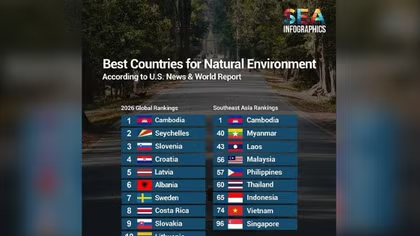
Cambodia currently manages 73 protected natural areas covering more than seven million hectares, equivalent to about 41% of the country’s total land area. These protected areas play a vital role in forest conservation, wildlife habitat protection and biodiversity preservation through stricter law enforcement and conservation measures.

ASEAN chief spotlights Vietnam’s role in shaping bloc’s future

ASEAN chief spotlights Vietnam’s role in shaping bloc’s future

Vietnam is expected to maintain active contributions across ASEAN’s three pillars - the political-security community, the economic community, and the socio-cultural community; while further enhancing regional connectivity through infrastructure projects and stronger economic linkages.

Vietnam supports UNESCO's people-centred approach, multilateral cooperation: official

Vietnam supports UNESCO's people-centred approach, multilateral cooperation: official

Van affirmed Vietnam’s support for the UNESCO80 reform roadmap, focusing on the organisation’s core mandate, priority areas, interdisciplinary approach, and the special status of the Vietnam National Commission for UNESCO, and UNESCO representative offices, alongside efforts to diversify resources and strengthen global partnerships to enhance the organisation’s effectiveness.

Regional media highlight significant step in Vietnam’s leadership structure

Regional media highlight significant step in Vietnam’s leadership structure

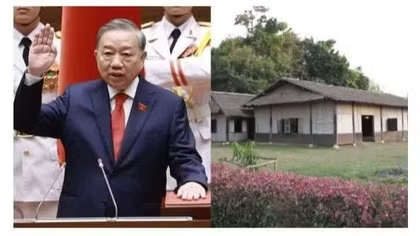
Under General Secretary and President Lam’s leadership, Vietnam is expected to maintain a balanced foreign policy, strengthen its regional standing and accelerate economic development, thereby improving living standards and creating new opportunities for international investors, according to the India-based platform Devdiscourse.

Laos identifies 10 key tasks to build independent, self-reliant economy

Laos identifies 10 key tasks to build independent, self-reliant economy

Laos will step up agricultural production to ensure food security, meet domestic demand and expand exports; encourage the development of agro-processing industries, including those related to rubber, aquatic products, cassava and sugarcane, as well as fertiliser and animal feed production, in order to increase added value and create jobs in rural areas.