Colombia's new peace deal with Farc rebels rejected by opposition

Deal will be discussed by congress on Wednesday as government claims new accord includes amendments to 56 of 57 points raised by opposition.

The Colombian opposition has rejected the latest version of a peace agreement between Farc guerrillas and the country’s government, following a six-hour meeting with government delegates.

Rightwing senator and opposition leader Álvaro Uribe met Monday with Colombian president Juan Manuel Santos to review the revised accord.
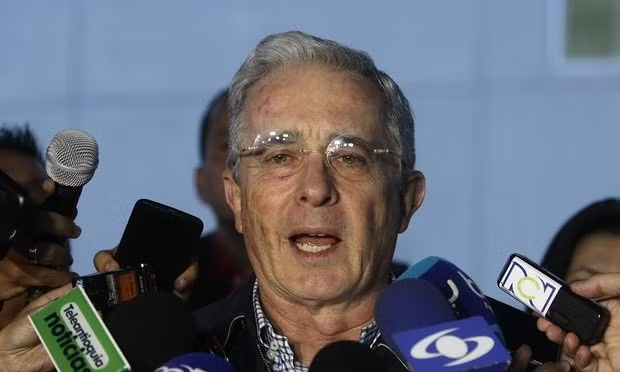
Opposition leader Álvaro Uribe had met with President Juan Manuel Santos on Monday to review the revised accord. (Photo: EPA)

Colombian voters unexpectedly rejected an earlier version of the government’s peace deal with the Farc in an 2 October referendum.

“We insisted on the introduction of amendments to the agreement prepared by the government and the Farc, and the government opposed these changes on substantial subjects,” Uribe told journalists.

Opponents reiterated that if some of their demands were not definitively included in the new deal, it would be a mere “reworking of the agreement rejected by the citizens”.

“We are totally willing to engage in dialogue with the government and the guerrillas concerning these changes,” Uribe said.

The conservative leader said the opposition was proposing to meet guerrilla delegates who had arrived Monday in Bogota to prepare for the signing of the peace agreement.

According to the government, the new accord includes amendments pertaining to 56 of the 57 points raised by the opposition.

Santos, who won the Nobel Peace prize in October, said the deal would be presented to congress on Wednesday for discussion.

The armed conflict that has endured for more than half a century has left more than 260,000 dead, more than 60,000 missing and 6.9 million displaced.
The Guardian

Other News

Vietnam supports UNESCO's people-centred approach, multilateral cooperation: official

Vietnam supports UNESCO's people-centred approach, multilateral cooperation: official

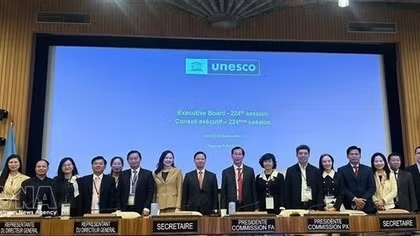
Van affirmed Vietnam’s support for the UNESCO80 reform roadmap, focusing on the organisation’s core mandate, priority areas, interdisciplinary approach, and the special status of the Vietnam National Commission for UNESCO, and UNESCO representative offices, alongside efforts to diversify resources and strengthen global partnerships to enhance the organisation’s effectiveness.

Regional media highlight significant step in Vietnam’s leadership structure

Regional media highlight significant step in Vietnam’s leadership structure

Under General Secretary and President Lam’s leadership, Vietnam is expected to maintain a balanced foreign policy, strengthen its regional standing and accelerate economic development, thereby improving living standards and creating new opportunities for international investors, according to the India-based platform Devdiscourse.

Laos identifies 10 key tasks to build independent, self-reliant economy

Laos identifies 10 key tasks to build independent, self-reliant economy

Laos will step up agricultural production to ensure food security, meet domestic demand and expand exports; encourage the development of agro-processing industries, including those related to rubber, aquatic products, cassava and sugarcane, as well as fertiliser and animal feed production, in order to increase added value and create jobs in rural areas.

Malaysia steps up cyber security resilience

Malaysia steps up cyber security resilience

To ensure accountability, Malaysia plans to finalise the Cybercrime Bill this year which addresses both cyber-dependent and cyber-enabled offences, introducing stricter penalties and prison terms to enhance deterrence.

US public opinion positive about PM Pham Minh Chinh’s visit

US public opinion positive about PM Pham Minh Chinh’s visit

Public opinion in the US is generally positive about Vietnamese Prime Minister Pham Minh Chinh’s trip to the US from September 17-23 to attend the 78th session of the United Nations General Assembly, which took place immediately after the upgrading of the Vietnam - US relations to a comprehensive strategic partnership on the occasion of US President Joe Biden’s official visit to Vietnam.