- Cuba’s Raul Castro blasts Trump’s Mexican wall and trade policy
- Former U.S. intelligence chief rejects Trump wiretap accusation
- Merkel, Trump to Meet in Washington This Month
- Under fire, Trump's attorney general removes himself from campaign probes
Republican U.S. House of Representatives leaders on Monday unveiled legislation to do away with Obamacare, eliminating the requirement that most Americans obtain medical insurance and creating a system of tax credits to coax people to purchase private insurance on the open market.
Speaker Paul Ryan said he could guarantee that he had enough votes to win passage of the measure in the House, adding that conservatives should be excited about the plan to repeal and replace Democratic former President Barack Obama's signature domestic policy achievement.
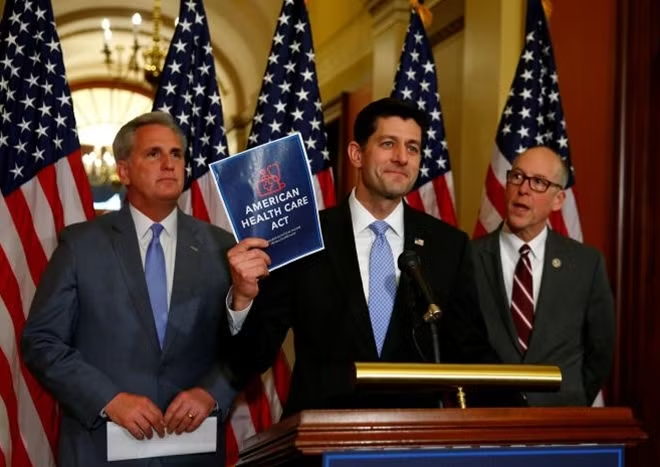 |
| (L-R)U.S. House Majority Leader Kevin McCarthy, U.S. House Speaker Paul Ryan, and U.S. Representative Greg Walden hold a news conference on the American Health Care Act on Capitol Hill in Washington, U.S. March 7, 2017. REUTERS/Eric Thayer |
But conservatives slammed the proposal, with Republican Senator Mike Lee calling it "exactly the type of back-room dealing and rushed process that we criticized Democrats for."
Trump said the plan was open to negotiation, but said it had already earned support "from everybody." Vice President Mike Pence described it as a "framework," signaling the measure was far from its final form. Health and Human Services Secretary Tom Price called it "a work in progress."
The proposal represented a key step toward carrying out pledges by Trump and congressional Republicans to dismantle Obamacare.
But lawmakers face pressure from constituents not to throw America's healthcare system into chaos. Democrats denounced the proposal as taking away health insurance from millions of Americans and benefiting the rich.
Some conservative Republicans complained the bill did not go far enough in removing government from the healthcare industry.
In the Senate, where Republicans can afford to lose only two votes from their razor-thin majority, Republican Senator Rand Paul called the plan "Obamacare Lite" and said he wanted a repeal-only option.
Trump, in an evening Twitter message, said he was "sure" Paul would "come along with the new and great healthcare program because he knows Obamacare is a disaster!"
Conservative groups including Heritage Action for America, the Club for Growth, Americans for Prosperity and Freedom Partners, backed by the billionaire Republican donor Koch brothers, urged its defeat for different reasons.
The Club for Growth derided it as "RyanCare" and a "warmed-over substitute for government-run healthcare."
"We think you have to get rid of Obamacare completely," said conservative Republican Representative Jim Jordan, who announced plans to introduce his own bill to repeal Obamacare on Wednesday, the same day that House committees begin debating and considering amendments on the Republican plan.
Conservative opponents said the legislation maintains some Obamacare regulations and mandates that have caused rising insurance prices, creates a new entitlement in the form of tax credits and fails to embrace free-market ideals.
Instead of current income-based subsidies to buy a plan, the plan proposes tax credits, which would range from $2,000 to $4,000.
The 2010 Affordable Care Act, known as Obamacare and passed by Democrats over unified Republican opposition, is popular in many states, even some controlled by Republicans. It has brought medical coverage to about 20 million previously uninsured Americans.
Democrats and some moderate Republicans said the new House measure would hit lower-income Americans by rolling back the expansion of the Medicaid health insurance program for the poor.
Although Republicans control both Congress and the White House, the future remains uncertain for the plan. It must win approval in the House and the Senate before it could go to Trump for his signature.