Diversifying rice varieties to combat climate change

The effects of this year’s severe drought on agriculture in the economically vital Mekong Delta will be felt for months, if not years, to come, say environmentalists and United Nations experts.

They also say Vietnam and other Mekong countries must prepare for an increase in future extreme weather events by boosting their early disaster planning and preparedness activities to mitigate the negative impacts of these types of weather phenomena.

The weather system delivered an increase in storms in 2015, followed by the worst drought in the Mekong Delta area in nearly a century, wreaking havoc on the environment and the livelihoods of the regions 20 million inhabitants.

The Vietnam government released a drought recovery plan on October 17 that outlines measures be taken in the short, medium and long terms. In the report, government economists have estimated the total economic loss from the drought at US$660.8 million (VND15 billion).
This calculates out to 0.35% of the national GDP, resulting in negative agricultural growth of 0.18% for calendar year 2016, the first time in decades the agriculture segment of the economy has contracted.

The intense drought that peaked in the country between February and May brought record-high salt levels and severe water shortages. About 2 million people had no access to water for consumption and domestic use, 2.2 million were food insecure, and more than 2 million lost income due to damaged or lost livelihoods, the report said.

Though drought conditions in Vietnam ended in September, their ramifications have created an ongoing need for humanitarian assistance.

The drought impact for affected households is still lingering and needs are pertinent, particularly in terms of water storage and purification, hygiene and nutrition support, disease surveillance and response, and livelihood recovery, the report said.

The drought recovery plan lays out a wide range of goals aimed at ensuring that the 18 provinces affected by the drought including those in the Mekong Delta region, receive water and water treatment supplies, foods, seed packages, nutritional supplements, essential medicines, and fish and poultry restocks.

The plan will also provide irrigation infrastructure repairs, cash-for-work programs, and technical assistance and technology for improved meteorological and disaster forecasting.

The provinces have estimated that the total cost of the recovery from now until 2020 will be more than US$1.2 billion, the report said.

“For medium-and longer-term recovery, there should be a more comprehensive approach to water supply, water, and land resource management, adaption measures for livelihoods and agricultural restructuring for a changing climate,” said Vu Minh Hai of Vietnam's Climate Change Working Group in an email.

The Vietnam government has provided support of nearly US$60.7 million (VND1.5 billion dong) since 2015 to provide food, water purification tablets, financial aid, and water infrastructure repair work to the drought-affected areas of the country, according to the drought recovery plan.

United Nations agencies and NGOs have mobilized a further US$6.1 million from various sources to provide water supplies, sanitation and hygiene, nutrition, food, health, and financial aid for Vietnamese who live in the provinces affected by the drought, the report said.

Robinson, a former president of Ireland who previously served as UN High Commissioner for Human Rights, said leaders of countries must do more, especially since other extreme weather events will continue to take a toll on areas with vulnerable populations in the future.

“We want leaders of countries to be in the forefront of a new approach,” said Robinson, who visited Vietnam earlier this year as part of a UN mission to see how climate change weather patterns have affected the Mekong Basin.

Despite ongoing efforts to continuously monitor and address the impact of climate change, saltwater intrusion, and water availability in the Mekong Delta’s farmlands, the sharing of information with farmers remains “still slow and uncoordinated,” said Wilhelmina Pelegrina, food and ecological agriculture campaign coordinator at Greenpeace Southeast Asia.

“Democratizing and decentralizing climate information at the level of villagers or municipalities and enabling farmers and fisherfolk to have access to this information and its interpretation are crucial,” she said in an email.

“By having climate information in the hands of farmers and fisherfolk combined with their local knowledge systems, they will be able to plan and adjust their farming and fishing systems.”

Farmers in the Mekong Delta must “climate-proof” their farming by diversifying their crops to ensure that they have food when extreme weather events occur, Pelegrina said.

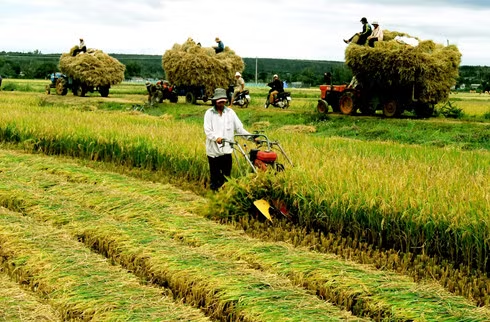
“Having diversity on-farm will be a challenge in the Mekong Delta as this is the rice bowl of Vietnam and the source of almost 90% of exported rice,” she said. “The region will have to look into ways to diversify and ensure resilience in their rice system. At the very least, by having different rice varieties that are adapted to local conditions.”
VOV

Other News

Private economic sector poised for breakthrough growth

Private economic sector poised for breakthrough growth

More than a year after the Politburo's Resolution No. 68-NQ/TW on private sector development came into effect, expectations now extend beyond increasing the number of enterprises. The goal is to build a stronger business community with greater resilience, larger ambitions and the capacity to compete in global supply chains.

Vietnam remains ASEAN growth leader in 2026 despite global headwinds: WB

Vietnam remains ASEAN growth leader in 2026 despite global headwinds: WB

Vietnam is expected to remain one of ASEAN’s fastest-growing economies in 2026, supported by resilient exports, strong investment inflows and an ambitious reform agenda, despite mounting global uncertainties, according to the World Bank’s latest Vietnam Economic Update released on May 15.

Ministry establishes monitoring framework for carbon market

Ministry establishes monitoring framework for carbon market

Under a new circular, the exchange of greenhouse gas emission quotas and carbon credits is conducted on the domestic carbon credit exchange through the carbon trading system, which is interconnected with the national registration system.

Biofuel ready for nationwide rollout

Biofuel ready for nationwide rollout

For biofuels, particularly E10, to develop successfully, stronger and more coordinated policies are needed, especially pricing mechanisms capable of creating a sufficiently attractive gap between E10 and mineral-based petrol, an expert has said.

Vietnamese farm produce promoted at African investment, trade forum

Vietnamese farm produce promoted at African investment, trade forum

The 12th Africa Forum for Investment & Commerce (AFIC 12) opened in Algiers, the capital of Algeria, on May 9, drawing around 2,000 participants, including officials, economists, businesses, financial and development organizagtions from 43 African countries and international partners, including Vietnam.

Int'l medical, pharmaceutical expo opens in Hanoi

Int'l medical, pharmaceutical expo opens in Hanoi

The exhibition, which runs until May 9 at the Hanoi International Centre for Exhibition, showcases advanced products and technologies across a range of fields, including pharmaceuticals, drug manufacturing machinery and equipment, medical devices, hospital and clinic services and dental equipment.

Mega projects to transform Ho Chi Minh City urban landscape

Mega projects to transform Ho Chi Minh City urban landscape

Leading the charge in this massive building spree is the new central city square in the core of the Thu Thiem new urban area. Spanning more than 20 ha, it’s the crown jewel of the Central Square and new administrative center complex.

Vietnam establishes itself as one of region’s most dynamic manufacturing and supply bases

Vietnam establishes itself as one of region’s most dynamic manufacturing and supply bases

The country’s stable political and economic environment provides a critical foundation for long-term sourcing strategies. At the same time, Vietnam has demonstrated a strong ability to scale up manufacturing, supported by a continuously expanding industrial base capable of meeting both high-volume demand and increasingly complex technical and quality requirements.

Vietnamese pomelos gain broader access to Australian market

Vietnamese pomelos gain broader access to Australian market

The update by Australia’s Department of Agriculture, Fisheries and Forestry to its Biosecurity Import Conditions system (BICON) on April 10, officially setting out import conditions for Vietnamese pomelos, is regarded as a major milestone in market access efforts.

Vietnam's industry spearheads transition to circular economy

Vietnam's industry spearheads transition to circular economy

The circular economy is no longer just a policy choice. It has become an inevitable trend for delivering sustainable and green growth, sharpening competitiveness at home and abroad, and meeting Vietnam’s net-zero emissions target by 2050. It is now a prerequisite to sustain long-term economic expansion, particularly in industrial production and supporting industries.

Nearly 100 tonnes of Vietnamese fruits, vegetables airlifted to UAE

Nearly 100 tonnes of Vietnamese fruits, vegetables airlifted to UAE

Vietnamese fresh produce and processed foods are increasingly recognised for their quality, with items such as cashew nuts, coffee and spices gaining popularity among Middle East consumers. In 2025, Vietnam’s farm produce exports to the UAE exceeded 445 million USD, up nearly 24% year-on-year.