Do Muoi – bright example of diligence, thrift, integrity, selflessness

The life of Do Muoi, former General Secretary of the Communist Party of Vietnam (CPV) Central Committee, is a bright example of diligence, thrift, integrity and selflessness, according to his assistant Phan Trong Kinh. 

In an article written in commemoration of the leader, who passed away on October 1, 2018 in Hanoi, Kinh said the Party General Secretary had devoted himself to the cause of the Party and the people, without thinking of himself. He was always present at the fiercest battlefields, and always undertook the most difficult job, Kinh wrote. 
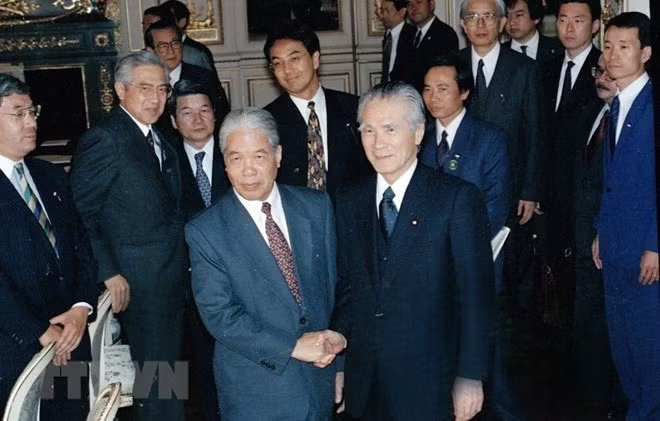
Former Party General Secretary Do Muoi (L) meets with Japanese Prime Minister Tomiichi Murayama during his official visit to Japan from April 18 to 19, 1995 (Photo: VNA)
Former Party General Secretary Do Muoi (L) meets with Japanese Prime Minister Tomiichi Murayama during his official visit to Japan from April 18 to 19, 1995 (Photo: VNA)

He recalled that as the Commander and Political Commissar of military zones in the Red River delta, Do Muoi directed operations to defeat large-scale mopping-up operations of the French colonialists in 1949-1950 in Thai Binh, Hung Yen and Hai Duong provinces. He also commanded a raid into Cat Bi airport in Hai Phong, burning dozens of aircraft of the enemy. 

Serving as Deputy Prime Minister for 20 years, Do Muoi was assigned many missions of utmost importance, such as resisting the US imperialists’ destruction war and providing supplies for the southern battlefield. He also regular spent time at the sites of key projects. 

During his tenure as Chairman of the Council of Ministers, Do Muoi quickly handled the galloping inflation in 1988-1989, abolished the subsidization regime, and built the 1991 Political Programme of the CPV and the 10-year socio-economic strategy for 1991-2000. He proposed many useful ideas to the Politburo and the National Assembly in designing important policies of the country. 

Do Muoi was elected as General Secretary of the Party at the time of the collapse of the Soviet Union and socialist countries in East Europe, when the country was facing serious socio-economic difficulties. The first thing he did was to direct actions to stabilize the political situation and thoughts of Party officials, members and the people, while persisting in following the socialist path as selected by the Party and President Ho Chi Minh. He also continued with the Doi Moi cause, worked to expand relations with other countries and to normalize relations with China and the US, took the initiative in joining the Association of Southeast Asian Nations (ASEAN). During the period, the country reaped many achievements in economic development, national defence, maintenance of security and social order, as well as in the cause of national industrialization and modernization. 

During meetings with foreign leaders, politicians and diplomats, General Secretary Do Muoi was always straightforward and sincere while demonstrating self-confidence and national pride, thus leaving good impression on international guests. He had contributed greatly to the achievements in the field of external relations of the Party and the State since the Party’s 7th and 8th congresses. 

Throughout all his positions, Do Muoi always paid attention to two issues that he considered as key national policies, which are industrialization-modernization and education-training. 

According to him, education-training is the most important national policy, which serves as an important driving force for national industrialization and modernization, and a condition to fully tap the human resources – the key factor of social and economic development. 

The author of the article stressed that he had learnt a lot from the Party leader during more than 40 years working as his assistant.
VNA

Other News

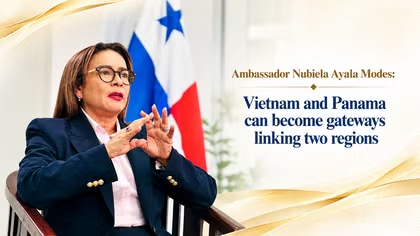
Vietnam and Panama can become gateways linking two regions

Vietnam and Panama can become gateways linking two regions

"Panama can serve as a strategic platform for Vietnamese companies seeking greater access to Latin America and the Caribbean, while Vietnam represents an important gateway for strengthening Panama’s engagement with Southeast Asia", Ambassador Nubiela Ayala Modes confirmed.

Localities committed to achieving 2026 growth targets

Localities committed to achieving 2026 growth targets

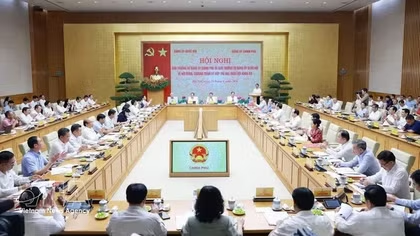
Localities nationwide hailed effective and flexible directions delivered by the Government so far this year, resulting in positive nine-month socio-economic growth, and reaffirmed their commitment to achieving targets set for the whole 2026 at an online Government-locality conference on October 3.

Creating new drivers for Vietnam-Canada cooperation

Creating new drivers for Vietnam-Canada cooperation

The elevation of bilateral ties to a Strategic Partnership shows that Vietnam and Canada increasingly view each other not simply as trading partners, but as long-term partners in addressing economic, technological and regional challenges.

Top leader asks for sports development to build national strength

Top leader asks for sports development to build national strength

The top leader applauded the efforts of ministries, sectors, localities, social organisations, coaches, athletes, experts in developing physical education and sports in recent times, stressing that Resolution No. 08 has provided an important political foundation for sports development over the past 15 years, while Conclusion No. 70 set important orientations for the new period.

Vietnam mobilises resources to affirm its leadership role in APEC 2027

Vietnam mobilises resources to affirm its leadership role in APEC 2027

PSNews - Vietnam is recognised by its partners as an influential member of the Asia-Pacific Economic Cooperation (APEC) forum, with expectations that it will continue to demonstrate leadership when it hosts APEC for the third time in 2027, according to Standing Deputy Minister of Foreign Affairs Nguyen Minh Vu.

Top Vietnamese leader receives Chairman of Japan Bank for International Cooperation

Top Vietnamese leader receives Chairman of Japan Bank for International Cooperation

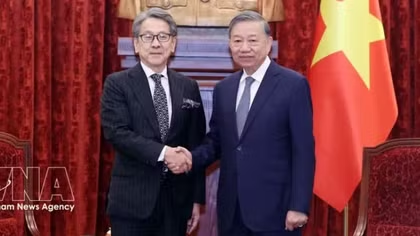
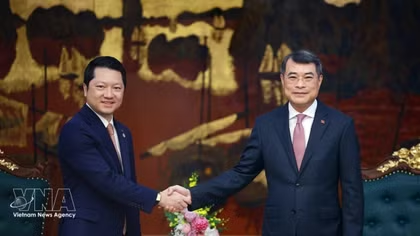
General Secretary and President Lam urged JBIC to continue promoting the substantive implementation of projects under the Asia Zero Emission Community (AZEC), and step up discussions on potential cooperation within the framework of the POWERR Asia (Partnership on Wide Energy and Resources Resilience Asia) initiative, including the development of strategic energy reserves.

NA, Government's Party committees meet on legislature's second session agenda

NA, Government's Party committees meet on legislature's second session agenda

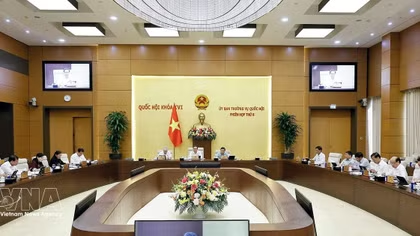
National Assembly President Tran Thanh Man coordination must go beyond finishing the agenda to improve the quality of NA decisions and Government enforcement; deal with policies rather than just paperwork, especially in the fight against corruption and other negative phenomena; and pin down final responsibility for each product, not just progress.

Prime Minister receives Cambodian Minister of Inspection

Prime Minister receives Cambodian Minister of Inspection

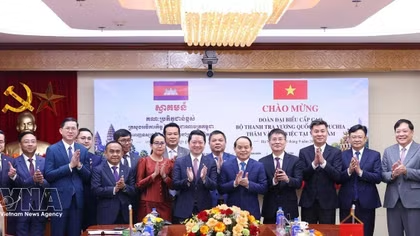
Prime Minister Le Minh Hung asked the two countries' inspection agencies to build on their achievements by regularly exchanging information and experience, maintaining delegation exchanges, and coordinating inspections in areas related to bilateral economic, trade and investment cooperation.

Urgent action needed to address law enforcement as weak link: Top leader

Urgent action needed to address law enforcement as weak link: Top leader

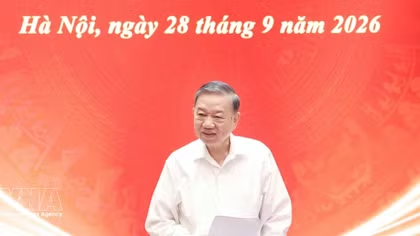
General Secretary of the Communist Party of Vietnam Central Committee and President To Lam on September 28 called for urgent and fundamental improvements in law enforcement, stressing that legislation and its enforcement must form a unified whole and ultimately serve development, protect legitimate rights and interests, and strengthen public trust.

Vietnamese, Cambodian inspectors reinforce collaboration

Vietnamese, Cambodian inspectors reinforce collaboration

The Government Inspectorate of Vietnam broadly accepted the Cambodian ministry's proposals to maintain, renew and make more effective regular meetings between professional units and training establishments, and increase exchanges of senior, expert and specialised working-group delegations.