Erdogan Tries to Patch Up Relations With EU After Year of Finger-Pointing

Turkey and the European Union have had an ongoing spat since 2016 after Brussels expressed strong criticism of Ankara over mass arrests in the country, connected with the failed coup attempt. Despite Turkey's courting of the bloc with a view to entering it, negotiations have been halted.

Turkish President Recep Tayyip Erdogan has decided to change his stance towards Europe after a year of strained relations, confessing it in front of journalists aboard a plane from Chad to Tunisia on Thursday.

"I always say this: We are obliged to lessen the number of foes and increase the number of friends. We have no problems with Germany, the Netherlands or Belgium. To the contrary, those who are in the governments of these countries are my old friends," Erdogan stated.
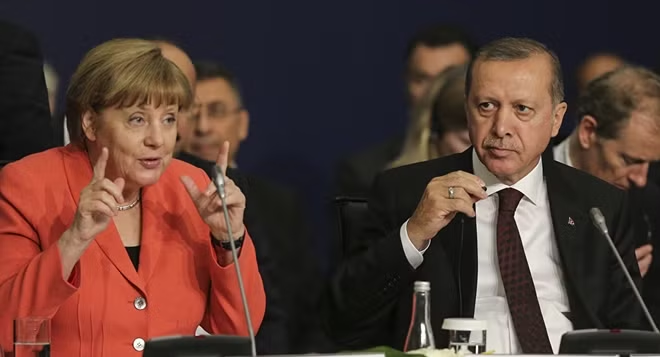
Source: AP
Source: AP

Out of all the EU members, Turkey has the most strained relations with Austria and Germany: the first one has repeatedly urged the country to end its accession bid, while the other has been insisting on the review of the bloc's economic policies due to arrests of human rights activists in Turkey.

However, Erdogan has described Germany's, Netherlands' and Belgium's governments as "old friends," noting that their last contacts were "quite good," especially regarding the Jerusalem issue.

"We had problems, but our latest meetings have gone very well. I asked for their support on Jerusalem; we are all on the same page. I have called [German President Frank Walter] Steinmeier to thank him. [Dutch Prime Minister Mark] Rutte sent some signals to improve ties with us. These are satisfactory. We, of course, hope to have good ties with the EU and EU countries," Erdogan emphasized.    

"Well, they did me wrong. Otherwise, I used to have good meetings with Rutte; Belgium in the same way. No need to mention Germany. My contacts with both Steinmeier and [German Chancellor Angela] Merkel have always been very good," he said.    

The Turkey-EU ties unravelled in November 2016, when the European Parliament suspended Turkish accession talks, following a constitutional referendum greatly expanding Erdogan's powers in April 2017, which prompted the EU to vote to reopen the monitoring process against Turkey.

Erdogan's statements look especially controversial in the light of his October's remarks, claiming that Turkey didn't need EU membership anymore.

Sputnik News

Other News

Vietnam supports UNESCO's people-centred approach, multilateral cooperation: official

Vietnam supports UNESCO's people-centred approach, multilateral cooperation: official

Van affirmed Vietnam’s support for the UNESCO80 reform roadmap, focusing on the organisation’s core mandate, priority areas, interdisciplinary approach, and the special status of the Vietnam National Commission for UNESCO, and UNESCO representative offices, alongside efforts to diversify resources and strengthen global partnerships to enhance the organisation’s effectiveness.

Regional media highlight significant step in Vietnam’s leadership structure

Regional media highlight significant step in Vietnam’s leadership structure

Under General Secretary and President Lam’s leadership, Vietnam is expected to maintain a balanced foreign policy, strengthen its regional standing and accelerate economic development, thereby improving living standards and creating new opportunities for international investors, according to the India-based platform Devdiscourse.

Laos identifies 10 key tasks to build independent, self-reliant economy

Laos identifies 10 key tasks to build independent, self-reliant economy

Laos will step up agricultural production to ensure food security, meet domestic demand and expand exports; encourage the development of agro-processing industries, including those related to rubber, aquatic products, cassava and sugarcane, as well as fertiliser and animal feed production, in order to increase added value and create jobs in rural areas.

Malaysia steps up cyber security resilience

Malaysia steps up cyber security resilience

To ensure accountability, Malaysia plans to finalise the Cybercrime Bill this year which addresses both cyber-dependent and cyber-enabled offences, introducing stricter penalties and prison terms to enhance deterrence.

US public opinion positive about PM Pham Minh Chinh’s visit

US public opinion positive about PM Pham Minh Chinh’s visit

Public opinion in the US is generally positive about Vietnamese Prime Minister Pham Minh Chinh’s trip to the US from September 17-23 to attend the 78th session of the United Nations General Assembly, which took place immediately after the upgrading of the Vietnam - US relations to a comprehensive strategic partnership on the occasion of US President Joe Biden’s official visit to Vietnam.