- No new COVID-19 cases confirmed on October 6 morning
- Kremlin critic Navalny discharged from Berlin hospital
- Russia says it has timeline of Navalny movements, wants to send investigators to Germany
 |
| Navalny |
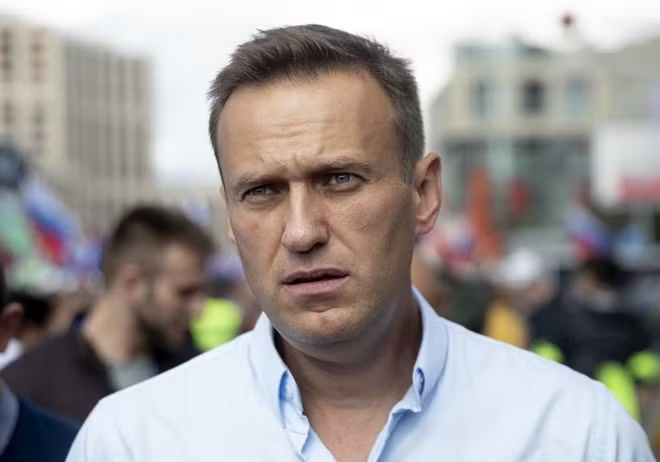
Director of Russia’s Federal Security Service Alexander Bortnikov, First Deputy Chief of Staff of the Presidential Administration Sergei Kiriyenko and four other high-ranking Russian officials were put on the EU’s blacklist against Russia over the incident with blogger Alexey Navalny, the Council of the European Union said, according to the EU Official Journal.
The sanctions list also includes the State Scientific Research Institute for Organic Chemistry and Technology (GosNIIOKhT). EU businesses will be banned from maintaining any ties with the institute.
The EU restrictions stipulate an entry ban and freezing financial assets in European banks.
Russian opposition figure Alexei Navalny fell gravely ill during a domestic flight on 20 August and was rushed to an Omsk hospital after an emergency landing in the city.
The doctors managed to save his life and stabilise his condition, although the activist fell into a coma. Medics there also ran tests on his blood and urine amid claims of the activist having been poisoned, but found no traces of chemicals proving such a theory.
Two days after his hospitalisation, Navalny was transferred to the Charite clinic in Germany at the behest of his family. Doctors there found traces of acetylcholinesterase inhibitor in his blood, which are used among other things in a number of medicines.
Over a week after his arrival at Charite, German authorities claimed on 2 September that their military laboratories had determined that Navalny was poisoned with a military-grade nerve agent from the Novichok group.
The Organisation for the Prohibition of Chemical Weapons (OPCW) later ran a separate test of Navalny's blood, stating in its conclusion on 6 October, that the cholinesterase inhibitors found are similar to Novichok agents, but are not on the list of prohibited chemicals.
Berlin accused the Russian authorities of being responsible for that and demanded an "explanation" from Moscow. Personnel at the Charite clinic never seconded the German authorities conclusion. However, after coming out of a coma on 7 September, the opposition politician gave an interview to the German magazine Der Spiegel, in which he also accused the Kremlin of being behind the alleged poisoning.