- Russian future-gen fighter jet will ‘burn homing missiles with laser defense’
- Russian scientists finish aircraft 'nervous system' to improve flight safety
- Moscow says preparing ‘tough response’ to US closure of Russian diplomatic compounds
- Internationally wanted Russian drug dealer arrested Vietnam
The updated blacklist includes Russian Deputy Energy Minister Andrey Cherezov, the head of the department of operational control and management in Russia's electric power industry Evgeniy Grabchak and state firm Technopromexport CEO Sergey Topor-Gilka.
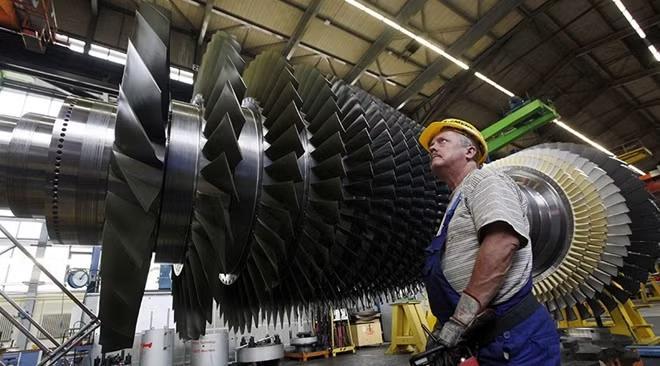 |
| An employee prepares to lift the rotor coil of a Siemens AG Gas Turbine class H is seen at the German industrial giant Siemens historic construction plant in Berlin. Photo: RT |
"Establishing an independent power supply for Crimea and Sevastopol supports their separation from Ukraine, and undermines the territorial integrity, sovereignty and independence of Ukraine. Gas turbines are a substantial element in the development of new power plants," the EU said in a statement.
Western companies are not allowed to do business in the Crimea. The region is under EU and US sanctions since voting to rejoin Russia in a referendum three years ago.
Last month, Siemens said four of its gas turbines, designed for the project in Taman, were illegally delivered to the Crimea by a Russian contractor. Taman is a peninsula in the Krasnodar region of Russia not far from the Crimea.
The German firm says it intends to terminate licensing agreements with Russian companies which supply equipment for power plants and suspend deliveries under existing contracts to Russian state companies. Siemens said it would lose up to $200 million from its $1.2 billion Russian revenue.
Siemens says it wants to buy back the turbines, but Russian contractor Technopromexport says it has not yet received a proposal.
The United States and the European Union imposed sanctions against the Crimea after the region of mostly ethnic Russian people voted to break away from Ukraine and rejoin Russia in a 2014 referendum. The restrictions oblige all Western companies to leave the peninsula.
After reunification, Crimea faced problems with electricity because nearly all of its power came from Ukraine. In November 2015, the peninsula declared a state of emergency after four power lines from Ukraine providing electricity to the region were blown up, leaving Crimea in total blackout.
The problem was solved by installing a power transmission cable under the Kerch Strait from mainland Russia.