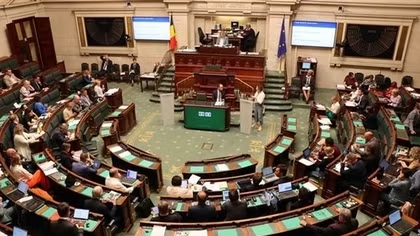
Divided and slow to respond at the start of the coronavirus outbreak in Europe, EU leaders believe they now have a chance to redeem themselves with an aid plan that would show Europeans the bloc can react to a crisis.
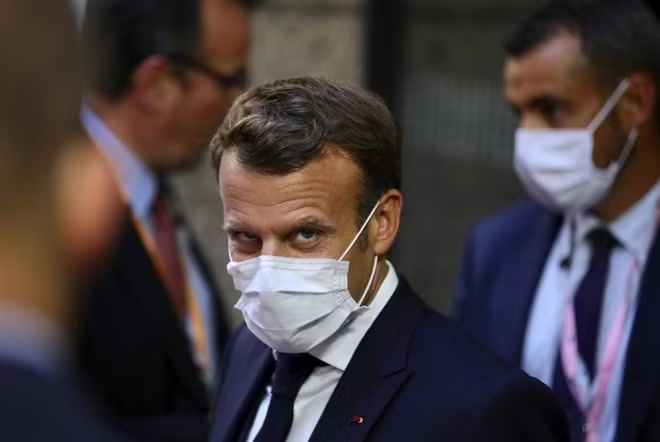 |
| French President Emmanuel Macron |
But old grievances between countries less affected by the pandemic and the indebted countries of Italy and Greece, whose economies are in freefall, have resurfaced, pitting Rome against The Hague and its allies in Stockholm, Copenhagen and Vienna.
With leaders not expected to restart until 1400 GMT, much rested on European Council President Charles Michel’s efforts to present a new basis for a deal, taking into account the competing demands of north and southern Europe.
“An agreement is a necessity”, French Finance Minister Bruno Le Maire told French BFM TV on Monday as weary diplomats slept or prepared for another day in what could be the longest-ever EU summit.
In the small hours of Monday, French President Emmanuel Macron lost patience with the “sterile blockages” of the Netherlands, Sweden, Denmark and Austria, later joined by Finland, banging his fist on the table, one diplomat said.
Another diplomat confirmed the outburst, saying tensions rose until Belgium’s Prime Minister Sophie Wilmes called for calm.
Michel earlier urged the 27 leaders to achieve “mission impossible”, reminding them that more than 600,000 people had now died from COVID-19 around the world.
That appeared to edge towards a potential breakthrough.
“We are not there yet, things can still fall apart. But it looks a bit more hopeful than at the times where I thought last night that it was over,” Dutch Prime Minister Mark Rutte said.
Within the 750 billion euro recovery fund, 390 billion euros could be considered as non-repayable grants, diplomats said, a compromise between the 350 billion level of the five “frugals” and the 400 billion euros demanded by France and Germany.
There was no immediate clarity on whether a deal was in the making, but Austrian Chancellor Sebastian Kurz told ORF radio he was satisfied with the negotiations.
“It was definitely the best decision that the group of the frugals...has been formed,” Kurz said. “There were the four of us, now there are five of us. These are all small countries, which alone would have no weight at all.”
ECB CALLS FOR AMBITION
Issues over tying payouts to economic and democratic reforms were still to be resolved, although Spain signalled willingness to put up with some conditions being attached to aid.
“We don’t reject conditionality,” Foreign Minister Arancha Gonzalez Laya told Cadena SER radio. “We need a basis that gives confidence to us and to our partners.”
European Central Bank (ECB) President Christine Lagarde cautioned against a quick deal at any cost.
“Ideally, the leaders’ agreement should be ambitious in terms of size and composition of the package...even if it takes a bit more time,” she told Reuters.