Experts describe value of palace in Thai Binh

A recent international workshop held in the northern province of Thai Binh once again confirmed the value of Lo Giang Palace built during the Tran Dynasty (1225-1400).

Experts from domestic institutes and seven foreign scientists from Japan, the Republic of Korea and China gathered on November 30 to review recent excavations and propose preservation plans for the site.

Lo Giang Palace is a system of royal buildings outside Thang Long Citadel that were used to provide accommodation for the king.

Many palaces were built under the Tran reign but not many still exist.

According to researchers, rare materials had been found at Lo Giang Palace that were unlike finds at other Tran palaces including Thien Truong (Nam Dinh province) and Vu Lam (Ninh Binh province).

Scientists from the Institute of Imperial Citadel Studies conducted excavations in 2014, 2015 and 2017 at Hong Minh commune in Hung Ha district and discovered various building materials and daily utensils, and the foundations of stone pillars at Thai Temple.
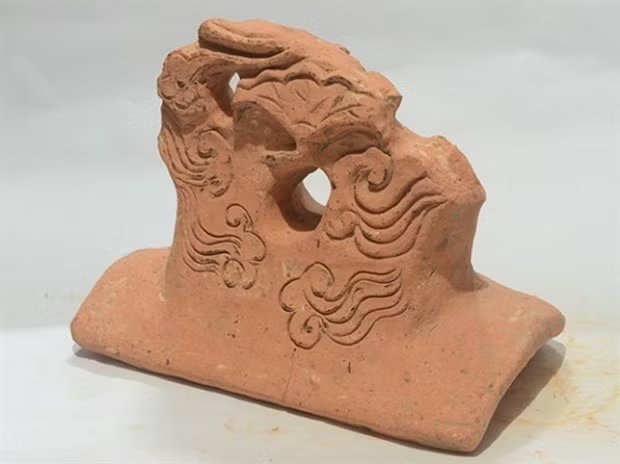
Decorative pattern of a dragon and cloud found at the site (Photo: giaoduc.net)
Decorative pattern of a dragon and cloud found at the site (Photo: giaoduc.net)

This is an important discovery as this is the first time we have found wooden architecture from the Tran Dynasty built on rectangular pillar foundations,” said Prof Bui Minh Tri, rector of the institute. “The remains of the pillars here are very big. It means the pillars must have been huge to hold up a very large building with many floors.”

Tri said the same form of pillars had been found at Thang Long Citadel which were built under the Ly Dynasty (1009-1225), but they were much smaller.

Tri said the palace at today’s Tran Temple (Thai Lang) might have used by kings Tran Nhan Tong (1278-1293) and Tran Anh Tong (1293-1314), and was also home to Kien Xuong Palace built under King Tran Hien Tong’s reign (1329-1341), according to records.

Experts confirmed that Lo Giang Palace covered a total area of 554sq.m.

They found various decoration details with dragon figures; pieces of tiles featuring the face of a lion and carving of a Chinese character with the word “King”.

The building must have been an important place, Tri said.

“Lo Giang Palace seems to have been a big and important palace during the Tran Dynasty in the ancient Long Hung Region,” Tri said. “It shows that the area was not only the place where Tran kings started their reigns because it was also used for important national events.”

Nguyen Thi Linh, Vice Chairperson of the provincial People’s Committee, said the authorities had assigned Hung Ha district to coordinate with the institute to construct a roof to protect Thai Temple and other remnants unearthed at Lang Sa.

Authorities will compile a dossier to ask the culture ministry for a national level historic relic title for the site and call for investment to preserve the palace.

Lo Giang Palace and Kien Xuong Palace are both mentioned in Dai Viet Su Ky Toan Thu (The Complete Annals of Dai Viet): “In 1293, the king’s mother passed away in Lo Giang Palace, Long Hung, her body was kept temporarily in Long Hung Palace; …in 1341, King Tran Hien Tong passed away, his body was kept temporarily at Kien Xuong Palace."

Linh said thanks to the discoveries, the province planned to develop the value of the palace and connect overall culture heritage in neighbouring areas for the purpose of socio-economic development of Hung Ha district and Thai Binh province.
VNA

Other News

Vietnam secure berth at FIFA U17 World Cup 2026 for first time

Vietnam secure berth at FIFA U17 World Cup 2026 for first time

Vietnam national U17 football team secured a place at the FIFA U17 World Cup 2026 for the first time after defeating United Arab Emirates national U17 football team 3-2 on in the final Group C match of the AFC U17 Asian Cup 2026 in Saudi Arabia on early May 14 (Vietnam time).

Vietnam’s most beautiful railway station twins with French counterpart

Vietnam’s most beautiful railway station twins with French counterpart

A twinning agreement between Da Lat Railway Station in Vietnam and Trouville-Deauville Railway Station in France was signed at the French Embassy in Vietnam on May 7, creating new opportunities for cooperation in station management and operations, as well as cultural and tourism promotion between the two sides.

Hanoi gains two more craft villages in World Crafts Cities network

Hanoi gains two more craft villages in World Crafts Cities network

The recognition of Chuyen My and Son Dong craft villages as members of the World Crafts Cities network represents international acknowledgement of the cultural value, artisanal techniques, creativity and sustainable vitality of Vietnam’s traditional craft villages, he said.

Thang Long - Hanoi Festival 2026 to return in September

Thang Long - Hanoi Festival 2026 to return in September

Co-hosted by the municipal People’s Committee, the Department of Culture and Sports, and domestic and foreign agencies, the whole spectacle is meant to honour the city’s millennia-old heritage while reafffirming its strategy of establishing culture as a development engine.

Spreading Vietnamese cultural identity in digital space

Spreading Vietnamese cultural identity in digital space

In the context of deep international integration, cultural identity serves as both a “shield” against assimilation and a defining marker of a nation’s image. Protecting and promoting uniquely Vietnamese cultural values has therefore become a pressing task, particularly in an increasingly complex digital environment.

ITE HCMC 2026 to promote Vietnam’s tourism on global map

ITE HCMC 2026 to promote Vietnam’s tourism on global map

With its large scale, the ITE HCMC 2026 aims to promote tourism cooperation between Vietnam and priority markets such as Northeast Asia, Western Europe, North America, Southeast Asia, and Oceania while also boosting visitor arrivals from the Indian market

Vietnamese puppetry seeks renewal amid preservation challenges

Vietnamese puppetry seeks renewal amid preservation challenges

Although widely regarded as a cultural “speciality” attracting tourists, Vietnamese puppetry is facing multiple challenges in preservation and development, requiring renewed efforts to both safeguard its identity and adapt to contemporary cultural currents.

Project on digital transformation in cultural sector approved

Project on digital transformation in cultural sector approved

By 2030, the project targets the establishment of shared digital platforms across 100% of cultural sectors. All digitised cultural heritage will be standardised under the national data framework and shared in accordance with regulations, while 80% of public digital heritage assets are expected to receive digital identifiers to clarify ownership and management, encouraging organisations and individuals to do the same and support market development.

Vietnam eyes becoming region’s leading tourism destination

Vietnam eyes becoming region’s leading tourism destination

Vietnam has in recent years undergone a notable transformation in its tourism development strategy, placing a strong emphasis on nature-based and eco-tourism. This shift is not merely aligned with global trends, but represents a necessary step towards safeguarding valuable natural resources, while appealing to a growing segment of environmentally conscious travellers.