This precious collection of golden books is considered the most special exhibition of the sacred heritages of the Nguyen Dynasty.
Only 22 of the 94 golden books of the Nguyen Dynasty were chosen for display at the Vietnam National Museum of History.
These books epitomize the historical, economical, and cultural significance of the 13 Nguyen reigns from 1802 to 1945.
Dinh Ngoc Trien, Head of the Artifact Management Division of the Vietnam National Museum of History, said, "According to our statistics on the 13 reigns, Gia Long had 36 golden books, Minh Mang had 9, Thieu Tri had 12, Tu Duc had 7, Kien Phuc had 1, Ham Nghi had 2, Dong Khanh had 3, Thanh Thai had 10, Duy Tan had 1, Khai Dinh had 8 and Bao Dai had 5.
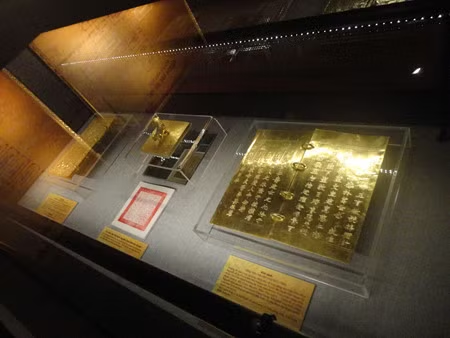 |
On September 2, 1945, the Government of the Democratic Republic of Vietnam received the collection, one of thousands of other heritages, from King Bao Dai at his abdication ceremony in the Hue Royal Palace.
In 2007, the State Bank of Vietnam handed over the precious artifacts of the Nguyen Dynasty to the Vietnam National Museum of History for preservation.
Golden books are ancient documents with records of important royal events such as state affairs and imperial ceremonies. Golden books also record achievements by a royal family member, a King, a Queen, a Prince, or other royal family member, or political events like naming a prince or conferring a title on a family member.
This is part of the legacy of the royal family, according to Mr. Phan Thanh Hai, Director of the Hue Monuments Conservation Centre.
Compared to other dynasties, during the Nguyen Dynasty, filial piety was strongly featured. It was reflected through all ancestral shrines and honoring of the ancestors. Golden books provide evidence of that.
Books of gold were used only for the King, the Queen, and the Queen Mother. Books of silver or gold-plated copper or bronze were used for subordinates and other occupations. The contents of the golden books were compiled by the Kings themselves or high-ranking mandarins.
They were manufactured by book artisans in the Ministry of Rituals. Golden books always have a length of 24 – 28 cm and a width of 13- 16 cm. Each golden book consists of 13- 14 Chinese character pages.
They are covered by 2 pages with royal decorative patterns of dragon, clouds, phoenix …. Golden books were kept in a silver or wooden box, depending on the tastes and skills of the artisan.
Researcher Nguyen Hong Tran said, "I’m so impressed by this exhibit with stunning golden books like these. They are bright, they are beautiful, and very meaningful. It’s great that the Kings thought of making golden books. In each reign, each King’s achievements and contributions to the country are recorded in golden books. In the past, a diamond knife was used to carve Chinese characters. Only people with beautiful hand-writing were employed. It’s meticulous work."
"After 143 years in power over 13 reigns, the Nguyen Dynasty has left an impressive mark on Vietnam’s cultural and historical values. For patriotism, I’m most impressed by the Thanh Thai Duy Tan reign. For culture, King Minh Mang was the one with lots of reforms and new ideas. King Thieu Tri was a thoughtful and considerate person, he said.
Through the golden books, visitors can learn the character and achievements of each reign of the Nguyen Dynasty as well as each King’s background and major achievements during his rule.
Among the 22 books on display, a poem by King Minh Mang which consists of 15 pages is the heaviest and most aesthetic item.
Dang Thi Hien, a museum employee, talked about items from the Gia Long reign, "This is the golden book about King Gia Long conferring a title on Lord Nguyen Hoang, who made a significant contribution to the establishment of the Nguyen Dynasty in the south. And these are golden books about Gia Long conferring titles on Lord Nguyen Phuc Chu and his wife."
"Nguyen Phuc Chu was the 6th Lord of the Nguyen Dynasty, who created the examinations for the royal court and developed the national military. Thanks to this, the southern regions have since developed rapidly. Until 1709, Lord Nguyen Phuc Chu ordered the casting a seal, proclaiming national sovereignty," he said.
The exhibition also intrigued many international visitors. Hillary, a visitor from the UK, said that she saw the golden books exhibit as soon as she came in.
She said, "I’ve never heard of them before, they are very beautiful so we just had a look around the ornate carvings, the work on the outer leaves of the book, it’s fantastic and actually I can read a little Chinese characters so it’s quite interesting to see a few words here and there. The Dynasty was in power for so long. It’s very interesting to find out a little bit more."
The collection also serves as a rich resource for archeologists, cultural and historical researchers who wants to learn more about the imperial treasures of Vietnam.
The golden books of the Nguyen Dynasty provide insights into the cultural, historical and many other aspects of the Nguyen Dynasty, in particular, and Vietnam’s feudal regime, in general.