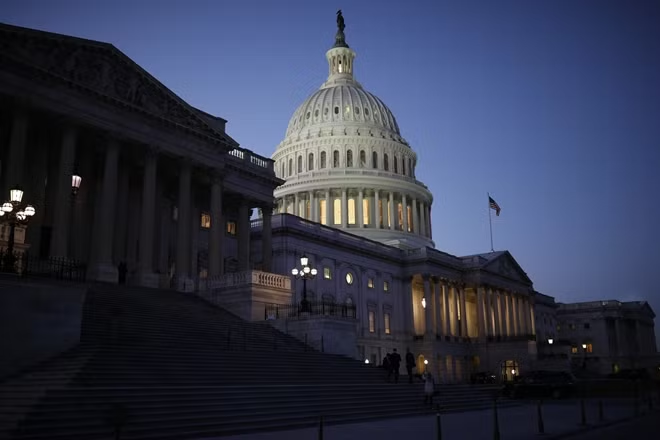
It's an unprecedented situation given that shutdowns usually happen in times of divided government. But this is the first time it's happened with one party controlling both Congress and the White House.
Since most government offices won't open again until Monday, there is time over the weekend for legislators to reach a compromise, and House members have been kept in Washington, D.C., in case that happens.
At midnight, talks among Senate leaders were still happening on the Senate floor after a procedural vote late Friday lacked the 60 yes votes needed to advance a four-week funding bill that the House passed on Thursday.
Around 12:15 a.m. ET, Senate Majority Leader Mitch McConnell voted no on the stopgap measure, doing so for procedural reasons that allowed him to the preserve the ability to bring up a substitute bill later. The final vote was 50-49, with Sen. John McCain, R-Ariz, absent from the vote.
The apparent congressional paralysis risked overshadowing the first anniversary of President Trump's inauguration and capped off a year defined at times by chaos and frustration from both the White House and congressional Republicans despite their unified control of Washington.
And it comes after days of hurried negotiations to find a compromise failed, leading to finger-pointing from both parties eager to shift the blame to the other side.
Republicans and McConnell were angling for a four-week continuing resolution, that included extending the popular Children's Health Insurance Program (CHIP) for six years in an effort to entice Democrats to vote for the insurance program they want to fund.
 |
But Democrats and Senate Minority Leader Chuck Schumer, D-N.Y., were pushing to include an immigration measure that would include a pathway to citizenship for roughly 700,000 immigrants enrolled in the Deferred Action for Childhood Arrivals (DACA) program the Trump administration rescinded last year. Democrats wanted a pathway to citizenship for those roughly 700,000 immigrants who were in the country illegally after being brought here as children.
Republicans blamed Democrats for angling for the DACA legislative fix over keeping the government open, using the hashtag #SchumerShutdown and launching an accompanying website focused on Schumer.
Shortly before midnight, the White House released a statement blasting Democrats as "obstructionist losers."
"Senate Democrats own the Schumer Shutdown. Tonight, they put politics above our national security, military families, vulnerable children, and our country's ability to serve all Americans. We will not negotiate the status of unlawful immigrants while Democrats hold our lawful citizens hostage over their reckless demands. This is the behavior of obstructionist losers, not legislators," White House press secretary Sarah Sanders said. "When Democrats start paying our armed forces and first responders we will reopen negotiations on immigration reform. During this politically manufactured Schumer Shutdown, the President and his Administration will fight for and protect the American people."
However, the hashtag #TrumpShutdown was also trending on Twitter late Friday night, and Democrats believe that it's Republicans who will end up shouldering the majority of blame from the public given the GOP controls both Congress and the White House.
Trump appeared to complicate efforts to reach a compromise over the past weeks, at first signaling he would sign any immigration deal but then rejecting a bipartisan proposal, bending to his conservative, hardline base and insisting any deal had to have funding for his trademark border wall. And negotiations further stalled after Trump reportedly used a vulgarity in questioning why the U.S. should welcome immigrants from Africa instead of places like Norway. (Trump has denied that he used that language.)
Polling released Friday from both Washington Post/ABC News and CNN found that most Americans would blame Trump and Republicans over Democrats in the event a shutdown occurred. However, CNN also found a majority said approving a budget deal was more important than finding a way to advance DACA.
If the shutdown continues, essential services will continue and essential workers would remain on the job, though unpaid. Active duty military will be unaffected, along with postal services. In a change from the last time the government shut down in October 2013, the Interior Department announced they will work to keep national parks open and "as accessible as possible."