Government urges rollout of EV charging infrastructure in apartment buildings

The Ministry of Construction has been tasked with completing urban planning standards with green transport infrastructure taken into account, including charging stations, by the second quarter of 2026.

Prime Minister Pham Minh Chinh has issued a dispatch directing ministries, sectors and localities to accelerate the development of electric vehicle (EV) charging infrastructure in urban areas and apartment buildings.
Government urges rollout of EV charging infrastructure in apartment buildings -0
Government urges rollout of EV charging infrastructure in apartment buildings

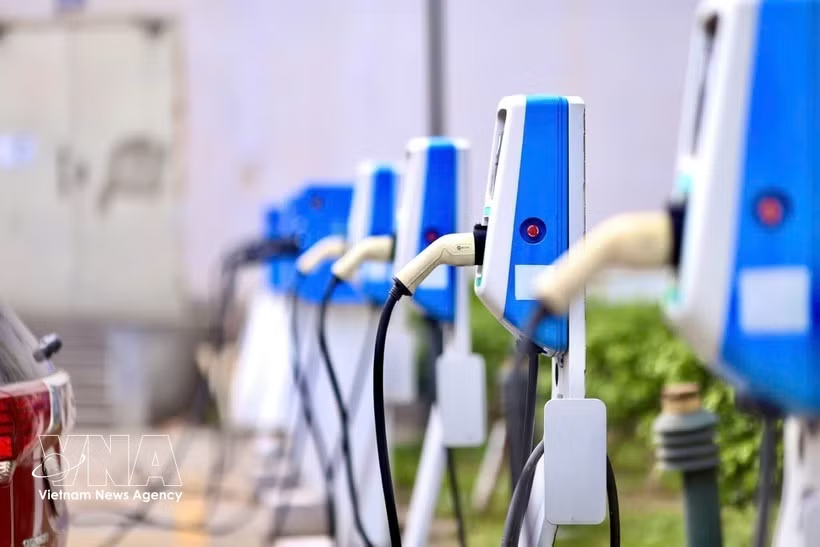
Dispatch No. 27/CD-TTg, dated March 31, 2026, highlights that the transition to electric transport is an inevitable trend aligned with the country’s goals on green growth, digitalisation and energy transition. However, the development of charging stations, parking facilities and battery-swapping points in residential areas remains limited and inconsistent. Many urban projects lack adequate parking planning to meet EV charging demand, placing pressure on internal power systems and raising concerns over fire safety.

To address these challenges, PM Chinh requested ministries, agencies and provincial authorities to improve communications, ensure transparency in planning information, and review and update policies, standards and regulations related to EV infrastructure. He stressed the need for strict supervision to prevent corruption, wastefulness and vested interests during implementation.

The Ministry of Construction has been tasked with completing urban planning standards with green transport infrastructure taken into account, including charging stations, by the second quarter of 2026. It must also revise national technical regulations for apartment buildings to provide detailed guidance on the design, installation and incident response for charging systems, with a deadline set for April 30, 2026.

In addition, the ministry will work with relevant agencies to remove bottlenecks in licensing procedures for installing or upgrading charging stations at existing residential buildings. It is also required to review the implementation of the national action programme on green energy transition in transport to propose necessary adjustments.

Meanwhile, the Ministry of Industry and Trade has been assigned to develop and issue national technical standards on safety and energy efficiency for charging equipment and systems by the third quarter of this year. It will also encourage the adoption of electric and clean-fuel vehicles, as well as the use of public transport vehicles.

Vietnam Electricity (EVN) has been instructed to enhance power demand management and simplify procedures for grid connection and separate metering for charging stations in apartment complexes, ensuring transparency in electricity usage and billing.

Local authorities are required to review planning and ensure the allocation of land and infrastructure for EV charging systems, while guiding investors and apartment buildings' management boards to deploy and use charging facilities safely and efficiently./.

VNA

Other News

Overseas employment must become channel for developing Vietnam's human resources: official

Overseas employment must become channel for developing Vietnam's human resources: official

Under the revised Law on Vietnamese Guest Workers under Contract, priority is given to sending trained workers with professional and technical qualifications abroad so that they can improve their incomes, gain access to advanced technology and modern governance practices, and develop vocational skills, foreign languages, labour discipline and industrial working styles.

Storm brings heavy rains to northern Vietnam

Storm brings heavy rains to northern Vietnam

Storm Narra, the fourth to hit the East Sea this year, brought strong winds and heavy rains to northern Vietnam on early August 22, with some areas forecast to receive more than 500mm of rain as the storm moves slowly over the northern waters of the East Sea.

Finance ministry moves to cut business costs, spur growth

Finance ministry moves to cut business costs, spur growth

Tax policy is among the solutions with the most direct impact on companies. Rather than prioritising near-term revenue collection, fiscal policy is being run to help them preserve cash flow, expand production and build more sustainable revenue sources.

More than 1,700 war martyrs' remains recovered

More than 1,700 war martyrs' remains recovered

The national steering committee will continue verifying information on suspected martyrs’ graves in key areas, including Tan Son Nhat Airport in Ho Chi Minh City, Quan Y Bac Son Hill in Dong Nai, the Con Tien base area in Quang Tri and former Vi Xuyen battlefields in Tuyen Quang.

Hanoi to provide free textbooks from 2026–2027 school year

Hanoi to provide free textbooks from 2026–2027 school year

The municipal Department of Education and Training will work with the Department of Finance to guide wards, communes and educational institutions in implementing the student support policies adopted by central authorities and the municipal People’s Council.

Vietnamese students shine at AIMO 2026 international finals

Vietnamese students shine at AIMO 2026 international finals

The Vietnamese team won one Champion title, four First Runner-up awards, three Second Runner-up awards, 42 gold medals, 83 silver medals, 70 bronze medals and two consolation prizes at the 2026 International Finals of the Asia International Mathematical Olympiad Open Contest (AIMO) held in Hanoi on August 2-5.

Politburo's Resolution 57-NQ/TW powers new growth momentum

Politburo's Resolution 57-NQ/TW powers new growth momentum

NSO Director Nguyen Thi Huong said alongside foreign investment and the green economy, science – technology, innovation, the digital economy and digital transformation are the new drivers that can can pack a serious second-half punch.

Vietnam’s poverty reduction miracle: A journey for the people

Vietnam’s poverty reduction miracle: A journey for the people

From a country where more than 50% of the population lived below the poverty line in the early 1990s, Vietnam has reduced its poverty rate to just 2.95% today. This achievement reflects not only the effectiveness of socio-economic development policies, but also Vietnam’s ability to translate growth into tangible opportunities for its people, steadily realizing inclusive development and ensuring that no one is left behind.