Green tourism – an emerging trend in post-COVID-19 landscape

The growing trend of green tourism and rural tourism experience is anticipated to thrive in the near future as it starts to replace traditional tourism services at hotels and resorts, according to Ngo Hoai Chung, deputy director of the Vietnam National Administration of Tourism (VNAT).

Visiting Cao Phong orange orchard in Hoa Binh province

Visiting Cao Phong orange orchard in Hoa Binh province

Chung notes that eco-agriculture and healthcare tourism models are expected to provide a boost to tourist numbers, with the demand for high-end services at resort farms poised to increase considerably in the future.

Luu Duc Ke, deputy director of Viet Media Travel Corporation, says Hanoians typically try to escape the bustle of city life and seek eco-tourism sites in order to experience rural life. In addition, the eco-agriculture tourism model will serve to increase the acceleration of socio-economic developments in various localities.

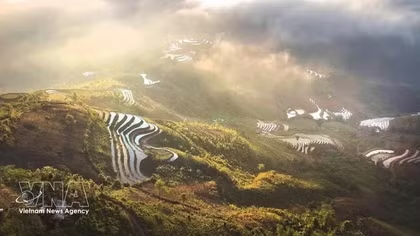
According to the travel executive, tours for the purpose of savouring scenic views of terraced fields during the ripening rice season in the northern mountainous districts of Mu Cang Chai, Hoang Su Phi, and Pu Luong, or orchard gardens in Luc Ngan district, 113km away from Hanoi capital, can be considered a diverse tourist experience for visitors.

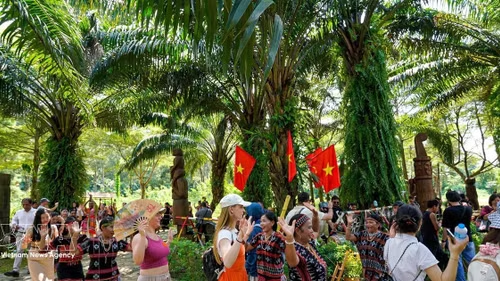
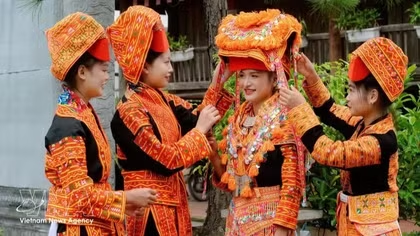
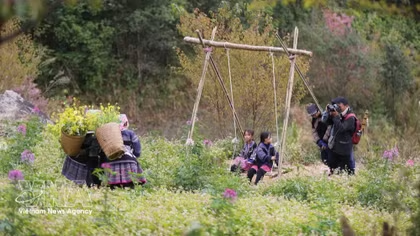
Meanwhile, guests visiting the northern mountainous province of Ha Giang are able to gain greater insights into the unique culture and customs of ethnic minority groups through participating in interesting activities alongside farmers, such as growing vegetables, or processing bee honey or “snow Shan tea”.

The central province of Quang Nam has designed tours, enabling guests to experience a range of farming activities, explore the real life of local farmers, and gain knowledge of the history and culture of regional craft villages.

These tours take visitors to sites such as Thanh Dong vegetable village, Thanh Ha pottery village, Trem Tay village, Dai Binh fruit village, Loc Yen ancient village, and Tra Que vegetable village.

According to the UN’s projections, 68% of the world's population will be living in urban areas by 2050. This means that the trend of eco-agriculture tourism will only increase in the future as tourists turn to green nature to enjoy a new experience.

VOV

Other News

Vietnam secure berth at FIFA U17 World Cup 2026 for first time

Vietnam secure berth at FIFA U17 World Cup 2026 for first time

Vietnam national U17 football team secured a place at the FIFA U17 World Cup 2026 for the first time after defeating United Arab Emirates national U17 football team 3-2 on in the final Group C match of the AFC U17 Asian Cup 2026 in Saudi Arabia on early May 14 (Vietnam time).

Vietnam’s most beautiful railway station twins with French counterpart

Vietnam’s most beautiful railway station twins with French counterpart

A twinning agreement between Da Lat Railway Station in Vietnam and Trouville-Deauville Railway Station in France was signed at the French Embassy in Vietnam on May 7, creating new opportunities for cooperation in station management and operations, as well as cultural and tourism promotion between the two sides.

Hanoi gains two more craft villages in World Crafts Cities network

Hanoi gains two more craft villages in World Crafts Cities network

The recognition of Chuyen My and Son Dong craft villages as members of the World Crafts Cities network represents international acknowledgement of the cultural value, artisanal techniques, creativity and sustainable vitality of Vietnam’s traditional craft villages, he said.

Thang Long - Hanoi Festival 2026 to return in September

Thang Long - Hanoi Festival 2026 to return in September

Co-hosted by the municipal People’s Committee, the Department of Culture and Sports, and domestic and foreign agencies, the whole spectacle is meant to honour the city’s millennia-old heritage while reafffirming its strategy of establishing culture as a development engine.

Spreading Vietnamese cultural identity in digital space

Spreading Vietnamese cultural identity in digital space

In the context of deep international integration, cultural identity serves as both a “shield” against assimilation and a defining marker of a nation’s image. Protecting and promoting uniquely Vietnamese cultural values has therefore become a pressing task, particularly in an increasingly complex digital environment.

ITE HCMC 2026 to promote Vietnam’s tourism on global map

ITE HCMC 2026 to promote Vietnam’s tourism on global map

With its large scale, the ITE HCMC 2026 aims to promote tourism cooperation between Vietnam and priority markets such as Northeast Asia, Western Europe, North America, Southeast Asia, and Oceania while also boosting visitor arrivals from the Indian market

Vietnamese puppetry seeks renewal amid preservation challenges

Vietnamese puppetry seeks renewal amid preservation challenges

Although widely regarded as a cultural “speciality” attracting tourists, Vietnamese puppetry is facing multiple challenges in preservation and development, requiring renewed efforts to both safeguard its identity and adapt to contemporary cultural currents.

Project on digital transformation in cultural sector approved

Project on digital transformation in cultural sector approved

By 2030, the project targets the establishment of shared digital platforms across 100% of cultural sectors. All digitised cultural heritage will be standardised under the national data framework and shared in accordance with regulations, while 80% of public digital heritage assets are expected to receive digital identifiers to clarify ownership and management, encouraging organisations and individuals to do the same and support market development.

Vietnam eyes becoming region’s leading tourism destination

Vietnam eyes becoming region’s leading tourism destination

Vietnam has in recent years undergone a notable transformation in its tourism development strategy, placing a strong emphasis on nature-based and eco-tourism. This shift is not merely aligned with global trends, but represents a necessary step towards safeguarding valuable natural resources, while appealing to a growing segment of environmentally conscious travellers.