India and China agree to end border standoff

India and China have agreed to an “expeditious disengagement” of troops in a disputed border area where their soldiers have been locked in a stand-off for more than two months, India’s foreign ministry said on Monday.

The decision comes ahead of a summit of the BRICS nations - a grouping that also includes Brazil, Russia and South Africa - in China next month, which Indian Prime Minister Narendra Modi is expected to attend.
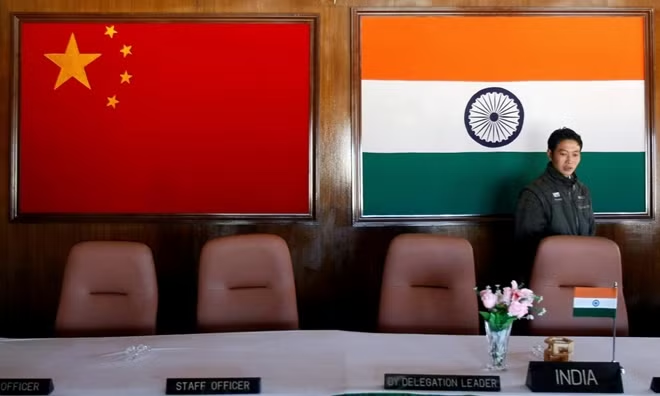
A man walks inside a conference room used for meetings between military commanders of China and India, at the Indian side of the Indo-China border at Bumla, in the northeastern Indian state of Arunachal Pradesh, November 11, 2009.

The Indian ministry said the two sides had agreed to defuse the crisis following diplomatic talks.

“In recent weeks, India and China have maintained diplomatic communication in respect of the incident at Doklam,” the ministry said in a statement.

“On this basis, expeditious disengagement of border personnel at the face-off site at Doklam has been agreed to and is on-going,” it said in a statement.

It did not offer more details of the terms of disengagement from the area which had raised fears of a wider conflict between the Asian giants who fought a brief border war in 1962.

China said Indian troops had withdrawn from the remote area in the eastern Himalayas. Chinese foreign ministry spokeswoman Hua Chunying said Chinese troops would continue to patrol the Doklam region.

“China will continue to exercise sovereignty rights to protect territorial sovereignty in accordance with the rules of the historical boundary,” she said.

India and China have been unable to settle their 3,500-km (2,175-mile) frontier and large parts of territory are claimed by both sides.

“China hopes India respects the historical boundary and works with China to protect peace along the border on the basis of mutual respect of each other’s sovereignty,” Hua added.
Reuters

Other News

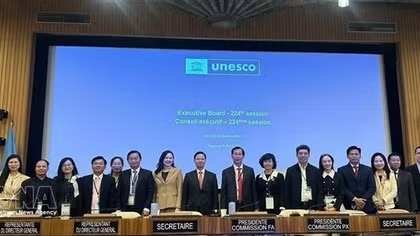
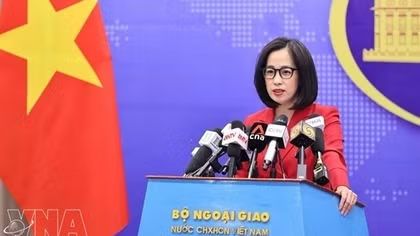
Vietnam supports UNESCO's people-centred approach, multilateral cooperation: official

Vietnam supports UNESCO's people-centred approach, multilateral cooperation: official

Van affirmed Vietnam’s support for the UNESCO80 reform roadmap, focusing on the organisation’s core mandate, priority areas, interdisciplinary approach, and the special status of the Vietnam National Commission for UNESCO, and UNESCO representative offices, alongside efforts to diversify resources and strengthen global partnerships to enhance the organisation’s effectiveness.

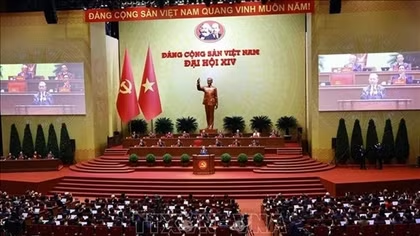
Regional media highlight significant step in Vietnam’s leadership structure

Regional media highlight significant step in Vietnam’s leadership structure

Under General Secretary and President Lam’s leadership, Vietnam is expected to maintain a balanced foreign policy, strengthen its regional standing and accelerate economic development, thereby improving living standards and creating new opportunities for international investors, according to the India-based platform Devdiscourse.

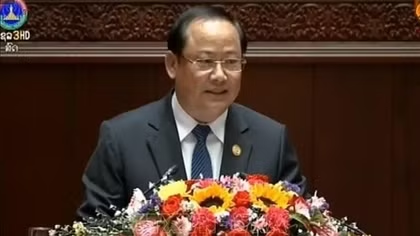
Laos identifies 10 key tasks to build independent, self-reliant economy

Laos identifies 10 key tasks to build independent, self-reliant economy

Laos will step up agricultural production to ensure food security, meet domestic demand and expand exports; encourage the development of agro-processing industries, including those related to rubber, aquatic products, cassava and sugarcane, as well as fertiliser and animal feed production, in order to increase added value and create jobs in rural areas.

Malaysia steps up cyber security resilience

Malaysia steps up cyber security resilience

To ensure accountability, Malaysia plans to finalise the Cybercrime Bill this year which addresses both cyber-dependent and cyber-enabled offences, introducing stricter penalties and prison terms to enhance deterrence.

US public opinion positive about PM Pham Minh Chinh’s visit

US public opinion positive about PM Pham Minh Chinh’s visit

Public opinion in the US is generally positive about Vietnamese Prime Minister Pham Minh Chinh’s trip to the US from September 17-23 to attend the 78th session of the United Nations General Assembly, which took place immediately after the upgrading of the Vietnam - US relations to a comprehensive strategic partnership on the occasion of US President Joe Biden’s official visit to Vietnam.