- Book on Vietnam’s economic development debuts in India
- India launches third resource monitoring satellite for commercial use
- NA Chairwoman to visit India, UAE
The world's biggest election this year began in Uttar Pradesh, the first of six stages that will elect an assembly to govern the impoverished state of nearly 220 million people.
Modi's nationalist Bharatiya Janata Party (BJP) swept to victory in Uttar Pradesh three years ago, and the election in the state that follows the shore of the river Ganges will set the tone for the 2019 national elections.
More broadly, voters will deliver a mid-term verdict on Modi and his nationalist party after his decision to withdraw 86 percent of the cash in circulation.
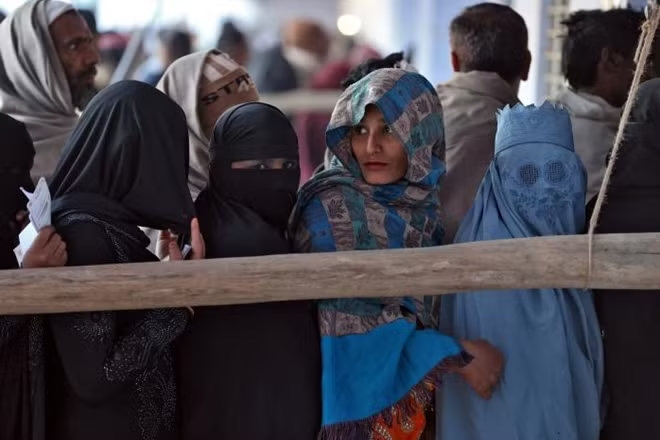 |
| People queue to cast their vote during the state assembly election, in the village of Kairana, in the state of Uttar Pradesh, India, February 11, 2017. REUTERS |
The banknote ban was launched by Modi three months ago to purge the economy of untaxed income and the proceeds of crime and corruption, and has disrupted daily life and commerce, and caused the economy to slow.
On the campaign trail, Modi has said he had the interests of the poor at heart in making the move - his biggest gamble yet.
"The results will tell us whether Modi continues to enjoy unquestioned support or if it has started to erode," said R.K. Mishra, an independent political analyst based in the state capital, Lucknow.
Amid tight security, voting was conducted in 73 constituencies of western Uttar Pradesh, where violence has erupted frequently over the last few years. Fighting between Hindus and Muslims killed about 65 people in 2013.
In the town of Kairana, where residents came to blows last year when the local BJP MP accused Muslims of driving out Hindus, voters from both communities turned out in large numbers.
By noon, nearly half of those eligible had cast their vote.
GODZILLA OF STATES
The BJP polled 42 percent of the vote in Uttar Pradesh in the 2014 election, winning 71 of 80 seats on its way to claiming India's biggest national mandate for three decades.
But people have shown growing impatience that Modi's campaign promises of development and "better days" to come have failed to deliver new jobs in a state where per capita income averages less than $750 a year and many communities lack access to power, clean water and basic medical services.
"It is the Godzilla of states," said BJP national spokesman Nalin Kohli, as he looked out over the darkened streets of Lucknow one evening this week.
People tend to vote along traditional caste and religious lines, and successive governments have exploited communal divisions to fire up their power base and poach voters.
"The situation gets very bad here sometimes – there is fighting between groups, between Hindus and Muslims," said Bhagwati Prasad, who sells material for Hindu cremation ceremonies outside a temple in Lucknow.
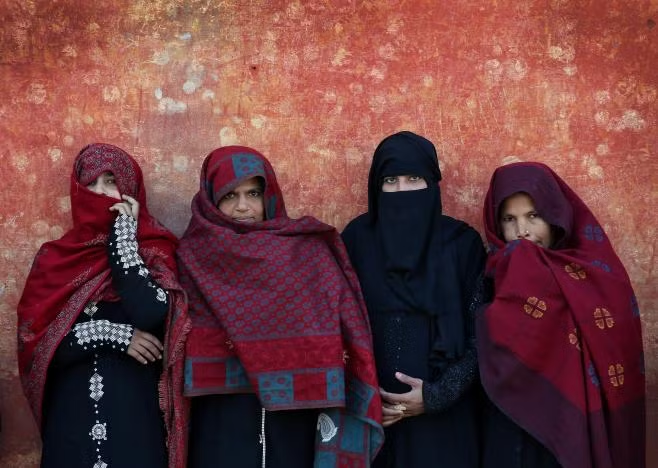 |
| People queue to cast their vote during the state assembly election, in the village of Kairana, in the state of Uttar Pradesh, India, February 11, 2017. REUTERS |
"I am a Hindu. If there is a Hindu-Muslim fight I have to stand with the Hindus."
The complexity of such politics makes it hard to predict outcomes in India's first-past-the-post system. Any party scoring significantly more than 30 percent can win by a landslide.
Pollsters say it will be tough for the BJP to repeat its 2014 election performance.
In not fielding a for the post of chief minister, it risks repeating a tactical blunder that contributed to a heavy defeat in Bihar, another Hindi-speaking heartland state, in 2015.
The Samajwadi Party, which runs Bihar and is led by 43-year-old Chief Minister Akhilesh Yadav, won a majority in the last state election, in 2012, with just 29 percent of the vote.
Yadav has formed an alliance with Rahul Gandhi of the Congress party that, polls show, will be tough to beat.
Ranking third, Mayawati, who ran the state from 2007 to 2012 and whose Bahujan Samaj Party draws its support from communities on the bottom rung of India's ancient caste hierarchy.
She has fielded a big crop of candidates from the Muslim minority that makes up 19 percent of the state's electorate. Polls show most Muslims siding with the ruling Samajwadi Party-Congress alliance, however.
Results from Uttar Pradesh, along with Punjab, Goa, Uttarakhand and Manipur, are due on March 11.